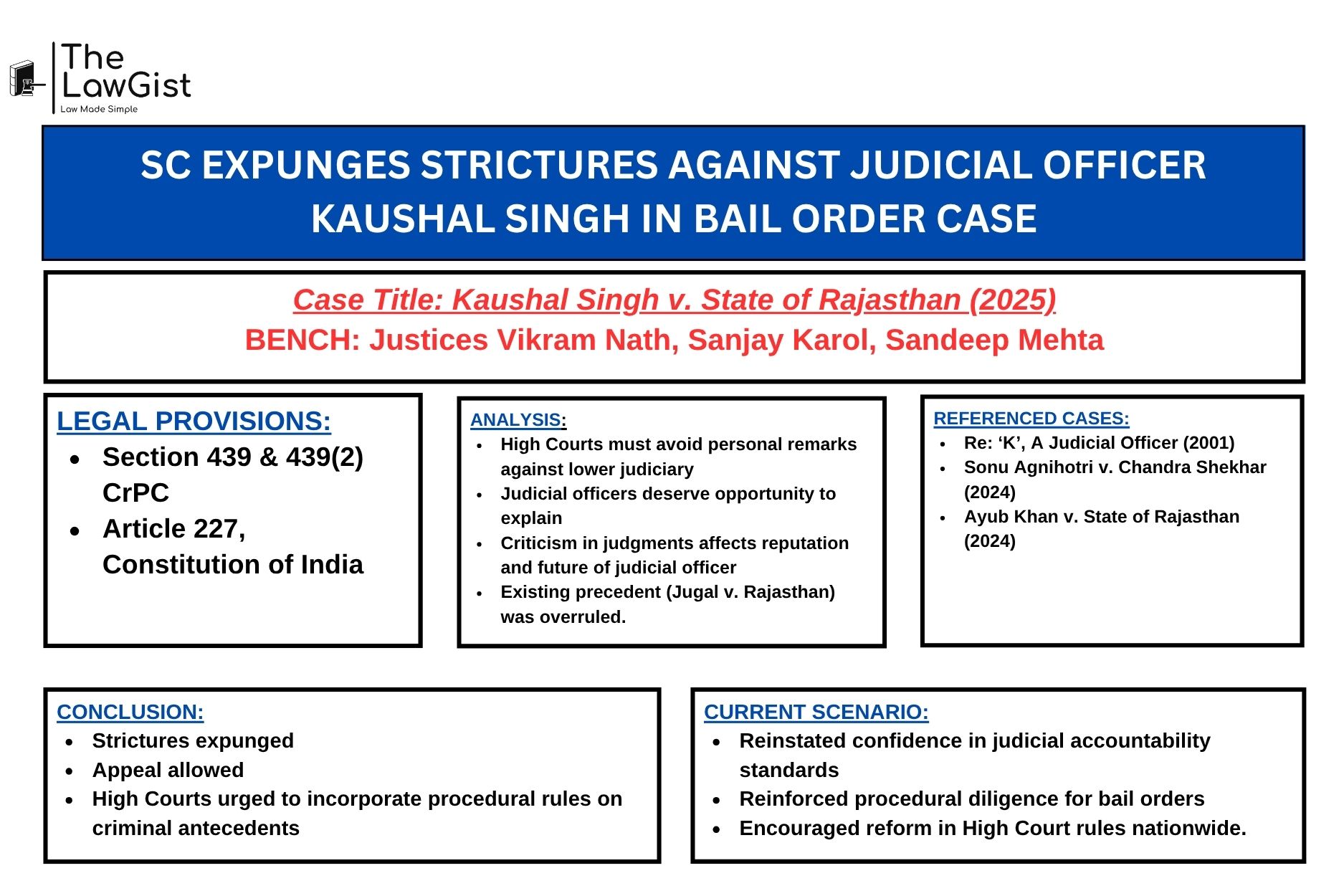
Supreme Court expunges Rajasthan High Court’s remarks on Judicial Officer in Kaushal Singh bail order case.
SC EXPUNGES STRICTURES AGAINST JUDICIAL OFFICER KAUSHAL SINGH IN BAIL ORDER CASE
CASE SUMMARY – In Kaushal Singh vs. State of Rajasthan (2025), the Supreme Court expunged adverse remarks made by the Rajasthan High Court against a Judicial Officer for allegedly granting bail in a “cavalier” manner. The High Court’s criticisms were deemed excessive and procedurally unjust, especially since the officer wasn’t given a hearing. The Supreme Court reaffirmed precedents discouraging personal criticism in judgments and clarified that errors by judicial officers should be addressed administratively. It also urged High Courts to mandate disclosures of criminal antecedents in bail pleas. This judgment safeguards judicial integrity and promotes standardized procedural conduct.
| ASPECTS | DETAILS |
| Case Title | Kaushal Singh vS. State of Rajasthan, Criminal Appeal No(s). of 2025 (Arising out of SLP (Crl.) No. 2254 of 2025) |
| Introduction | Judicial Officer Kaushal Singh challenged the Rajasthan High Court’s adverse observations made against him for granting bail without proper due diligence. |
| Factual Background | Bail was granted by the appellant to Sethu @ Angrej, an accused in a case under IPC Sections including 307. The High Court later criticized the grant as negligent, overlooking his criminal history. |
| Legal Issues |
|
| Applicable Law |
|
| Analysis | The Supreme Court observed that judges should not be condemned unheard and emphasized judicial discipline and decorum in criticism. It reiterated prior judgments that personal strictures should be avoided in judicial orders unless the officer is given a chance to explain. |
| Conclusion | The Court expunged the High Court’s remarks against the Judicial Officer and allowed the appeal. It also suggested all High Courts incorporate rules mandating disclosure of accused’s criminal records in bail applications. |
| Current Scenario | The judgment stands as a reaffirmation of judicial protection from unmerited criticism and promotes standardized bail procedures across courts, especially regarding criminal antecedents. |
“To err is human, even for judges. Justice must correct, not condemn.”
SOURCE – SUPREME COURT OF INDIA
READ ALSO – Article 227 of the Constitution