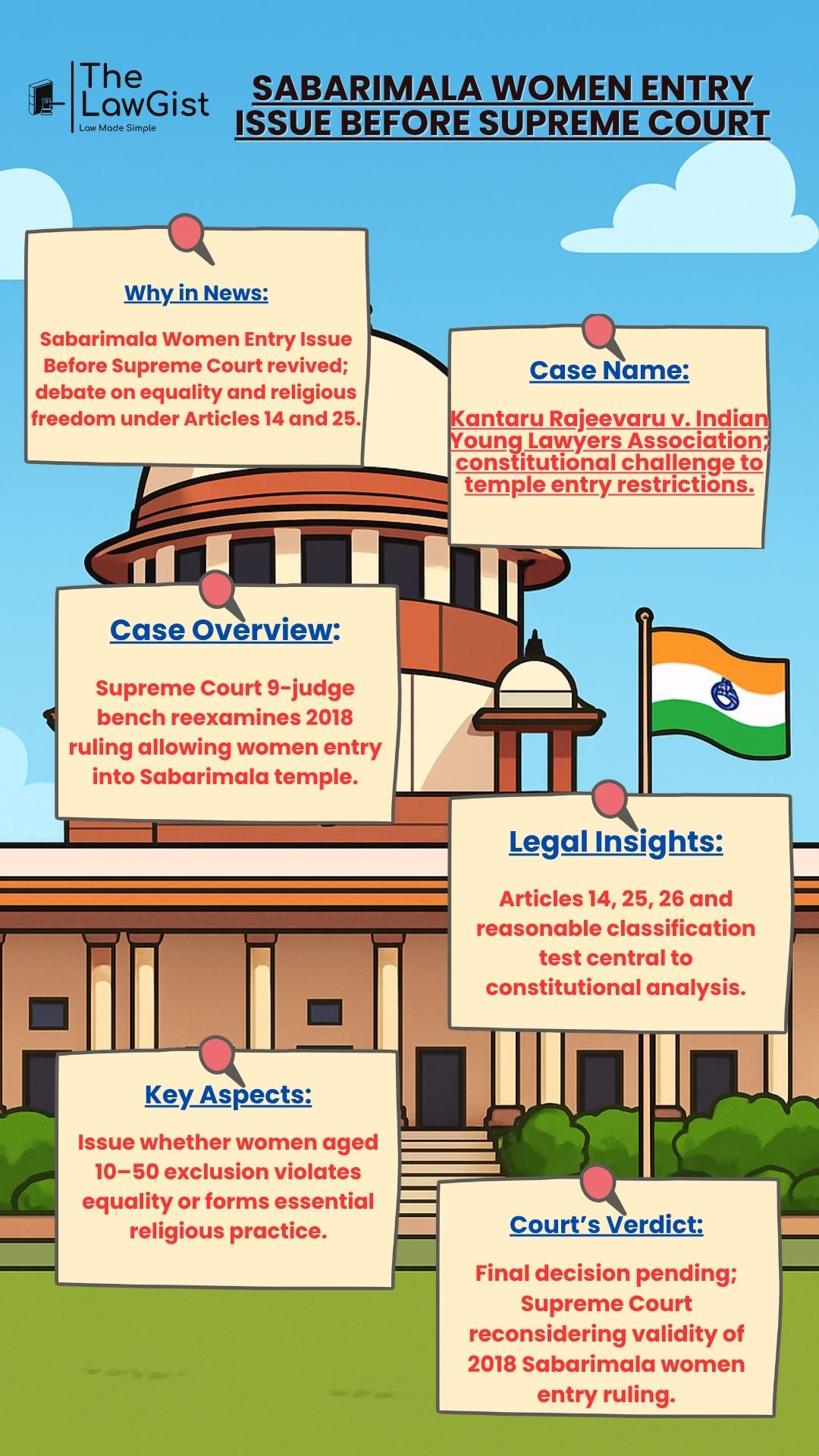
Case in NewsThe Sabarimala Women Entry Issue Before Supreme Court resurfaces as Travancore Devaswom Board defends the practice of temple. |
Discover powerful Latin Maxims and simplify complex legal terms in seconds
Case Overview
The dispute regarding entry of women into the Sabarimala Temple is being reconsidered by a 9-judge bench of the Supreme Court of India headed by Justice Surya Kant along with Justice B. V. Nagarathna, Justice M. M. Sundresh, Justice Ahsanuddin Amanullah, Justice Aravind Kumar, Justice Augustine George Masih, Justice Prasanna B. Varale, Justice R. Mahadevan & Justice Joymalya Bagchi.
Senior Advocate Abhishek Manu Singhvi appearing for the Travancore Devaswom Board argued that restricting women aged 10–50 from entering Sabarimala is based on the belief that Lord Ayyappa is worshipped there as a Naishtika Brahmachari (eternal celibate). The matter revisits the 2018 judgment that permitted entry of women of all age groups.
Key Aspects
The dispute revolves around the constitutional validity of restricting certain categories of women from entering the temple & whether such exclusion forms part of essential religious practice.
- The 2018 Constitution Bench allowed women of all ages to enter Sabarimala Temple citing gender equality.
- TDB argues women aged 10–50 were restricted due to the celibate nature of the deity.
- Devotees must observe a strict 41-day vratam before undertaking the pilgrimage.
- Petitioners claim the exclusion violates equality & dignity under the Constitution.
- The central issue is whether the restriction amounts to discrimination or a protected religious practice.
Legal Insights
The case raises “ constitutional questions regarding equality, religious freedom & the doctrine of reasonable classification.
- Article 14 – Equality before law & the test of reasonable classification.
- Article 25 – Freedom of religion & the right to practice religious beliefs.
- Article 26 – Rights of religious denominations to manage religious affairs.
- Article 17 – Prohibition of discriminatory exclusion analogous to untouchability.
- The Board argues the restriction satisfies the twin test of reasonable classification intelligible differentia & rational nexus with the deity’s celibate identity.
Court’s Verdict
The Supreme Court of India has not yet delivered a final decision. The 9-judge bench is currently hearing arguments on whether the 2018 Sabarimala judgment should be reconsidered or reversed & the matter remains pending for further hearings.
Source – Supreme Court of India
Read also – Constitution
The LawGist ensures exam success with quality notes—TPL, Current Affairs, Recent Judgments & more. Backed by trusted resources and videos, The LawGist is every aspirant’s first choice