Supreme Court rules probation under Probation of Offenders Act 1958 does not erase conviction for departmental punishment.
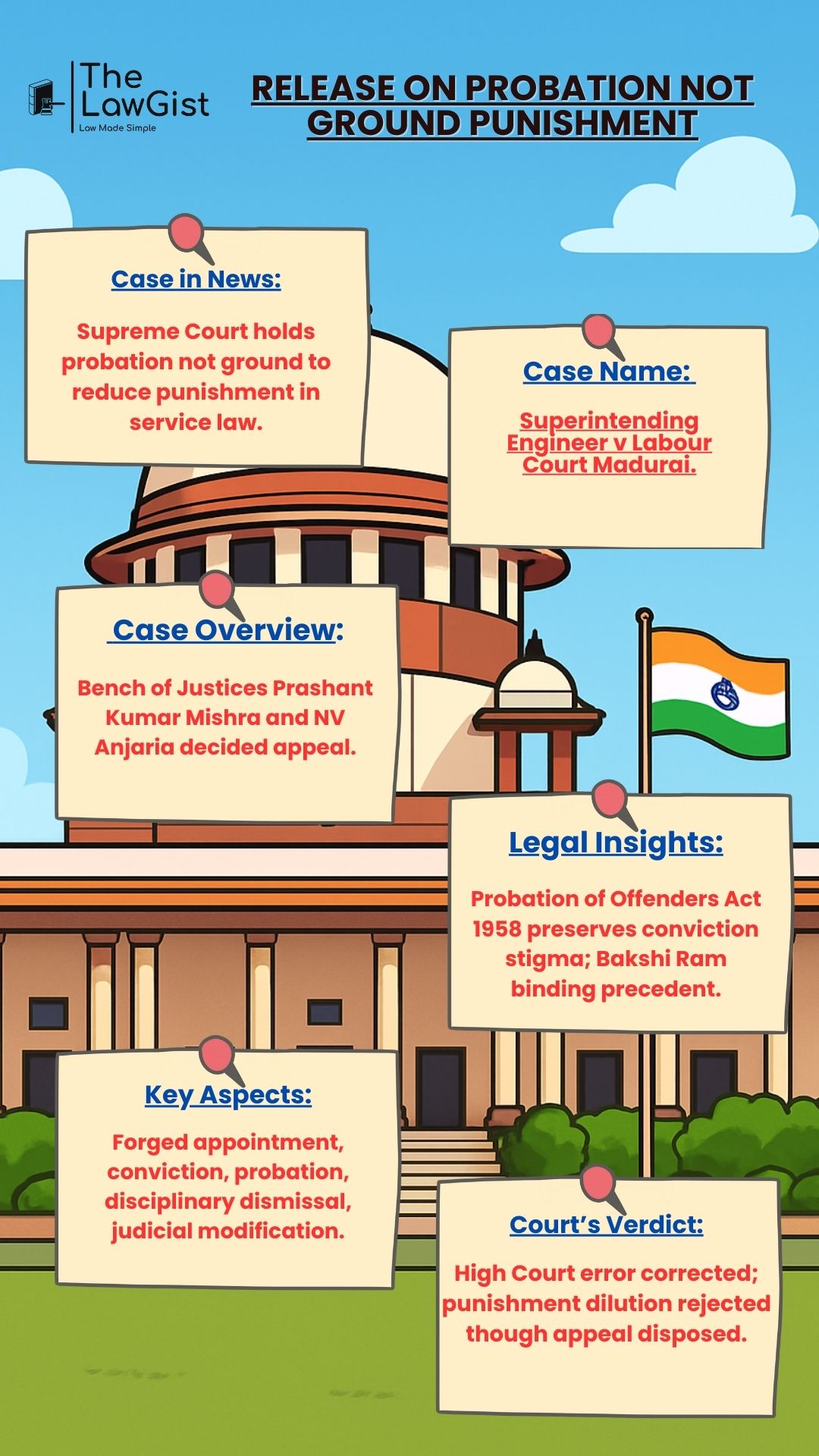
Case in NewsRelease On Probation Not Ground Punishment, Supreme Court rules conviction valid for departmental action . |
Discover powerful Latin Maxims and simplify complex legal terms in seconds.
Case Overview
Case Name: The Superintending Engineer vs The Labour Court Madurai & Ors.
In The Superintending Engineer v The Labour Court Madurai & Ors., the Supreme Court of India examined whether release on probation in a criminal case can dilute punishment in departmental proceedings . The matter was decided by a bench comprising Supreme CourtJustice Prashant Kumar Mishra and Justice NV Anjaria . The Court scrutinised the Madras High Court’s approach in modifying disciplinary punishment solely due to the grant of probation to a convicted workman .
Step into the world of justice with Courtroom Chronicles
Key Aspects
The case reflects the tension between criminal jurisprudence granting reformative relief and service law standards governing integrity in public employment . The Court analysed whether probation erases the consequences of misconduct proved in a domestic inquiry .
- The workman secured appointment by impersonation and forged educational certificates .
- A departmental inquiry found charges proved, leading to dismissal from service .
- The Labour Court reduced punishment to pay reduction and increment cut .
- The High Court further modified punishment to compulsory retirement citing probation .
- The employer challenged this dilution before the Supreme Court .
Legal Insights
The judgment reiterates settled principles distinguishing criminal leniency from service discipline . The Court emphasised consistency with binding precedent and statutory intent .
- Probation of Offenders Act 1958: Grant of probation does not obliterate conviction .
- Service Jurisprudence: Proven misconduct independently justifies departmental punishment .
- Union of India v Bakshi Ram (1990) 2 SCC 426 : Conviction stigma survives despite probation .
- Articles 226 & 136, Constitution of India: : Scope of judicial review in disciplinary matters .
Court’s Verdict
The Supreme Court held that the High Court erred in treating probation as a ground to reduce punishment, as conviction continues to carry stigma . Reiterating Bakshi Ram, the Court set aside the High Court’s observations favouring the workman . However, considering the workman’s demise, the Court refrained from interfering with the modified punishment and disposed of the appeal accordingly .
Source – Supreme Court of India
Read also – Constitution of India
The LawGist ensures exam success with quality notes—TPL, Current Affairs, Recent Judgments, and more. Backed by trusted resources and videos, The LawGist is every aspirant’s first choice.