 Headline
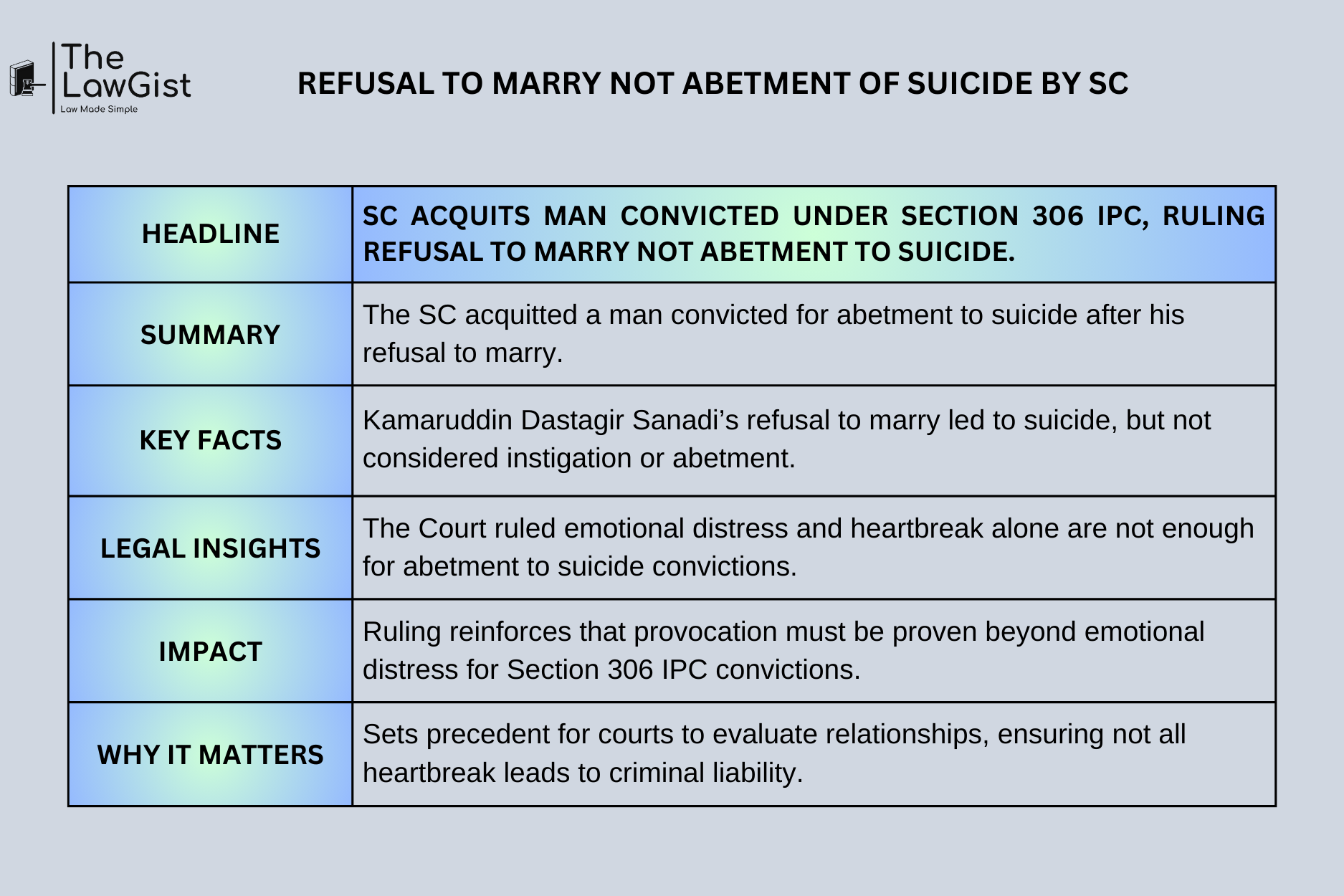
The Supreme Court of India sets aside conviction in abetment in case of suicide.
Summary
The Supreme Court of India acquitted a man who was convicted under Section 306 of the Indian Penal Code (IPC) for abetment to suicide after his lover committed suicide due to his denial to marry her. The Supreme Court held that denial alone does not amount to doing of suicide by her.
Key Facts
- Case Name: Kamaruddin Dastagir Sanadi vs. State of Karnataka
- Judges Name: Justice Pankaj Mithal & Justice Ujjal Bhuyan
- The denial by the accused to marry his lover led to cause her suicide.
- The Supreme Court stated that denial alone to not marry does not create a provocation for suicide.
Legal Insights
The Supreme Court of India stresses that for a conviction under Section 306 of Indian Penal Code, it must be shown that the actions of the accused or omissions led the victim to feel she had no option but commit suicide. The denial to marry, in this case, was seen as part of a broken relationship, not instigation.
Impact
This judgment focuses that emotional breakdown alone, is not enough to constitute abetment to suicide. The ruling shed light that an intentional act or provocation must be proven for such a conviction.
Why It Matters
The ruling of the Supreme Court sets a precedent for how courts should look into private relationships in the context of suicide cases, making sure that not every refusal or heartbreak leads to criminal liability under abetment laws.
Source