NATO Heads of State and Government at the 2025 Hague Summit reaffirming commitment to collective defence and increased investment.
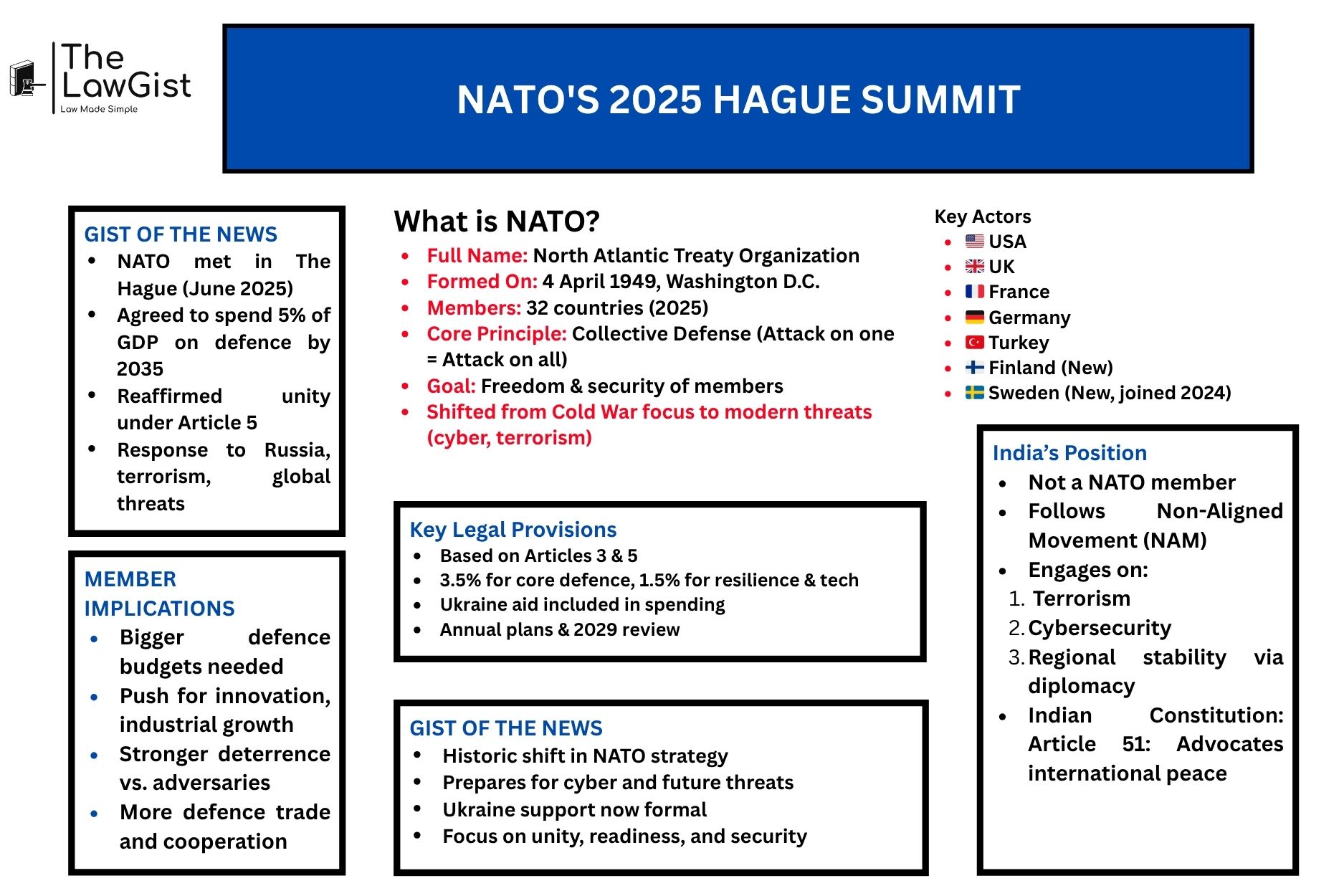
GIST OF THE NEWSOn June 25, 2025, the Heads of State and Government of the North Atlantic Treaty Organization (NATO) convened in The Hague to issue a landmark declaration. Against the backdrop of rising geopolitical tensions, persistent security threats, and an evolving military landscape, the declaration reaffirms NATO’s unity and its fundamental commitment to collective defence under Article 5 of the Washington Treaty. The Hague Summit underscores a paradigm shift in how NATO will prepare to counter threats over the coming decade—most notably by setting a groundbreaking target of 5% of GDP in annual defence spending by 2035. |
BACKGROUND
NATO was founded in 1949 as a collective security alliance between North American and European nations, designed to deter Soviet aggression during the Cold War. The key principle of NATO, articulated in Article 5 of the Washington Treaty, is that an attack against one member is considered an attack against all. Since the end of the Cold War, NATO has evolved to address a broader spectrum of challenges, including terrorism, cyber threats, and hybrid warfare. The alliance currently comprises 32 member states and has increasingly focused on collective readiness and strategic deterrence in response to Russia’s assertive posture and global instability.
LEGAL ASPECTS
The 2025 Hague Summit Declaration builds upon the Washington Treaty’s legal foundations, particularly Articles 3 and 5. Article 3 commits members to maintain and develop their capacity to resist armed attack, and the 2025 declaration provides a structured, quantitative benchmark to fulfill that obligation. The new defence investment target—5% of GDP—includes two components: at least 3.5% for core NATO defence expenditures and up to 1.5% for broader security-related spending.
This marks a significant expansion beyond the previous 2% GDP guideline, which many member states struggled to meet consistently. By establishing annual planning, a review process in 2029, and provisions for civil preparedness, innovation, and industrial resilience, NATO has legally framed a multi-dimensional defence policy that reflects the modern threat environment.
The summit also legally integrates support for Ukraine into NATO’s broader strategic aims. For the first time, direct contributions to Ukraine’s defence and industrial base will be counted within the defence spending calculations. This move signals a formal, collective recognition of Ukraine’s security as integral to that of NATO.
IMPLICATIONS FOR NATO MEMBER STATES
The 2025 declaration sets in motion a major shift in defence policy across the Alliance. For many member nations, particularly in Europe, the 5% GDP target will require significant policy changes, budget reallocations, and public support. While countries like the United States, the United Kingdom, and Poland already allocate substantial funds toward defence, others—such as Germany, Italy, and Canada—will face internal debates over the trade-offs between defence spending and domestic priorities like healthcare and education.
Nevertheless, the implications are far-reaching and largely positive. Firstly, the strengthened financial commitment will enhance NATO’s ability to deter adversaries, particularly Russia, which remains the primary long-term threat to Euro-Atlantic security. Secondly, the emphasis on infrastructure, cyber defence, innovation, and industrial capacity addresses the need for multi-domain preparedness, including in space and digital realms.
Furthermore, the declaration’s call for the removal of defence trade barriers among allies will facilitate smoother procurement processes, improve interoperability, and encourage joint ventures across borders. This could usher in a new era of transatlantic defence industrial cooperation, with positive ripple effects for the economy and security of member states.
Beyond policy shifts, the 2025 summit sends a strong geopolitical message: NATO remains united, adaptive, and forward-looking. With continued support for Ukraine and strategic preparation against potential threats from authoritarian states, the declaration signals to adversaries that the Alliance is not only surviving but thriving. The mention of future summits in Türkiye (2026) and Albania highlights a conscious effort to maintain geographic and political inclusivity across the alliance, reinforcing internal cohesion.
The declaration also reflects a new level of strategic clarity and burden-sharing, addressing past criticisms that some NATO countries were not contributing their fair share. By tying Ukraine support directly to NATO security and incorporating it within legal frameworks, the alliance reinforces its credibility and resolve.
CONCLUSION
The Hague Summit Declaration of 2025 marks a transformative moment in NATO’s 76-year history. It codifies a bold and far-reaching vision for the Alliance, emphasizing robust defence investments, expanded industrial cooperation, and steadfast commitment to collective security in a volatile world.By raising the bar to 5% of GDP in defence spending and integrating Ukraine’s security into the broader NATO strategy, the declaration reflects a deep awareness of current global dynamics and the steps necessary to maintain peace and stability. It also strengthens the alliance’s operational readiness and resilience across conventional and non-conventional domains.As the alliance moves toward its 2026 summit in Türkiye and beyond, the implementation of these commitments will define NATO’s ability to deter aggression, preserve democracy, and protect nearly one billion citizens in an increasingly uncertain world. The Hague Summit was not merely a reaffirmation of past principles—it was a clear signal of NATO’s preparedness for the future.
SOURCE – NATO
READ ALSO – THE HAGUE SERVICE CONVENTION: ENHANCING CROSS- BORDER LEGAL COOPERATION