SUPREME COURT HOLDS TANKER DRIVER LIABLE IN MOTOR ACCIDENT CLAIM
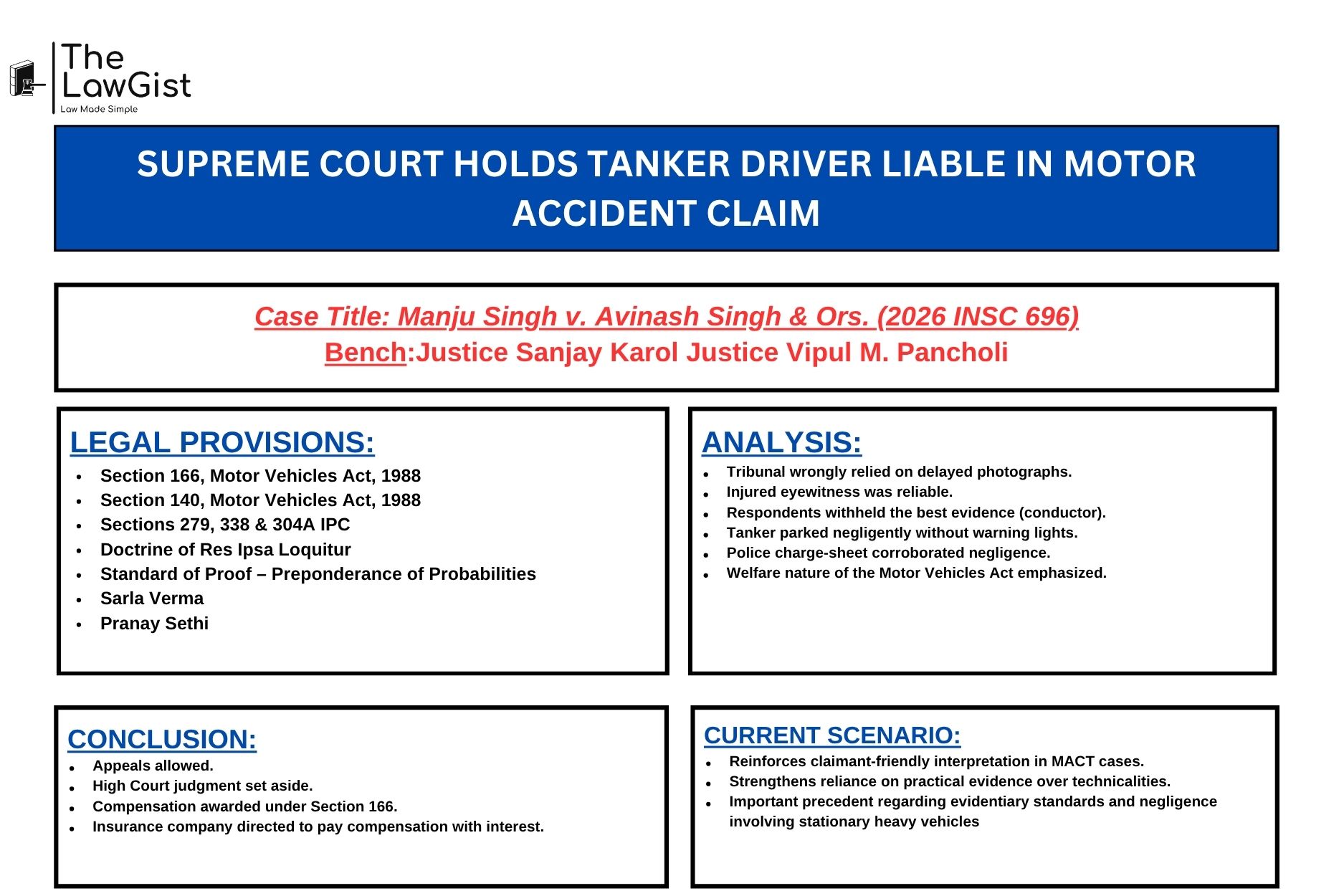
CASE SUMMARY– The Supreme Court in Manju Singh vs. Avinash Singh & Ors. (2026 INSC 696) overturned the decisions of the Motor Accident Claims Tribunal and the Allahabad High Court, which had denied compensation to the legal heirs of three deceased victims of a road accident. The Court held that motor accident claims are decided on the principle of preponderance of probabilities and not strict criminal standards. Rejecting delayed photographs relied upon by the lower courts, it accepted the testimony of the injured eyewitness and held that the tanker driver was negligent for parking the vehicle without adequate warning signals. Compensation was awarded following Sarla Verma and Pranay Sethi.
| ASPECTS | DETAILS |
| Case Title | Manju Singh vs. Avinash Singh & Ors., 2026 INSC 696 |
| Introduction | The Supreme Court considered whether the Motor Accident Claims Tribunal and the Allahabad High Court wrongly denied compensation under Section 166 of the Motor Vehicles Act by holding the Maruti car driver solely negligent. The Court re-examined the evidence and the standard of proof applicable in motor accident compensation cases. |
| Factual Background | On 30 January 2002, a Maruti car carrying four persons collided with a tanker on the Allahabad-Kanpur Road. Three occupants died while one survived with serious injuries. The Tribunal dismissed compensation claims under Section 166, accepting the defence that the tanker was stationary and the car driver was negligent. The High Court affirmed this decision. |
| Legal Issues | 1. Whether the Maruti car driver alone was negligent.
2. Whether the Tribunal rightly relied upon photographs taken several hours after the accident. 3. Whether the testimony of the injured eyewitness deserved greater evidentiary value. 4. Whether the claimants were entitled to compensation under Section 166 of the Motor Vehicles Act. |
| Applicable Law | • Section 166, Motor Vehicles Act, 1988.
• Section 140, Motor Vehicles Act, 1988. • Doctrine of Res Ipsa Loquitur. • Principles laid down in Sarla Verma v. DTC (2009) and National Insurance Co. Ltd. v. Pranay Sethi (2017). • Standard of proof—Preponderance of probabilities. |
| Analysis | The Supreme Court held that motor accident claims are civil proceedings governed by the standard of preponderance of probabilities rather than proof beyond reasonable doubt. It rejected reliance on photographs taken 10–12 hours after the accident, preferred the testimony of the injured eyewitness, drew an adverse inference against the respondents for not examining the tanker conductor, and found that parking a heavy vehicle at night without warning signals amounted to negligence. The police charge-sheet against the tanker driver further supported the claimants’ case. |
| Conclusion | The Supreme Court set aside the judgments of the Tribunal and High Court, held the tanker driver negligent, allowed compensation under Section 166, recalculated compensation applying Sarla Verma and Pranay Sethi, and directed the insurer to satisfy the award. |
| Current Scenario | This judgment strengthens the jurisprudence that MACT proceedings are welfare-oriented, that technical rules of evidence should not defeat genuine claims, and that injured eyewitness testimony carries significant weight. It also reiterates that improperly parked heavy vehicles without safety warnings can constitute negligence. |
“Motor accident claims must be decided on the touchstone of justice and preponderance of probabilities rather than rigid criminal standards.”
SOURCE – SUPREME COURT OF INDIA