Headline
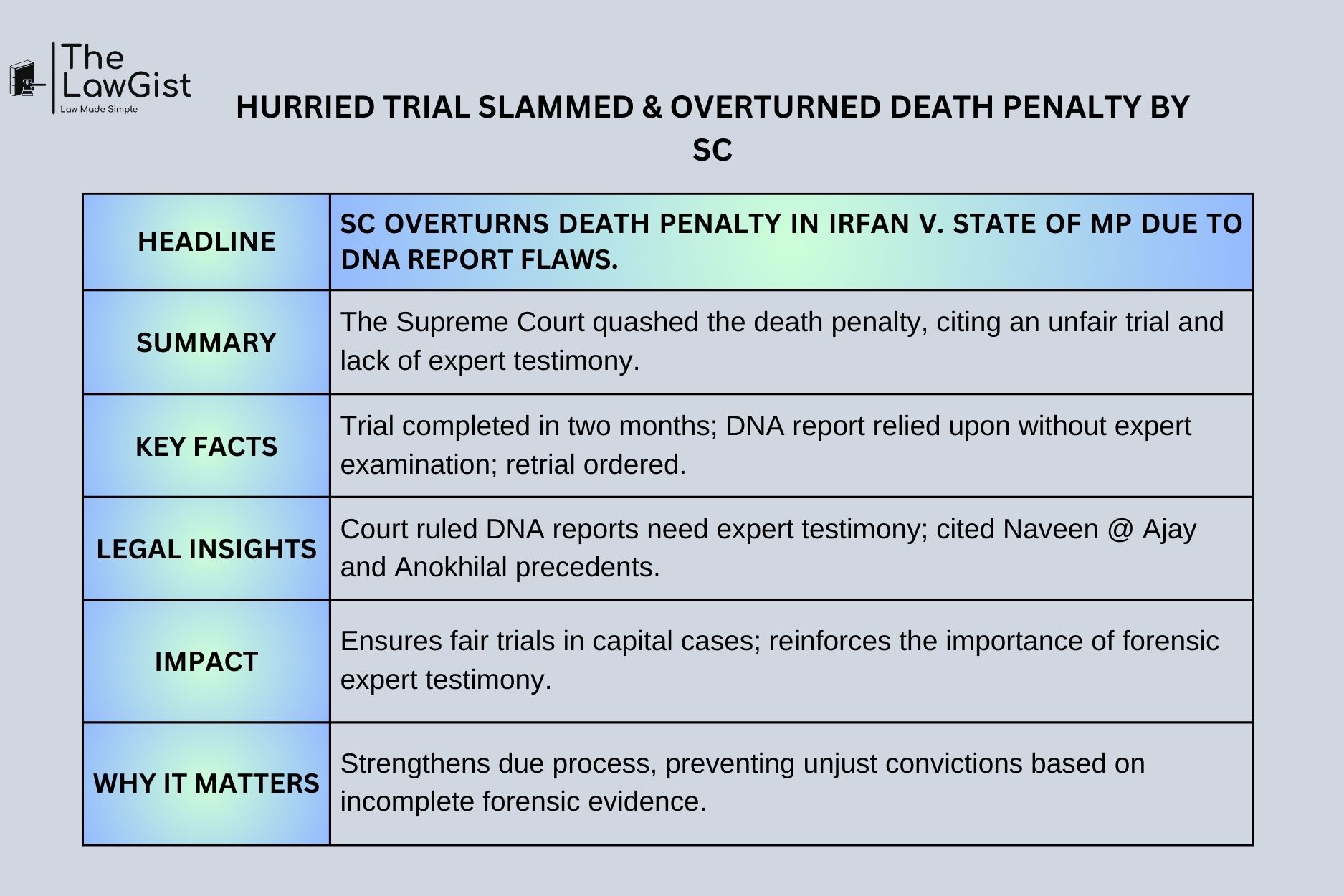
The Supreme Court of India quashes the death penalty in ‘Irfan v. State of MP’ over defects in DNA report.
Summary
The Supreme Court of India set aside the death penalty given to the accused in Irfan v. State of Madhya Pradesh, quoting a defect in the process of trial. The Court discovered that undue haste caused a miscarriage of justice, as the DNA report which was important to the case was relied upon without examining scientific experts. The case was remanded for a fresh trial.
Key Facts
- Case Name: Irfan vs. State of Madhya Pradesh
- Judge Name: Justice Vikram Nath, Justice Sanjay Karol, and Justice Sandeep Mehta
- Charges: Kidnapping, attempt to murder, and minors gang rape.
- Trial Issues: The trial was completed in under 2 months, rejecting the accused a fair and just defense. The DNA report was accepted without the statements of the expert.
Legal Insights
The Supreme Court of India held that dependence on a DNA report without expert testimony violates the principles of fair and just trial. The court quoted the case of Naveen @ Ajay v. State of MP, which also mandated examination of the expert for DNA reports. The Court also reaffirmed Anokhi Lal v. State of MP, needing senior advocates for the cases of capital punishment.
Impact
The decision shows the requirement of expert testimony in cases involving forensic evidence. It strengthens due process rights, making sure that the trials, particularly those leading to capital punishment, should be fair and thorough.
Why It Matters
This ruling of the Supreme Court shows its commitment to make sure that justice is not compromised by procedural failures. It sets a strong precedent for protecting the rights of the defendants, mainly in death penalty cases.
Source: