Supreme Court clarifies that procedural defects in appointment approval may be curable when the recruitment process itself remains fair and transparent.
SUPREME COURT ON CURABLE RECRUITMENT IRREGULARITIES IN COOPERATIVE SOCIETIES
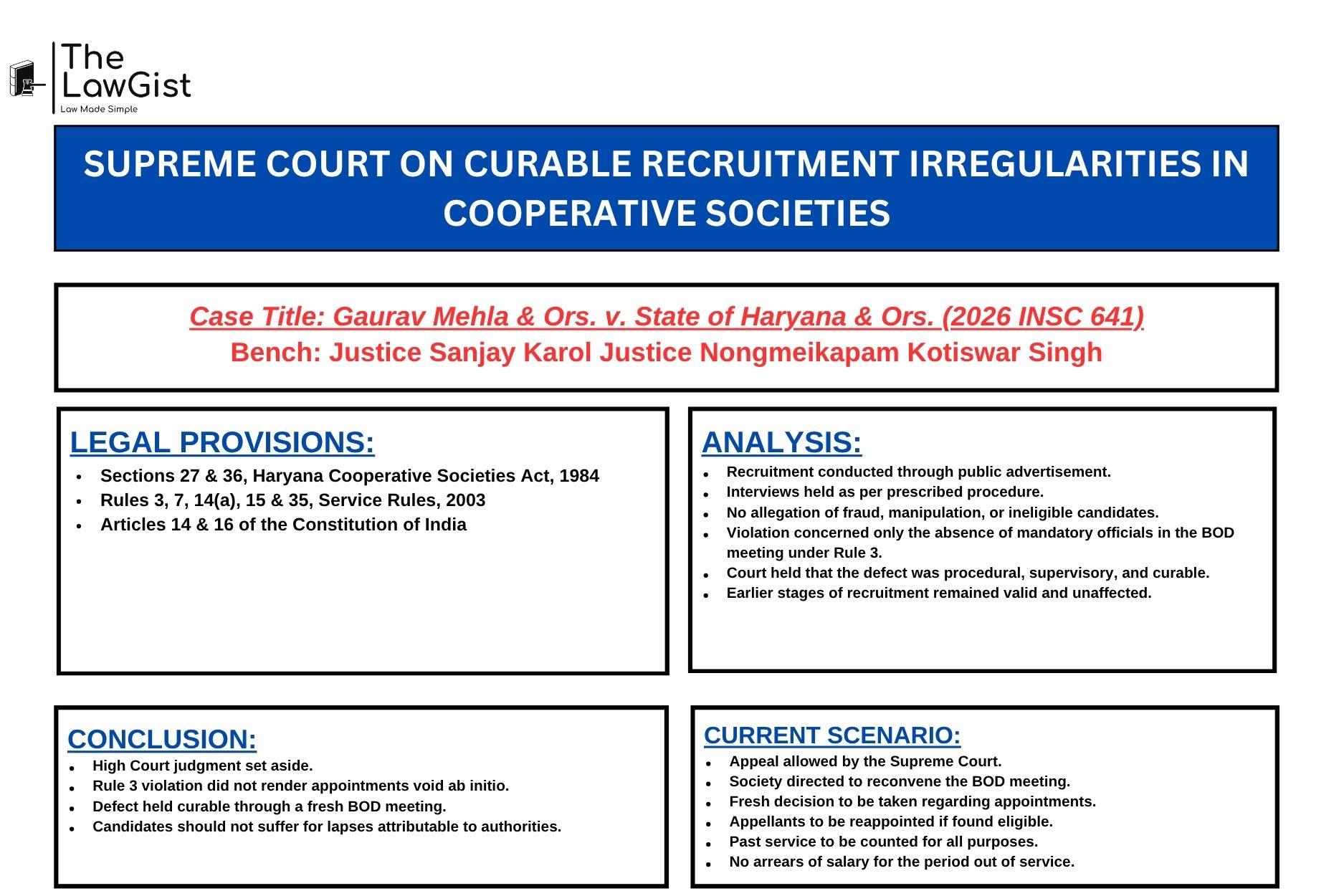
CASE SUMMARY – In Gaurav Mehla & Ors. vs. State of Haryana & Ors. (2026 INSC 641), the Supreme Court considered whether appointments made by a cooperative society were invalid because mandatory officials were absent during the Board of Directors’ meeting approving appointments under Rule 3 of the Service Rules, 2003. The Court held that although Rule 3 was mandatory, its violation constituted a curable procedural irregularity rather than a fundamental illegality. Since the recruitment advertisement, interview process, and candidate eligibility were never challenged, the entire recruitment could not be annulled. The Court directed reconvening of the Board meeting and reconsideration of appointments.
| ASPECTS | DETAILS |
| Case Title | Gaurav Mehla & Ors. vs. State of Haryana & Ors. |
| Introduction | The case concerns the validity of appointments made by a Cooperative Marketing Society where the final appointment decision was taken without the presence of certain officials whose attendance was mandated under Rule 3 of the Primary Cooperative Marketing-cum-Processing Societies Ltd. Staff Service Rules, 2003. |
| Factual Background | In 2014, the Society advertised 3 posts of Clerk-cum-Salesman and 4 posts of Peon-cum-Chowkidar. After interviews and selection, appointments were approved by the Board of Directors on 13.08.2014. Society members challenged the recruitment alleging violations of Rule 3, Rule 14(a), reservation norms, sanctioned strength, and advertisement requirements. The Additional Registrar, Additional Chief Secretary, Single Judge, and Division Bench invalidated the appointments. The matter reached the Supreme Court. |
| Legal Issues | 1. Whether Rule 3 requiring presence and concurrence of specified officials is mandatory or directory. 2. Whether non-compliance with Rule 3 invalidated the appointments. 3. Whether defects were substantive or curable. 4. Whether Rule 35 and Section 36 could save the appointments. 5. Whether employees with 10 years of service deserved equitable protection. |
| Applicable Law | Haryana Cooperative Societies Act, 1984 (Sections 27 & 36); Primary Cooperative Marketing-cum-Processing Societies Ltd. Staff Service Rules, 2003 (Rules 3, 7, 14(a), 15 & 35); Articles 14 and 16 of the Constitution of India. |
| Analysis | The Court divided recruitment into three stages: (1) Advertisement, (2) Selection/Interview, and (3) Final Appointment. It found no illegality in the first two stages. The only defect was absence of mandatory officials during the Board meeting. The Court held that these officials performed a supervisory role and their absence did not affect the fairness of recruitment. Therefore, the defect was curable and severable from the earlier valid stages. |
| Conclusion | The Supreme Court set aside the High Court judgment and held that the appointments could not be invalidated solely due to non-compliance with Rule 3. The Board of Directors was directed to reconvene and reconsider appointments with the mandatory officials present. |
| Current Scenario | The appeal was allowed. The Society was directed to hold a fresh Board meeting within one month. If the appellants are found eligible and suitable, they must be reappointed, with past service counted for all purposes, though without back wages for the period they remained out of service. |
“A procedural defect in the final stage of appointment cannot invalidate an otherwise fair and transparent recruitment process, particularly when the candidates are not at fault.”
SOURCE- SUPREME COURT OF INDIA