Supreme Court expands scope of “member” under Companies Act in landmark 2026 ruling.
SUPREME COURT CLARIFIES “DEEMED MEMBERSHIP” UNDER COMPANIES ACT IN BAIS SURGICAL CASE
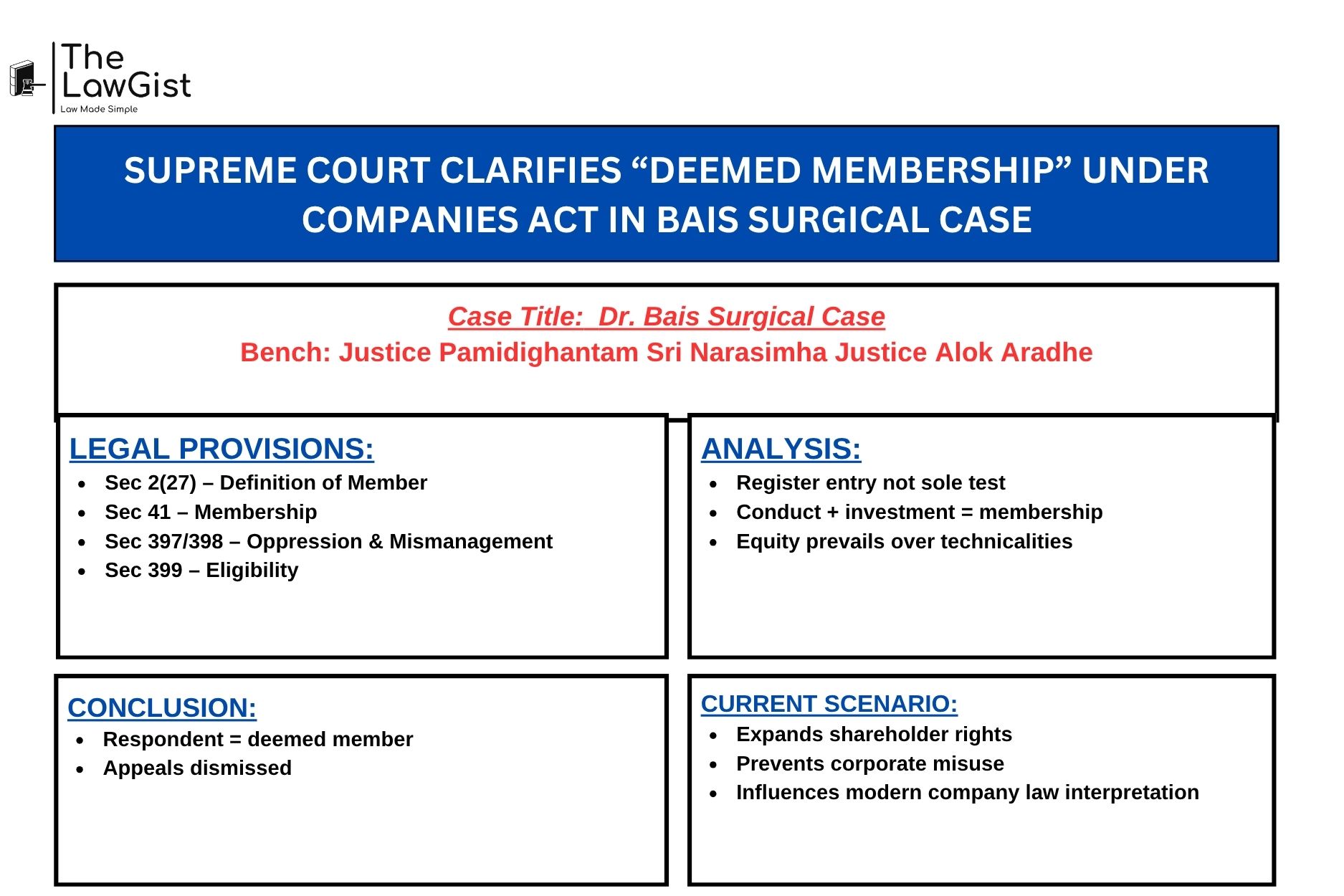
CASE SUMMARY – The Supreme Court in Dr. Bais Surgical and Medical Institute Pvt. Ltd. vs. Dhananjay Pande held that a person may be treated as a “member” of a company even without formal entry in the register of members. The Court emphasized that equitable considerations under Sections 397–398 of the Companies Act, 1956 must prevail over technical requirements. Since the respondent had invested substantial funds, was appointed Managing Director, and was treated as a stakeholder, he qualified as a deemed member. The Court ruled that companies cannot exploit procedural lapses to deny rights, thereby strengthening minority shareholder protection and dismissing the appeals.
| ASPECTS | DETAILS |
| Case Title | Dr. Bais Surgical and Medical Institute Pvt. Ltd. & Ors. vs. Dhananjay Pande (2026 INSC 447) |
| Introduction | The case concerns whether a person can be treated as a “member” of a company without their name being entered in the register of members, for invoking remedies under Sections 397–398 of the Companies Act, 1956. |
| Factual Background | Respondent invested substantial funds and was appointed Managing Director. Shares were allegedly allotted but not formally recorded. Disputes arose, leading to oppression and mismanagement petitions. Company challenged his locus standi. |
| Legal Issues | 1. Whether entry in register is mandatory for membership?
2. Can a “deemed member” maintain a petition under Sections 397–398? |
| Applicable Law | Sections 2(27), 41, 397, 398, 399 of Companies Act, 1956; Judicial precedents on equitable jurisdiction and minority protection. |
| Analysis | Court emphasized equitable interpretation. Membership is not strictly confined to register entry. Conduct, investment, and recognition can establish “deemed membership.” Company cannot benefit from its own failure to register shares. |
| Conclusion | Respondent qualifies as a member. Appeals dismissed. Relief granted to respondent. |
| Current Scenario | Strengthens minority shareholder protection; reinforces equitable approach under oppression/mismanagement jurisprudence; relevant under Companies Act, 2013 analogously. |
“Equity prevails where technicality defeats genuine shareholder rights.”
SOURCE- SUPREME COURT OF INDIA