LAW AND GOVERNANCE
SUPREME COURT UPHOLDS DISTINCTION BETWEEN SENTENCE AND VICTIM COMPENSATION
Rajendra Bhagwanji Umraniya v. State of Gujarat
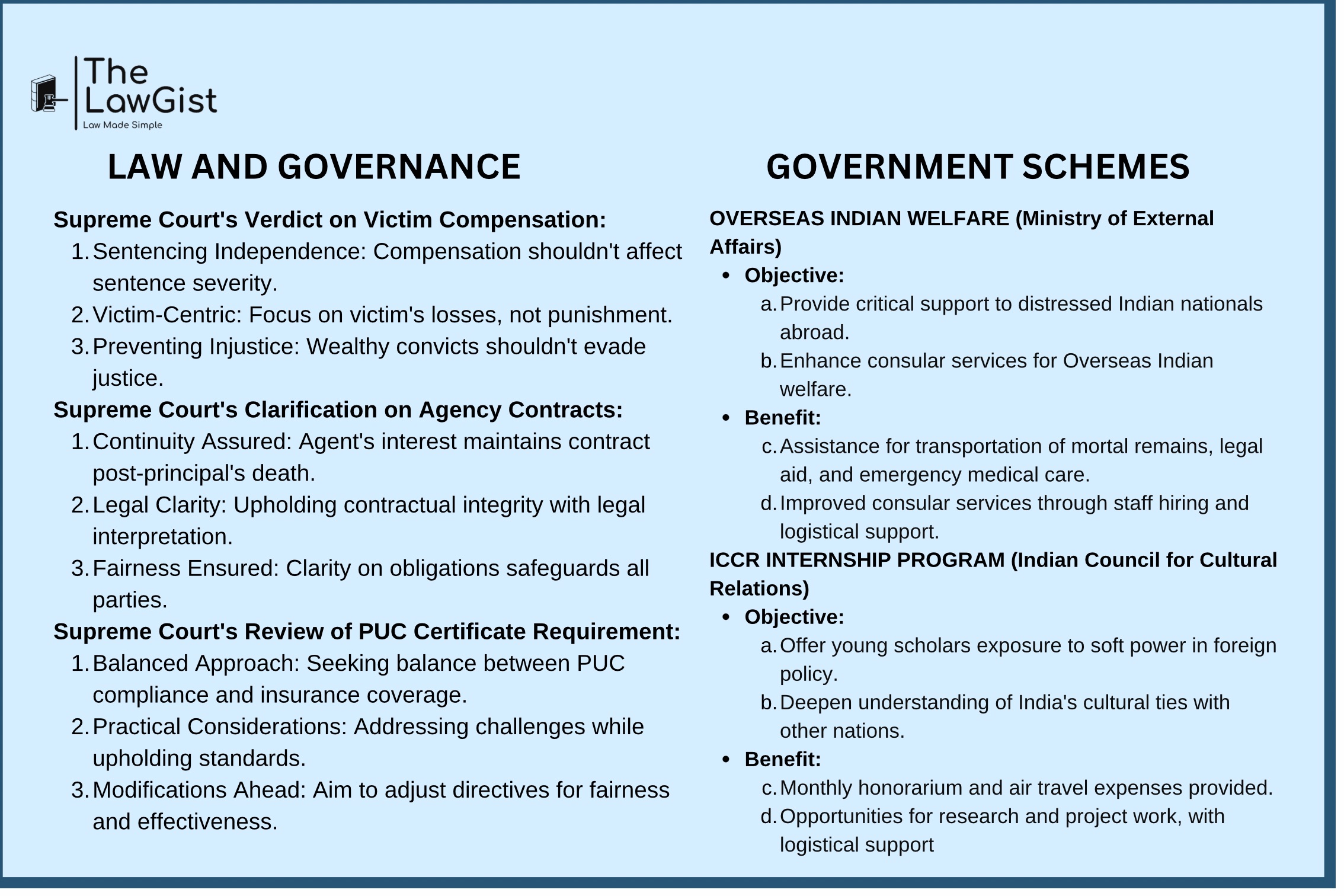
In a recent ruling, the Supreme Court emphasized the independence of sentencing from victim compensation, stating that compensating victims should not influence the severity of a convict’s sentence. The Court underscored that victim compensation aims at restitution, not punishment, and should not undermine justice by allowing convicts to buy their way out. The decision reaffirms the victim-centric nature of Section 357 of the Code of Criminal Procedure, which focuses solely on addressing victims’ losses or injuries without impacting sentencing.
Legal Provision:
Legal Framework:
|
Source- Supreme Court of India
SUPREME COURT CLARIFIES AGENT’S RIGHTS UPON PRINCIPAL CONTRACTOR’S DEATH
SESHAREDDY (D) REP. BY HIS LR. CUM IRREVOCABLE GPA HOLDER AND ASSIGNEE KOTAMREDDY KODANDARAMI v. STATE OF KARNATAKA & ORS.
The Supreme Court overturned a High Court ruling, affirming that the death of a principal contractor does not automatically terminate an agency contract if the agent holds a vested interest in the contract. By invoking Sections 201 and 202 of the Indian Contract Act, the Court upheld the agent’s right to continue the agency, ensuring fairness and contractual integrity. This decision provides clarity on the nuanced interplay between contractual obligations and agency relationships.
Legal Provisions:
Legal Framework:
|
Source- Supreme Court of India
SUPREME COURT REVISITS PUC CERTIFICATE REQUIREMENT FOR THIRD PARTY INSURANCE
MC Mehta v. Union of India & Ors.
The Supreme Court signaled a review of its 2017 mandate linking Pollution Under Control (PUC) certificates to third-party vehicle insurance. Acknowledging concerns raised by the General Insurance Council, the Court sought solutions to balance PUC compliance and insurance coverage effectively. This move reflects a commitment to address practical challenges while upholding environmental and insurance standards, fostering a holistic approach to road safety and pollution control.
Legal Provisions:
Legal Framework:
|
Source- Supreme Court of India
GOVERNMENT SCHEMES
OVERSEAS INDIAN WELFARE
(Ministry of External Affairs)
- Objectives:
- Provide critical support to Indian nationals facing distress situations abroad.
- Enhance consular services and improve the overall well-being of Overseas Indian nationals.
- Benefits:
- Transportation of mortal remains and emergency evacuation.
- Legal assistance, emergency medical care, and support for community welfare activities.
- Improved consular services through staff hiring and logistical support.
- Criteria:
- Applicant must be an Overseas Indian national in distress as defined by the scheme.
- Assistance provided on a means-tested basis to those most in need.
- Emphasis on improving consular services, supporting Indian communities abroad, and promoting cultural exchange.
ICCR INTERNSHIP PROGRAM (Indian Council for Cultural Relations)
(Ministry of External Affairs)
- Objectives:
- Provide a platform for young scholars to engage with soft power in foreign policy.
- Foster a deeper understanding of India’s cultural ties with other nations.
- Benefits:
- Monthly honorarium and one-time air travel expenses.
- Opportunities to work on specific projects and conduct research.
- Logistical support during the internship period.
- Criteria:
- Applicant must be an Indian citizen with a graduate degree in relevant fields.
- Postgraduate, research, and foreign language students also eligible.
- Preference for candidates with strong academic records and backgrounds in international relations.
- Selection process may include personal interviews, with priority given to exceptional candidates.
Source- mySchemes
Also Read- DAILY CURRENT AFFAIRS (15 MAY 2024)