SC clarifies power tariff dues, upholds collegium authority in judge removal, and warns political parties against using courts for electoral battles.
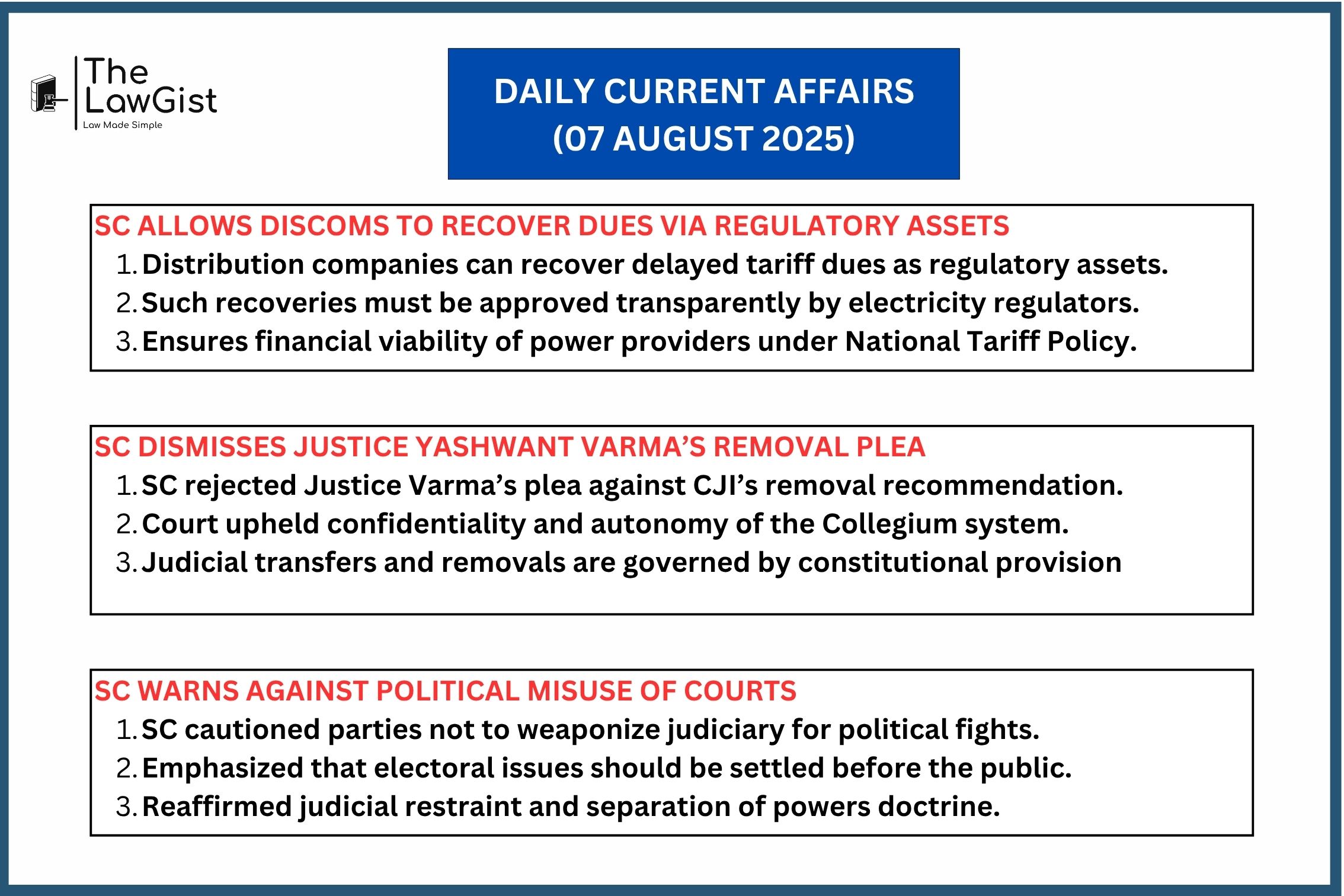
DAILY CURRENT AFFAIRS (07 AUGUST 2025)
SC ALLOWS DISCOMS TO RECOVER DUES VIA REGULATORY ASSETS
Case Name: BSES RAJDHANI POWER LTD. & ANR. VERSUS UNION OF INDIA AND ORS. (and connected matters)
The Supreme Court held that power distribution companies can recover dues as regulatory assets when tariff revisions are delayed. It upheld the National Tariff Policy, which aims to ensure financial viability of discoms while protecting consumer interest. The Court clarified that such dues must be transparently audited and approved by regulators.
Legal Provision
- Electricity Act, 2003 – Sections 61, 62, and 86 (Tariff determination and regulatory powers)
- National Tariff Policy, 2016
- Role of State Electricity Regulatory Commissions (SERCs) in approving tariffs and regulatory assets.
Source: Supreme Court of India
SC REJECTS JUSTICE YASHWANT VARMA’S PLEA AGAINST REMOVAL RECOMMENDATION
Case Name: XXX Petitioner(s) VERSUS THE UNION OF INDIA & ORS. Respondent(s)
The Supreme Court dismissed a petition filed by Delhi High Court judge Justice Yashwant Varma challenging the CJI’s recommendation for his removal. The Court upheld the confidentiality and immunity of the Collegium’s recommendation process and declined to interfere, citing the constitutional scheme governing judicial appointments and transfers.
Legal Provision
- Article 124 and 217 of the Constitution of India – Appointment and removal of judges
- Second Judges Case (1993) and Third Judges Case (1998) – Collegium system
- In-House Procedure laid down for judicial accountability
Source: Supreme Court of India
COURTS NOT FOR POLITICAL SCORES, SC WARNS RIVAL PARTIES
Case Name: DRAVIDA MUNNETRA KAZHAGAM Vs THIRU. C.VE. SHANMUGAM | SLP(C) No. 21487/2025
The Supreme Court strongly cautioned political parties against misusing the judiciary to settle political rivalries. It stated that courts must not become arenas for political vendetta and such disputes should be resolved democratically through elections. The judiciary’s role is to adjudicate legal issues, not mediate electoral battles.
Legal Provision
- Article 32 & 226 of the Constitution – Jurisdiction for constitutional remedies
- Doctrine of Separation of Powers
- Judicial Restraint principle – Courts should not interfere in political matters without legal justification
Source: Supreme Court of India
Also Read: DAILY CURRENT AFFAIRS (06 AUGUST 2025)