Article explaining force, criminal force, and assault under Sections 128–136 of BNS.
CRIMINAL FORCE AND ASSAULT (SECTIONS 128–136) UNDER BNS
The law relating to force, criminal force, and assault protects individuals from unlawful physical interference, threats, and violations of personal dignity under the Bharatiya Nyaya Sanhita (BNS) . These provisions are fundamental because they address common forms of aggression—ranging from minor physical contact to serious threats and obstruction of public servants. Sections 128 to 136 define these offences, clarify their essential ingredients, and prescribe punishments depending on the intention, nature of act, and surrounding circumstances. |
|
Section 128 – Use of Force
Definition: A person is said to use force when they:
- Cause motion, change of motion, or cessation of motion to another person; or
- Cause any substance to come into contact with another person or their belongings;
Such force may be caused:
- By one’s own bodily power
- By arranging objects to move without further action
- By inducing an animal
Example – Throwing a stone or splashing water on someone intentionally.
Case Law
- State of Maharashtra vs. Mohd. Yakub (1980) – The Supreme Court clarified that force includes indirect physical acts, meaning even causing an object to move and touch a person amounts to force.
Section 129 – Criminal Force
Definition: A person uses criminal force when:
- They intentionally use force
- Without the other person’s consent
- With the intention to commit an offence, or to cause injury, fear, or annoyance
Essential Ingredients
- Intention
- Absence of consent
- Likelihood of harm, fear, or annoyance
Example – Pulling someone’s clothes to insult or harass them.
Case Law
- Rupan Deol Bajaj vs. KPS Gill (1995) – The Supreme Court held that even a single act like slapping, if done with improper intent, constitutes criminal force and violates dignity.
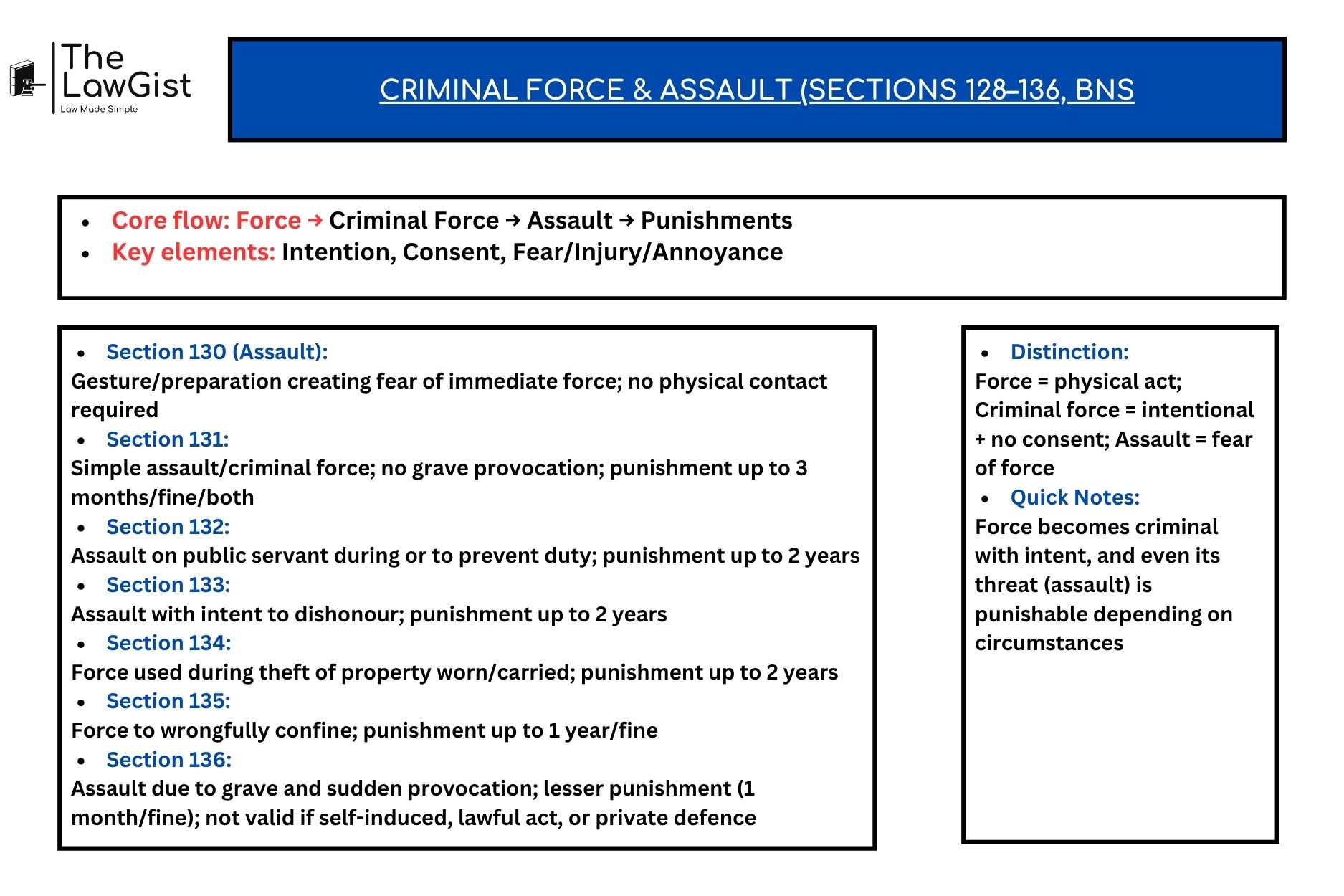
Section 130 – Assault
Definition: An assault is committed when a person:
- Makes a gesture or preparation
- Intending or knowing it is likely to cause apprehension
- That criminal force is about to be used
Note: Words alone do not amount to assault unless combined with gestures.
Example – Raising a hand or weapon in a threatening manner.
Case Law
- Queen vs. St. George (1840) – Pointing an unloaded gun was held to be assault because it created a reasonable fear of immediate harm.
Section 131 – Punishment for Assault or Criminal Force
Provision: Whoever commits assault or uses criminal force (without grave and sudden provocation) shall be punished with:
- Imprisonment up to 3 months, or
- Fine up to ₹1000, or
- Both
Example – Pushing someone intentionally during an argument.
Case Law
- Jagannath Shah vs. State of West Bengal (1969) – The court held that even minor acts like pushing or slapping fall under this section if done intentionally without justification.
Section 132 – Assault or Criminal Force to Deter Public Servant
Definition: Whoever assaults or uses criminal force against a public servant:
- While performing duty, or
- To prevent or deter them from duty, or
- In retaliation for their lawful acts
Punishment
- Imprisonment up to 2 years, or
- Fine, or
- Both
Example – Attacking a police officer during an arrest.
Case Law
- State of Punjab vs. Major Singh (1967) – The court emphasized the need for strict protection of public servants, as obstruction affects public administration.
Section 133 – Assault with Intent to Dishonour
Definition : Whoever assaults or uses criminal force:
- With the intention to dishonour a person
- Without grave and sudden provocation
Punishment
- Imprisonment up to 2 years, or
- Fine, or
- Both
Example – Publicly pulling someone’s clothes to humiliate them.
Case Law
- Ramkripal vs. State of Madhya Pradesh (2007) – The Supreme Court held that intention to insult or humiliate is the crucial element for this offence.
Section 134 – Assault in Attempt to Commit Theft
Definition : Whoever assaults or uses criminal force:
- While attempting to commit theft
- Of property worn or carried by a person
Punishment
- Imprisonment up to 2 years, or
- Fine, or
- Both
Example – Snatching a chain or bag using force.
Case Law
- Phool Kumar vs. Delhi Administration (1975) – The court clarified that use of force during theft increases gravity and may amount to robbery depending on facts.
Section 135 – Assault to Wrongfully Confine
Definition : Whoever assaults or uses criminal force:
- With the intention to wrongfully confine a person
Punishment
- Imprisonment up to 1 year, or
- Fine up to ₹5000, or
- Both
Example- Forcibly locking someone inside a room or restricting movement.
Case Law
- State of Gujarat vs. Keshavlal (1992) – Even temporary restraint using force was held sufficient to constitute wrongful confinement.
Section 136 – Assault on Grave and Sudden Provocation
Definition: Whoever assaults or uses criminal force:
- On account of grave and sudden provocation
Punishment
- Imprisonment up to 1 month, or
- Fine up to ₹1000, or
- Both
Important Conditions
Provocation is not valid if:
- Self-induced
- Due to lawful acts
- Due to private defence
Example – Immediate physical reaction after serious insult.
Case Law
- K.M. Nanavati vs. State of Maharashtra (1962) – The court explained that provocation must be grave, sudden, and cause loss of self-control, with no time for cooling down.
Discover insights on Latin Maxims and Legal Glossary and simplify complex legal terms in seconds.The LawGist ensures exam success with quality Blogs and Articles on — Top Legal Picks (TLP), Current Affairs, latest Supreme Court judgments as Courtroom Chronicles. Backed by trusted resources and videos, The LawGist is every Professionals and Aspirant’s first choice. Discover more at thelawgist.org
Conclusion
Sections 128–136 provide a comprehensive framework distinguishing:
- Force (basic physical act)
- Criminal Force (intentional unlawful force)
- Assault (threat creating fear of force)
These provisions emphasize:
- Consent and intention as key elements
- Protection of human dignity and personal liberty
- Special safeguards for public servants and vulnerable situations
Judicial interpretations have strengthened these provisions by clarifying that even minor acts, if intentional and insulting, can amount to offences. At the same time, the law balances justice by recognizing grave and sudden provocation in appropriate cases.
| Sec. | Offence | Key Point | Punishment | Example |
| 128 | Force | Causing motion/contact | — | Throwing stone |
| 129 | Criminal Force | Intent + No consent + Harm | — | Pulling clothes |
| 130 | Assault | Fear of force (no contact) | — | Raising hand to hit |
| 131 | Simple Assault | No grave provocation | 3 months / ₹1000 | Pushing |
| 132 | Public Servant | Force to deter duty | 2 years | Attacking police |
| 133 | Dishonour | Intent to insult | 2 years | Public humiliation |
| 134 | Theft + Force | Force during theft | 2 years | Chain snatching |
| 135 | Confinement | Force to restrict movement | 1 year / ₹5000 | Locking room |
| 136 | Provocation | Sudden provocation | 1 month / ₹1000 | Reaction to insult |
“Where physical force meets unlawful intent, the law steps in to protect dignity, liberty, and personal security.”
SOURCE – MHA
Discover insights on Latin Maxims and Legal Glossary and simplify complex legal terms in seconds.The LawGist ensures exam success with quality Blogs and Articles on — Top Legal Picks (TLP), Current Affairs, latest Supreme Court judgments as Courtroom Chronicles. Backed by trusted resources and videos, The LawGist is every Professionals and Aspirant’s first choice. Discover more at thelawgist.org