Chandigarh Court to deliver judgment in CBI v. Sanjiv Bansal & Ors involving Justice Nirmal Yadav, a case shaping judicial accountability.
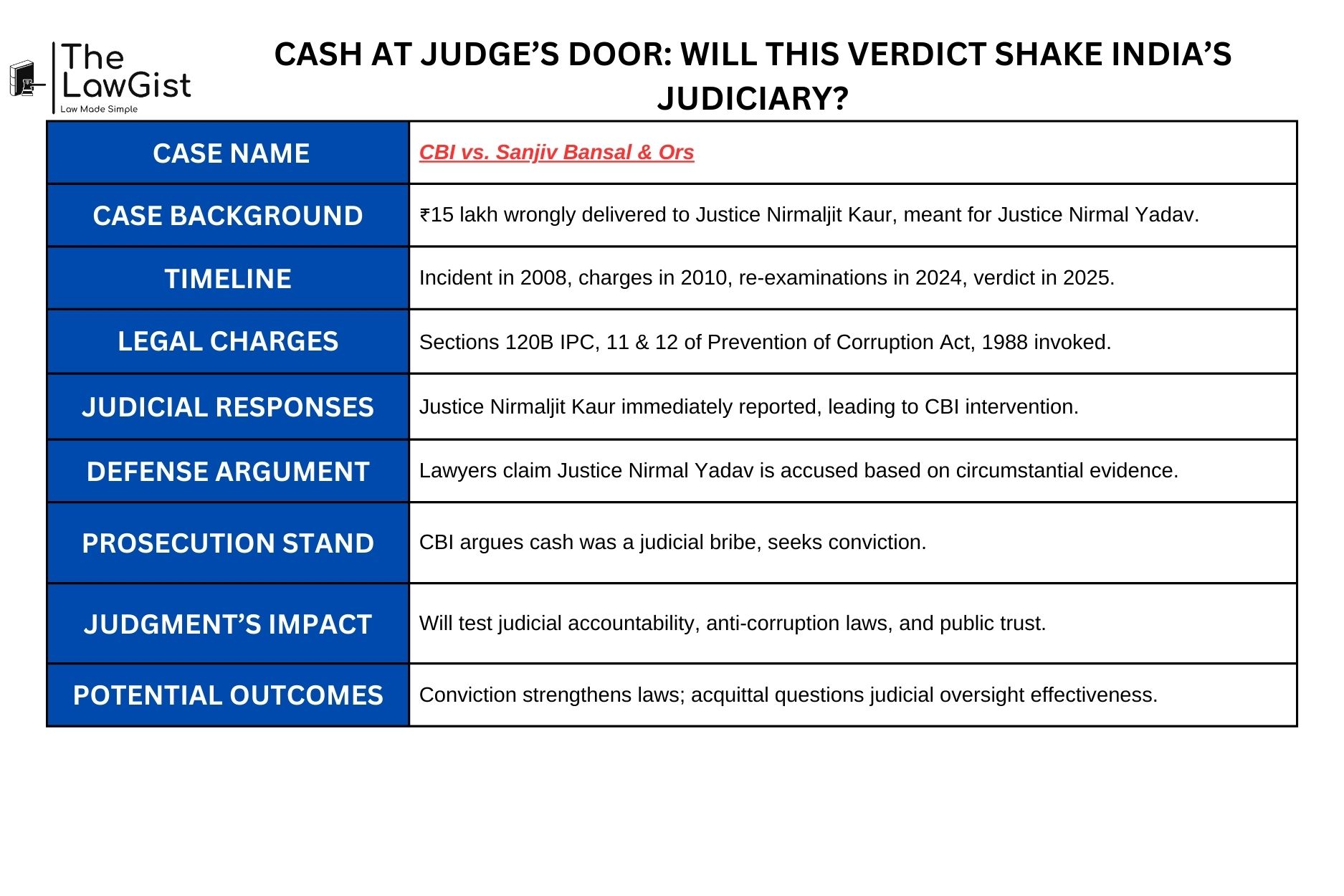
CASH AT JUDGE’S DOOR: WILL THIS VERDICT SHAKE INDIA’S JUDICIARY?
Chandigarh Court to Deliver Verdict in CBI vs. Sanjiv Bansal & Ors
After 17 years the much-debated case of CBI v. Sanjiv Bansal & Ors is coming to its conclusion. The Chandigarh Court of Special Judge Alka Malik will deliver its decision on 29th March, 2025. The case has Justice Nirmal Yadav, who was a former Punjab and Haryana High Court judge and was accused of accepting an unlawful monetary benefit.
The case is famously referred to as the “Cash at Judge’s Door” scandal and even became a turning point in judicial corruption investigations. The decision of Chandigarh Court is said to have a notable impact on judicial accountability and integrity. Cash at Judge’s Door: Will This Verdict Shake India’s Judiciary? still remains a serious question as the country awaits the final ruling.
CASE IN POINT: HOW IT ALL STARTED
On 13th August, 2008 a bag having ₹15 lakh was by mistake delivered to Justice Nirmaljit Kaur who was at that period a sitting judge of the Punjab and Haryana High Court. Suspecting foul play she immediately reported the incident to the police. Investigations later disclosed that the cash was allegedly meant for Justice Nirmal Yadav but was delivered by mistake due to a similarity in names. The case was handed over to the CBI by then Punjab Governor SF Rodrigues.
KEY ASPECTS: TIMELINE OF EVENTS
- 2008: ₹15 lakh mistakenly delivered to the residence of Justice Nirmaljit Kaur
- 2010: Justice Nirmal Yadav transferred to Uttarakhand High Court; charge sheet filed by CBI
- 2014: Special CBI Court frames charges against 5 accused
- 2016: Sanjeev Bansal, one of the main accused passes away
- 2024: Punjab and Haryana High Court permits re-examination of 12 witnesses
- March 29, 2025: Chandigarh Court to announce the verdict
LEGAL INSIGHTS: PROVISIONS & EXPERT OPINIONS
The prosecution has stated violations of:
- Section 120B IPC (Criminal Conspiracy) – For the alleged conspiracy to deliver the bribe mistakenly
- Section 11 of the Prevention of Corruption Act, 1988 – Public servant taking undue advantage
- Section 12 of the Prevention of Corruption Act, 1988 – Punishment for abetment of corruption
Senior Advocate SK Garg Narwana and Advocate VG Narwana who is representing Justice Nirmal Yadav argued that the case is of circumstantial evidence and lacks direct evidence. The CBI contends that the money was intended to influence proceedings.
RIPPLE EFFECT: WHY THIS CASE MATTERS?
- Judicial Integrity: Can this case restore public trust in the judiciary?
- CBI’s Credibility: Will the 17-year-long investigation of the agency hold up in court?
- Precedent for Judicial Corruption Cases: The verdict may influence the cases of future judicial accountability.
WHAT NEXT?
If convicted, Justice Nirmal Yadav could face serious legal consequences, strengthening anti-corruption laws of India within the judiciary. If acquitted, the case may raise questions about the effectiveness of judicial oversight mechanisms.
FINAL VERDICT: A TEST FOR THE JUDICIARY
The Punjab and Haryana High Court has a crucial role in ensuring due process in this case. The decision of the Chandigarh Court will not only decide the fate of Justice Nirmal Yadav but also set a precedent for handling allegations of corruption within India’s judiciary. Cash at Judge’s Door: Will This Verdict Shake India’s Judiciary? The nation awaits the final judgment.
Source
- Legal Glossary- Verdict
- District Court Chandigarh