
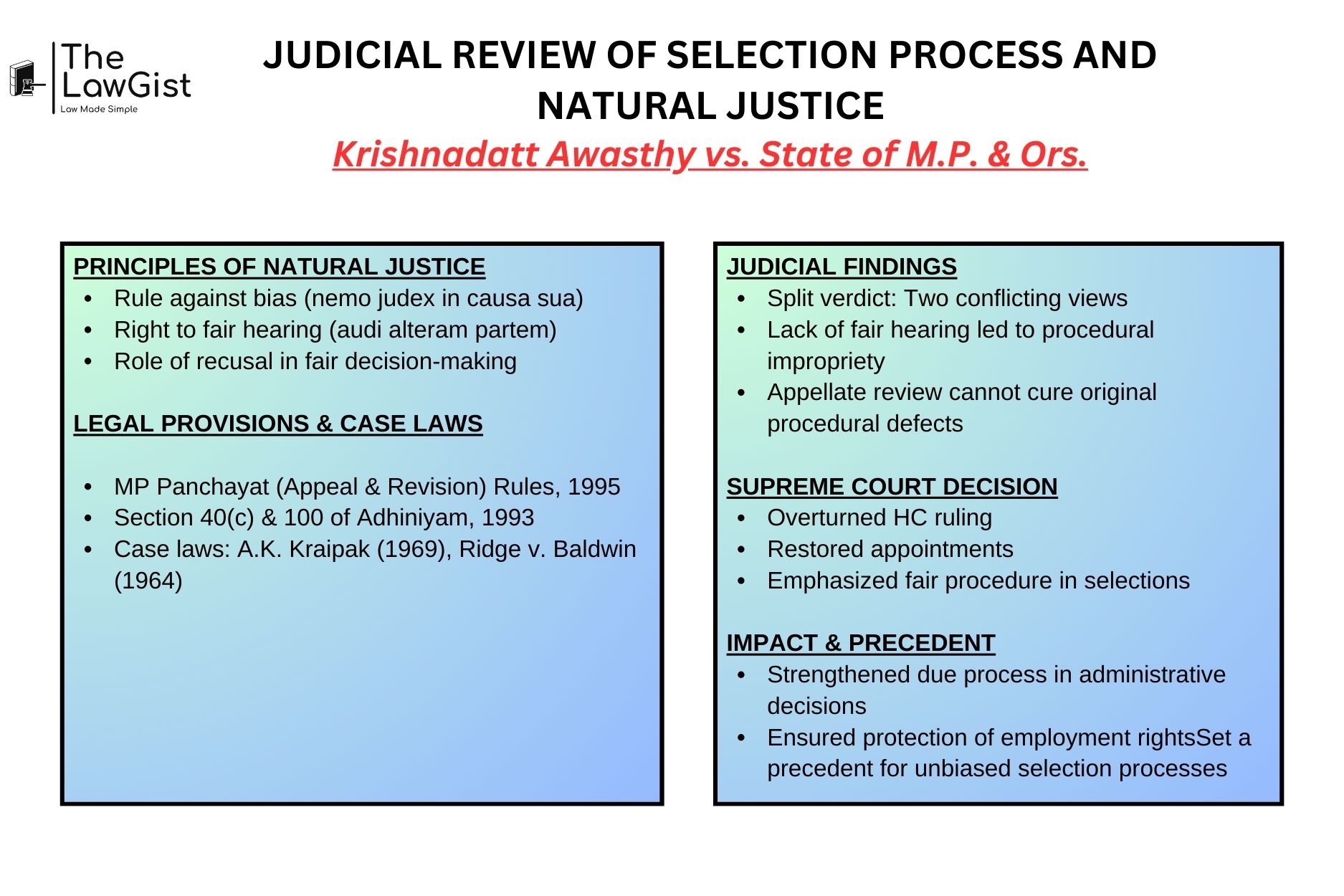
| ASPECTS | DETAILS |
| Case Title | Krishnadatt Awasthy vs. State of M.P. & Ors. |
| Introduction | The case pertains to the validity of appointments made for the post of school teachers (Shiksha Karmi Grade III) in Janpad Panchayat, Gaurihar, Madhya Pradesh in 1998. The appointments were challenged on the grounds of nepotism and bias in the selection process. Due to a split verdict, the case was referred to a larger bench of the Supreme Court. |
| Factual Background |
|
| Legal Issues |
|
| Applicable Law |
|
| Analysis | The rule against bias was alleged, but the Janpad Panchayat had passed a recusal resolution for committee members with close relatives among the candidates.The candidates were not given an opportunity to be heard, violating the principle of audi alteram partem.The principle of natural justice cannot be cured at the appellate stage if it was violated at the original stage. The absence of opportunity to defend led to an ex-parte cancellation, making the decision unsustainable. |
| Conclusion | The Supreme Court upheld Justice K.V. Vishwanathan’s opinion, ruling that the selection was not vitiated and the appellants were denied a fair hearing. The appointments were restored. |
| Current Scenario | The judgment reinforces the importance of adhering to principles of natural justice, ensuring fair procedures in administrative decisions, and preventing ex-parte decisions affecting livelihood. |
CASE SUMMARY – The Supreme Court examined the validity of appointments of Shiksha Karmis in 1998, which were set aside due to allegations of bias and nepotism. The case raised key issues on the rule against bias and the right to a fair hearing. The Court ruled that the candidates were denied the opportunity to present their case, violating the principle of audi alteram partem. It held that such a violation at the original stage could not be cured at the appellate level. Ultimately, the Court reinstated the appointments, emphasizing procedural fairness in administrative decisions.
SOURCE – SUPREME COURT INDIA
ALSO READ – SUPREME COURT RULING ON WRONGFUL CONFINEMENT & DOMESTIC WORKERS’ RIGHTS


