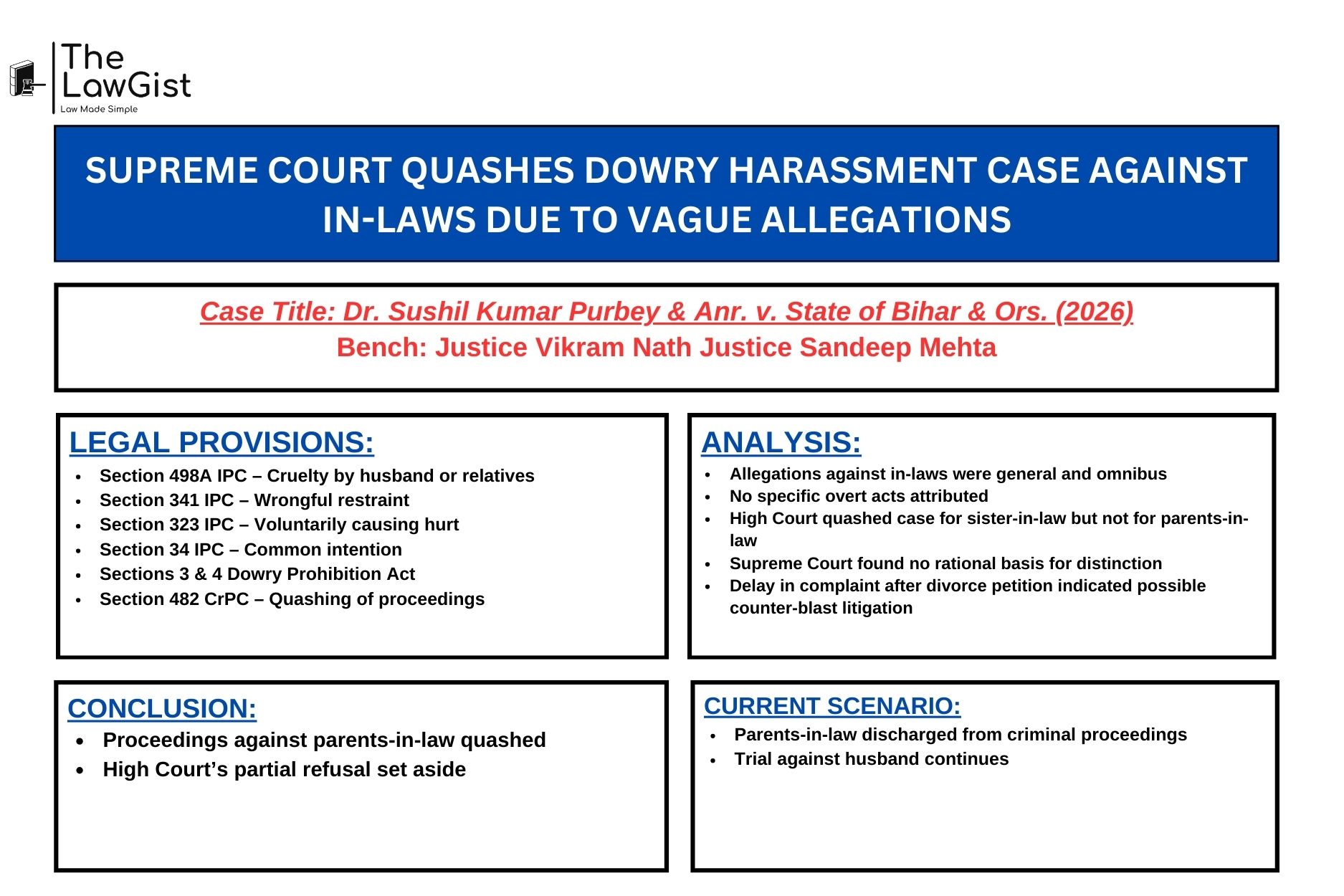
Supreme Court rules that vague allegations cannot sustain criminal proceedings against in-laws in dowry harassment cases.
SUPREME COURT QUASHES DOWRY HARASSMENT CASE AGAINST IN-LAWS DUE TO VAGUE ALLEGATIONS
CASE SUMMARY – The Supreme Court in Dr. Sushil Kumar Purbey & Anr. vs. State of Bihar & Ors. (2026) considered whether criminal proceedings against the complainant’s parents-in-law should continue when the allegations were vague and similar to those against the sister-in-law whose case had already been quashed by the High Court. The Court held that the FIR contained only general and omnibus allegations without specifying any overt acts by the parents-in-law. It further noted the timing of the complaint after the husband filed for divorce. Observing that similarly placed accused cannot be treated differently, the Court quashed the criminal proceedings against the parents-in-law while allowing the case against the husband to continue.
| ASPECTS | DETAILS |
| Case Title | Dr. Sushil Kumar Purbey & Anr. vs. State of Bihar & Ors. (2026) |
| Introduction | The Supreme Court examined whether criminal proceedings against the complainant’s father-in-law and mother-in-law under IPC and the Dowry Prohibition Act should be quashed when the allegations against them were general and identical to those against another accused whose case had already been quashed by the High Court. |
| Factual Background | The complainant married Dr. Rishi Raj in July 2019. The husband filed for divorce in March 2021. In March 2022, the complainant lodged an FIR alleging cruelty, dowry demands (BMW car), and assault against the husband, parents-in-law, and sister-in-law. The High Court quashed proceedings against the sister-in-law but refused to quash them against the parents-in-law. They appealed to the Supreme Court. |
| Legal Issues | 1. Whether criminal proceedings can continue against in-laws when allegations are vague and omnibus.
2. Whether the High Court erred by applying different standards for quashing proceedings against similarly placed accused. |
| Applicable Law | Sections 341, 323, 498A, 34 IPC, Sections 3 & 4 Dowry Prohibition Act, 1961, and Section 482 CrPC (inherent powers of High Court to quash proceedings). |
| Analysis | The Supreme Court compared allegations against the sister-in-law and the appellants and found them identical and lacking specific acts. No individual role, date, or overt act was attributed to the parents-in-law. Mere allegations that they “quarrelled” did not constitute a criminal offence. The Court also noted the delay in filing the complaint after the divorce petition, suggesting the possibility of a retaliatory complaint. |
| Conclusion | The Court held that the High Court wrongly distinguished between similarly placed accused. Since the allegations were general and omnibus, criminal proceedings against the parents-in-law were quashed. |
| Current Scenario | Criminal proceedings against the father-in-law and mother-in-law are quashed, but the case against the husband continues according to law since he did not seek quashing before the Court. |
“Criminal proceedings cannot continue against relatives when allegations are vague, omnibus, and unsupported by specific acts.”
SOURCE – SUPREME COURT OF INDIA