SC ON OBC CREAMY LAYER – PSU SALARY INCOME AND RESERVATION POLICY ANALYSIS
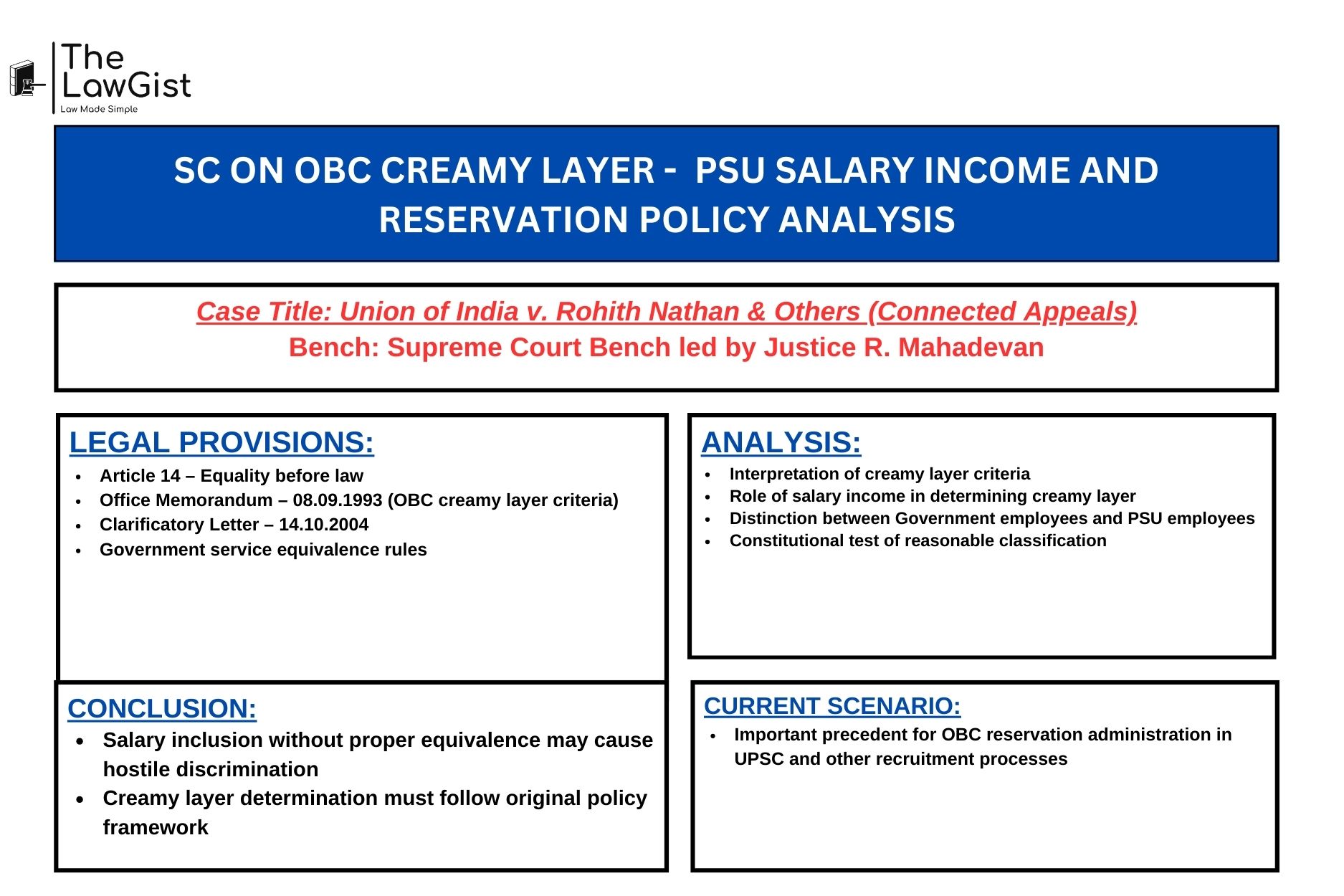
CASE SUMMARY – The Supreme Court in Union of India v. Rohith Nathan & Others examined the criteria for determining the creamy layer among Other Backward Classes (OBCs) in the context of Civil Services Examination candidates. The dispute arose over whether the salary income of parents employed in Public Sector Undertakings should be included while applying the income/wealth test under the Office Memorandum of 1993. Several High Courts had held that such inclusion created discrimination between PSU employees and government servants. The Supreme Court analysed the reservation framework, the clarificatory letter of 2004, and constitutional principles of equality to determine the proper interpretation of creamy layer guidelines.
| ASPECTS | DETAILS |
| Case Title | Union of India v. Rohith Nathan & Others |
| Introduction | The Supreme Court examined the determination of OBC creamy layer status, specifically whether salary income of parents employed in Public Sector Undertakings (PSUs) should be considered while applying the income/wealth test under the Office Memorandum governing OBC reservation. The case arose from conflicting interpretations of the Office Memorandum dated 08.09.1993 and the clarificatory letter dated 14.10.2004. |
| Factual Background | Candidates appearing in the Civil Services Examination claimed reservation under the OBC (Non-Creamy Layer) category. Their parents were employed in PSUs or private sector institutions with income exceeding the prescribed ceiling. Government authorities treated them as creamy layer candidates, denying OBC reservation. CAT and various High Courts held that salary income should not automatically determine creamy layer status and directed reconsideration. |
| Legal Issues | 1. Whether salary income of parents employed in PSUs/private sector can be included for determining OBC creamy layer status.
2. Whether the clarificatory letter dated 14.10.2004 is valid under the framework of the 1993 Office Memorandum. 3. Whether treating PSU employees differently from Government employees violates Article 14 of the Constitution. |
| Applicable Law | Article 14 of the Constitution of India; OBC reservation framework under Office Memorandum dated 08.09.1993; Clarificatory Letter dated 14.10.2004; Government guidelines on creamy layer determination. |
| Analysis | The Court examined the structure of the 1993 OM, which categorizes persons into different classes for determining creamy layer status. It analysed whether salary income should be counted when equivalence between PSU posts and Government posts is not determined. The Court also considered the principle of equality and non-discrimination in reservation policy. |
| Conclusion | The Court held that the mere inclusion of salary income of PSU employees for creamy layer determination without proper equivalence testing could result in discrimination. The validity and interpretation of the clarificatory letter were critically examined in light of the original reservation policy framework. |
| Current Scenario | The judgment clarifies the method of determining creamy layer status for children of PSU employees, ensuring consistency with the reservation policy and preventing arbitrary classification. It impacts Civil Services Examination allocations and OBC reservation administration across India. |
“Reservation policies must operate within the framework of equality, ensuring that classification does not result in discrimination.”
SOURCE – SUPREME COURT OF INDIA