SUPREME COURT REAFFIRMS DUTY OF FIRST APPELLATE COURTS TO DELIVER REASONED JUDGMENTS IN WILL DISPUTES
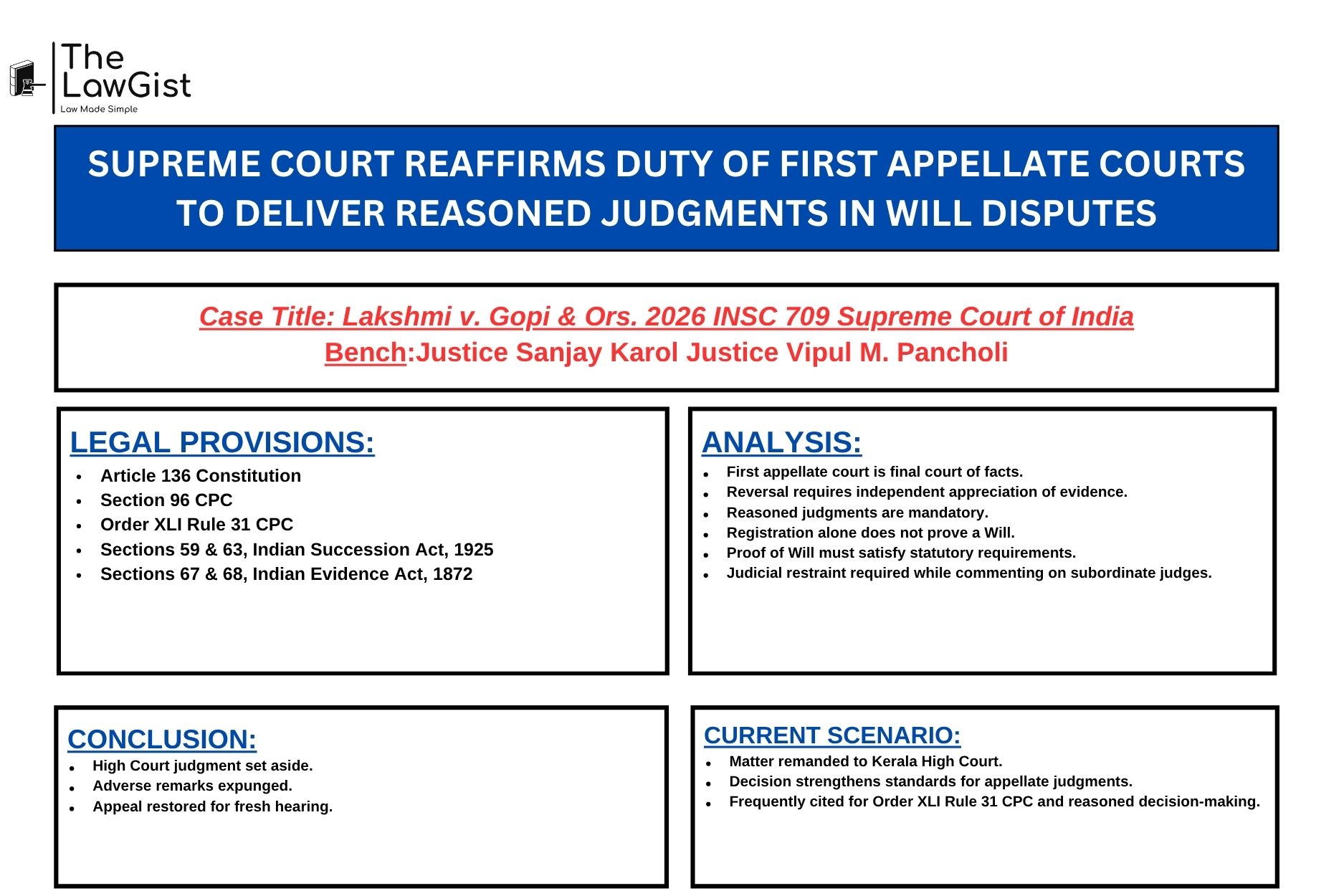
CASE SUMMARY – The Supreme Court in Lakshmi vs. Gopi & Ors. (2026) held that a first appellate court must provide a reasoned judgment when reversing a trial court’s findings. The dispute concerned the validity of a registered Will executed by Thankam. While the Trial Court held that the Will had not been proved in accordance with the Indian Succession Act, the Kerala High Court reversed the decision through a brief order and criticized the trial judge. The Supreme Court found this approach legally unsustainable, set aside the High Court’s judgment, expunged the adverse remarks, and remanded the matter for fresh adjudication in accordance with law.
| ASPECTS | DETAILS |
| Case Title | Lakshmi vs. Gopi & Ors. |
| Introduction | The Supreme Court examined whether the Kerala High Court was justified in reversing the trial court’s judgment concerning the validity of a Will without giving adequate reasons and whether its adverse remarks against the trial judge were appropriate. |
| Factual Background | Thankam executed a registered Will in 1999. After her death in 2011, her daughter Lakshmi filed a partition suit alleging no knowledge of the Will. The Trial Court held that the Will was not proved under Section 63 of the Indian Succession Act and granted partition. The High Court reversed the decision in a brief judgment and criticized the trial judge. |
| Legal Issues | 1. Whether the High Court complied with Order XLI Rule 31 CPC while reversing the trial court.
2. Whether the High Court was justified in making adverse remarks against the trial judge. 3. What are the legal requirements for proving a Will? |
| Applicable Law | Section 96 CPC; Order XLI Rule 31 CPC; Sections 59 & 63 of the Indian Succession Act, 1925; Sections 67 & 68 of the Indian Evidence Act, 1872; Article 136 of the Constitution. |
| Analysis | The Supreme Court reiterated that a first appellate court is the final court on facts and law and must independently analyze evidence before reversing trial court findings. It emphasized that reasoned judgments are essential for judicial transparency and fairness. The Court also summarized the legal requirements for proving a Will and held that appellate courts should exercise restraint while criticizing subordinate judges. |
| Conclusion | The Supreme Court set aside the Kerala High Court’s judgment and the adverse remarks against the trial judge. The first appeal was restored for fresh consideration by the High Court with all issues left open. |
| Current Scenario | The matter stands remanded to the Kerala High Court for fresh adjudication. The judgment serves as an important precedent requiring appellate courts to record detailed reasons before reversing trial court decisions and discourages unnecessary disparaging remarks against judicial officers. |
“Reason is the heartbeat of every judicial decision; without reasons, justice loses its legitimacy.”
SOURCE – SUPREME COURT OF INDIA