Supreme Court declares zero tolerance for AI-generated fake legal precedents and reinforces human oversight in judicial decision-making.
SUPREME COURT ON AI HALLUCINATIONS IN JUDICIAL DECISIONS
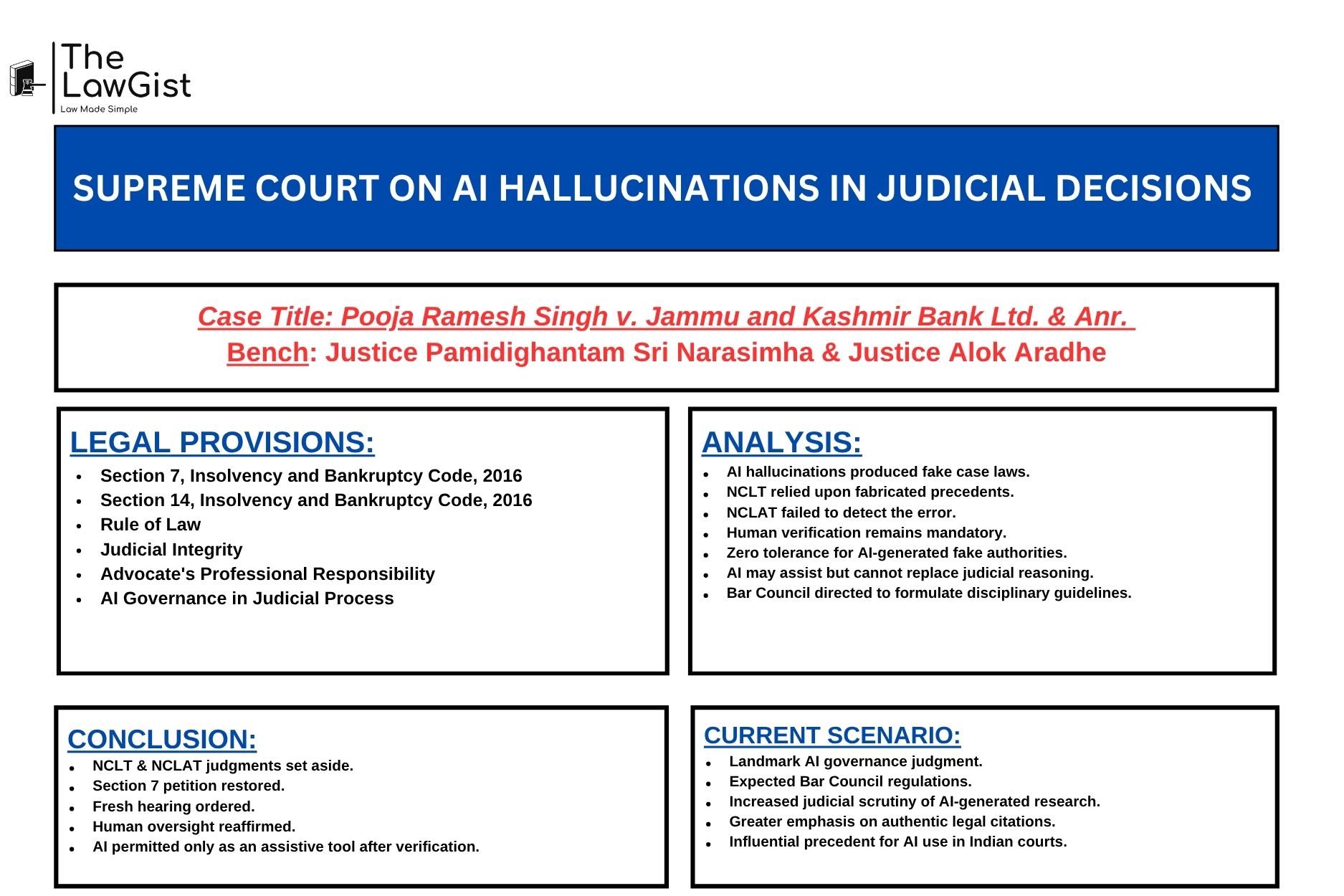
CASE SUMMARY – The Supreme Court in Pooja Ramesh Singh vs. Jammu and Kashmir Bank Ltd. & Anr. (2026 INSC 668) delivered a landmark judgment on the responsible use of Artificial Intelligence in the legal system. The Court found that the NCLT relied upon fabricated AI-generated judicial precedents while admitting insolvency proceedings, and the NCLAT failed to detect the error. Declaring a zero-tolerance policy toward fake AI-generated legal authorities, the Court held that any judgment based on such material is legally unsustainable. The NCLT and NCLAT decisions were set aside, the insolvency petition was restored, and the Bar Council of India was directed to formulate AI usage guidelines.
| ASPECTS | DETAILS |
| Case Title | Pooja Ramesh Singh vs. Jammu and Kashmir Bank Ltd. & Anr. |
| Introduction | This landmark judgment addresses the misuse of Artificial Intelligence (AI) in judicial proceedings. The Supreme Court emphasized that AI-generated fake or hallucinated legal precedents cannot be relied upon by courts or lawyers. The Court set aside the decisions of both the NCLT and NCLAT because they relied upon fabricated AI-generated case citations, thereby compromising the integrity of the judicial process. |
| Factual Background | The appellant, Pooja Ramesh Singh, was the suspended director of Essel Infraprojects Ltd. (EIL), which had provided a corporate guarantee for loans taken by Pan India Utilities Distribution Company Ltd. (PIUDCL). After loan defaults, Jammu and Kashmir Bank initiated insolvency proceedings under Section 7 of the Insolvency and Bankruptcy Code, 2016. The NCLT admitted the application, and the NCLAT affirmed the decision. During the appeal before the Supreme Court, it was discovered that the NCLT had relied upon fake and AI-generated judicial precedents. |
| Legal Issues | 1. Whether judicial decisions relying upon AI-generated fake precedents are legally sustainable.
2. Whether courts and advocates have a duty to verify AI-generated legal authorities before relying upon them. 3. Whether NCLT and NCLAT judgments should be set aside due to reliance on fabricated precedents. |
| Applicable Law | • Section 7, Insolvency and Bankruptcy Code, 2016.
• Section 14, Insolvency and Bankruptcy Code, 2016. • Principles of Rule of Law and Judicial Integrity. • Professional responsibilities of advocates under the Bar Council framework. |
| Analysis | The Supreme Court observed that AI is a valuable technological tool but cannot replace human judicial reasoning. AI-generated hallucinations threaten the rule of law when treated as authentic precedents. The Court declared a zero-tolerance policy against citing or relying upon fabricated AI-generated judgments. It further directed the Bar Council of India to frame guidelines and disciplinary measures regarding the misuse of AI by advocates. Since the NCLT relied upon non-existent judgments, its order became legally unsustainable regardless of the merits of the dispute. |
| Conclusion | The Supreme Court set aside the judgments of the NCLT and NCLAT, restored the Section 7 application to the NCLT, and directed fresh adjudication uninfluenced by fake AI-generated precedents. It also emphasized maintaining human oversight in every stage of adjudication while responsibly adopting AI technologies. |
| Current Scenario | This judgment has become a significant precedent regarding AI ethics in legal practice. It establishes India’s first clear judicial policy against AI hallucinations in litigation and is expected to influence future regulations, Bar Council guidelines, judicial training, and responsible AI adoption within courts. |
“Artificial Intelligence may assist justice, but truth, reasoning, and judicial responsibility must always remain under human control.”
SOURCE – SUPREME COURT OF INDIA