SUPREME COURT RECOGNIZES 100% FUNCTIONAL DISABILITY FOR AMPUTEE MASON IN MOTOR ACCIDENT COMPENSATION CASE
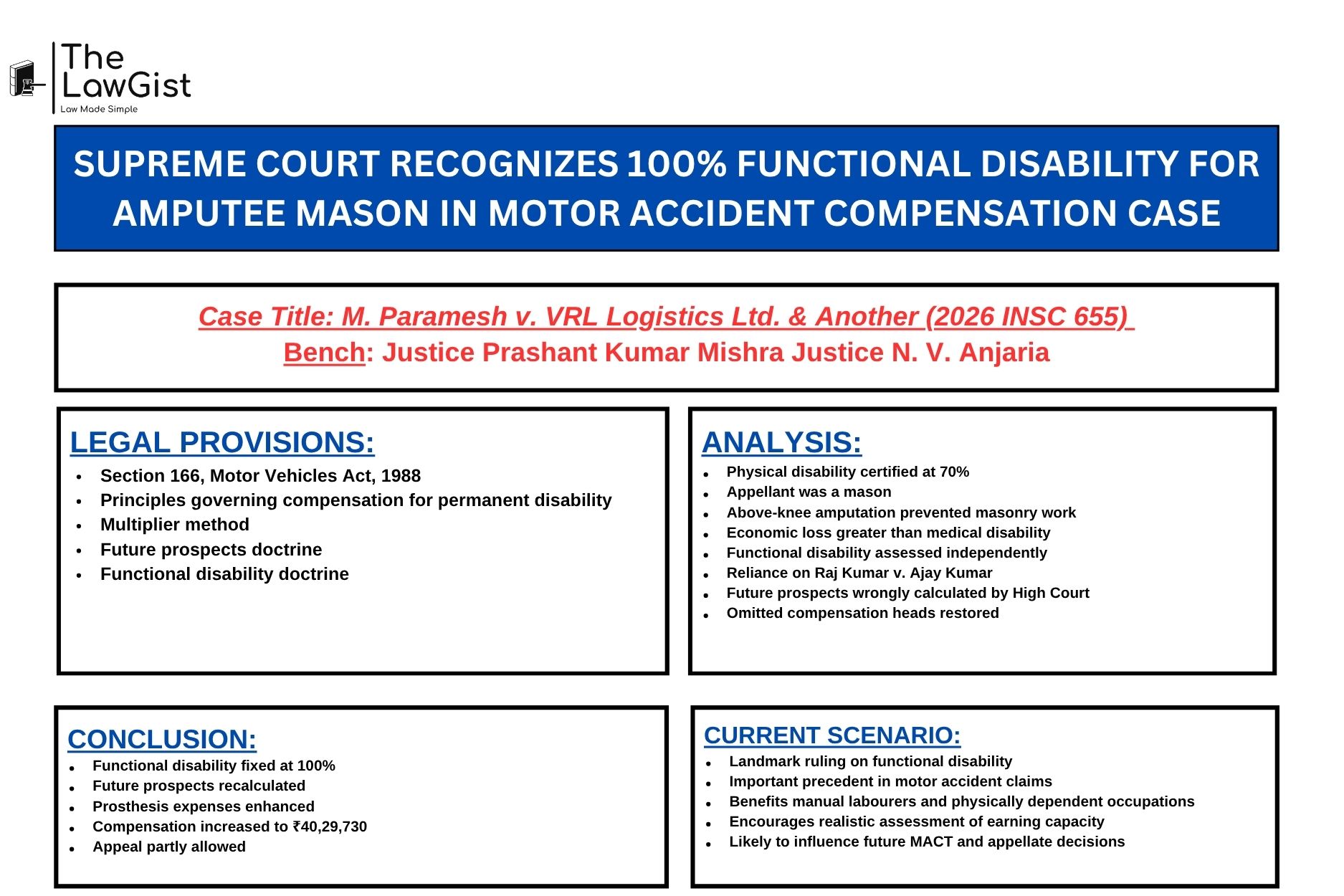
CASE SUMMARY – M. Paramesh vs. VRL Logistics Ltd. (2026) involved a mason who suffered an above-knee amputation after being hit by a negligently driven lorry. Although his permanent physical disability was assessed at 70%, the Supreme Court held that compensation must be based on functional disability and actual loss of earning capacity. Since the appellant could no longer perform masonry work, his functional disability was treated as 100%. The Court relied on Raj Kumar v. Ajay Kumar to distinguish physical disability from economic disability. Consequently, compensation was enhanced from ₹29.01 lakh to ₹40.29 lakh, including increased future medical expenses and future prospects.
| ASPECTS | DETAILS |
| Case Title | M. Paramesh vs. VRL Logistics Ltd. & Another, Civil Appeal No. 8708 of 2026 (Arising out of SLP (C) No. 35337 of 2025) |
| Introduction | The Supreme Court examined whether compensation awarded to a mason who suffered above-knee amputation in a motor accident adequately reflected his loss of earning capacity. The Court focused on the distinction between physical disability and functional disability. |
| Factual Background | On 18 April 2017, the appellant, a mason aged about 30 years, was riding a bicycle when a rashly driven lorry hit him. He suffered severe injuries resulting in amputation of his right leg above the knee. His permanent physical disability was assessed at 70%. He claimed compensation under Section 166 of the Motor Vehicles Act, 1988. |
| Legal Issues | 1. Whether compensation should be calculated on the basis of 70% physical disability or 100% functional disability.
2. Whether the High Court correctly computed future prospects. 3. Whether compensation towards future medical expenses and prosthesis required enhancement. |
| Applicable Law | • Section 166, Motor Vehicles Act, 1988.
• Principles laid down in Raj Kumar v. Ajay Kumar regarding functional disability and earning capacity. • Multiplier method for determining loss of future earnings. |
| Analysis | The Court found that the High Court incorrectly calculated future prospects and omitted certain compensation heads. More importantly, it held that a mason requires full physical mobility. Since the appellant lost his leg above the knee and could no longer perform masonry work, his earning capacity was effectively destroyed. Therefore, while medical disability remained 70%, functional disability had to be treated as 100%. The Court relied heavily on the principles in Raj Kumar regarding assessment of earning capacity rather than mere physical impairment. |
| Conclusion | The Supreme Court enhanced compensation from ₹29,01,570 to ₹40,29,730. Functional disability was assessed at 100%, future prospects recalculated correctly, and future medical expenses for prosthesis increased from ₹1 lakh to ₹2 lakh. The appeal was partly allowed. |
| Current Scenario | The judgment strengthens the jurisprudence that compensation in motor accident cases must be based on actual loss of earning capacity. It serves as an important precedent for labourers, masons, drivers, and other workers whose professions depend upon physical mobility. Courts are expected to focus on functional disability rather than mechanically applying percentages of physical disability. |
“Functional disability, and not merely physical disability, is the true measure of loss of earning capacity when an injured person can no longer pursue his profession.”
SOURCE – SUPREME COURT OF INDIA