Supreme Court reiterates that courts cannot award unsolicited monetary compensation in place of a decree for mandatory injunction without pleadings or consent.
CASE SUMMARY
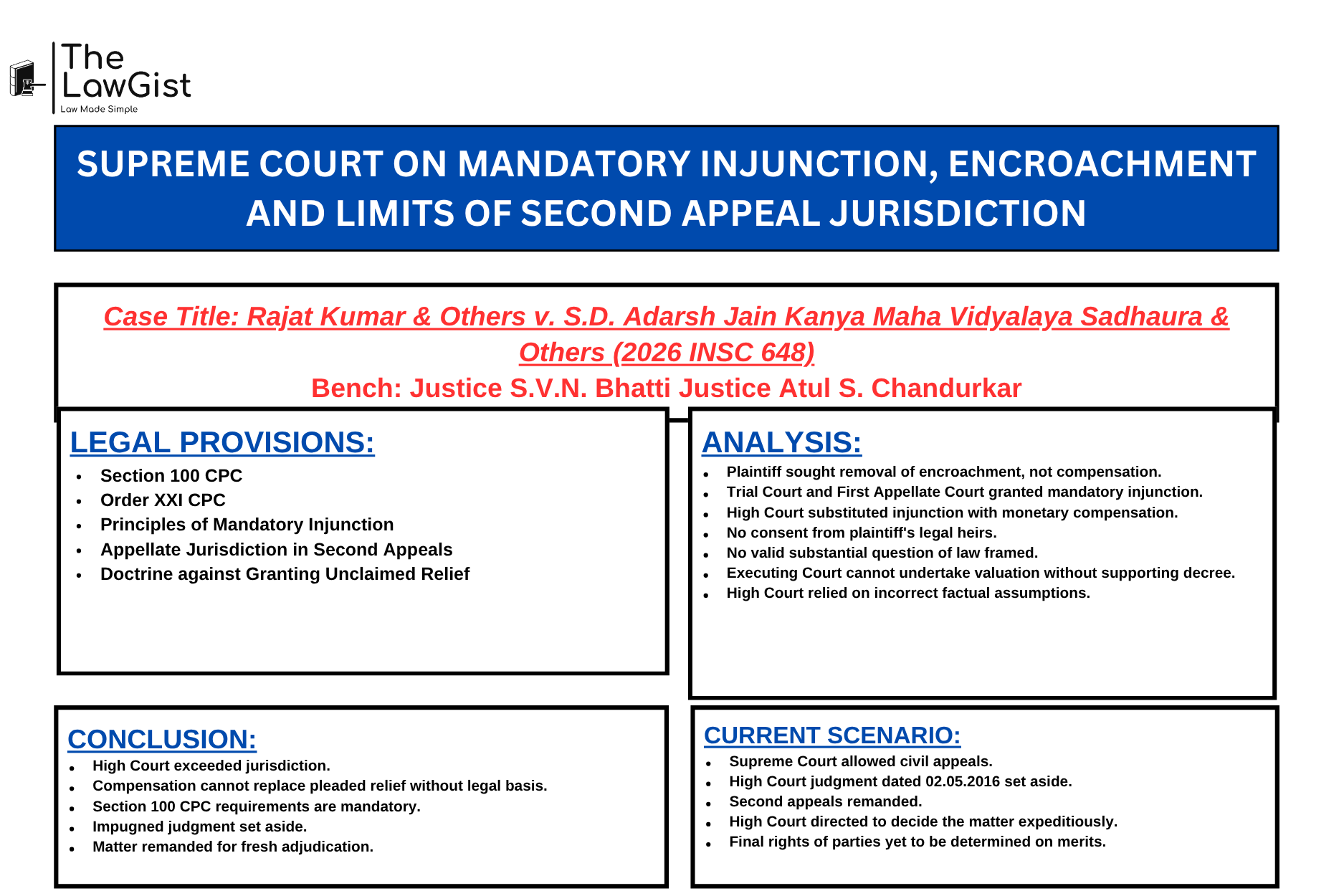
In Rajat Kumar & Others vs. S.D. Adarsh Jain Kanya Maha Vidyalaya Sadhaura & Others (2026 INSC 648), the Supreme Court examined whether a High Court could replace decrees of mandatory injunction with monetary compensation during second appeal proceedings. The plaintiff had successfully obtained decrees directing removal of an encroaching wall and an unauthorized lintel. However, the High Court substituted these decrees with compensation despite no such relief being claimed. The Supreme Court held that courts cannot impose compensation without pleadings or consent and emphasized strict compliance with Section 100 CPC. The impugned judgment was set aside and remanded for fresh consideration.
| Heading | Details |
| Case Title | Rajat Kumar & Others vs. S.D. Adarsh Jain Kanya Maha Vidyalaya Sadhaura & Others |
| Introduction | The case concerns illegal encroachment and unauthorized construction by the defendants, including erection of a wall and lintel affecting the plaintiff’s property rights. The dispute primarily revolved around whether the High Court could replace decrees of mandatory injunction with monetary compensation in second appeal proceedings. |
| Factual Background | The original plaintiff, Om Parkash, filed two civil suits. In the first suit, he sought removal of an allegedly illegal wall constructed on a common open space, obstructing light, air, and water flow. In the second suit, he sought removal of a lintel placed on his house wall by the defendants. Both suits were decreed in his favour by the Trial Court and affirmed by the First Appellate Court. The High Court, however, modified the decrees and awarded compensation instead of removal of the structures. |
| Legal Issues | 1. Whether the High Court could replace a decree for mandatory injunction with monetary compensation. 2. Whether compensation could be awarded when no such relief was pleaded or sought. 3. Whether the High Court properly exercised jurisdiction under Section 100 CPC. 4. Whether substantial questions of law were framed before interfering with concurrent findings of fact. |
| Applicable Law | Section 100, Code of Civil Procedure, 1908; Order XXI CPC relating to execution of decrees; Principles governing mandatory injunctions and appellate jurisdiction. |
| Analysis | The Supreme Court observed that the plaintiff never sought damages or compensation. Therefore, the High Court lacked authority to compel the legal heirs to accept compensation. The High Court also erred in directing the Executing Court to assess valuation despite setting aside the decree. Such a direction had no legal basis under Order XXI CPC. Further, the High Court failed to properly frame substantial questions of law as required by Section 100 CPC and proceeded on an incorrect factual assumption that the wall was common property. |
| Conclusion | The Supreme Court held that the High Court’s judgment was unsustainable. It set aside the impugned judgment and remanded the second appeals to the High Court for fresh consideration in accordance with Section 100 CPC. |
| Current Scenario | The Supreme Court allowed the appeals, restored the matter to the Punjab & Haryana High Court, and directed expeditious disposal of RSA Nos. 363 and 364 of 2008 on merits. The underlying property dispute remains pending adjudication before the High Court. |
SOURCE – SUPREME COURT OF INDIA
Quote
“A court cannot compel a successful plaintiff to accept monetary compensation when no such relief was claimed and no consent was given.”