Courts reaffirm consumer rights despite arbitration clauses, scrutinise ARC loan sales, and clarify Telegram blocking powers under IT law.
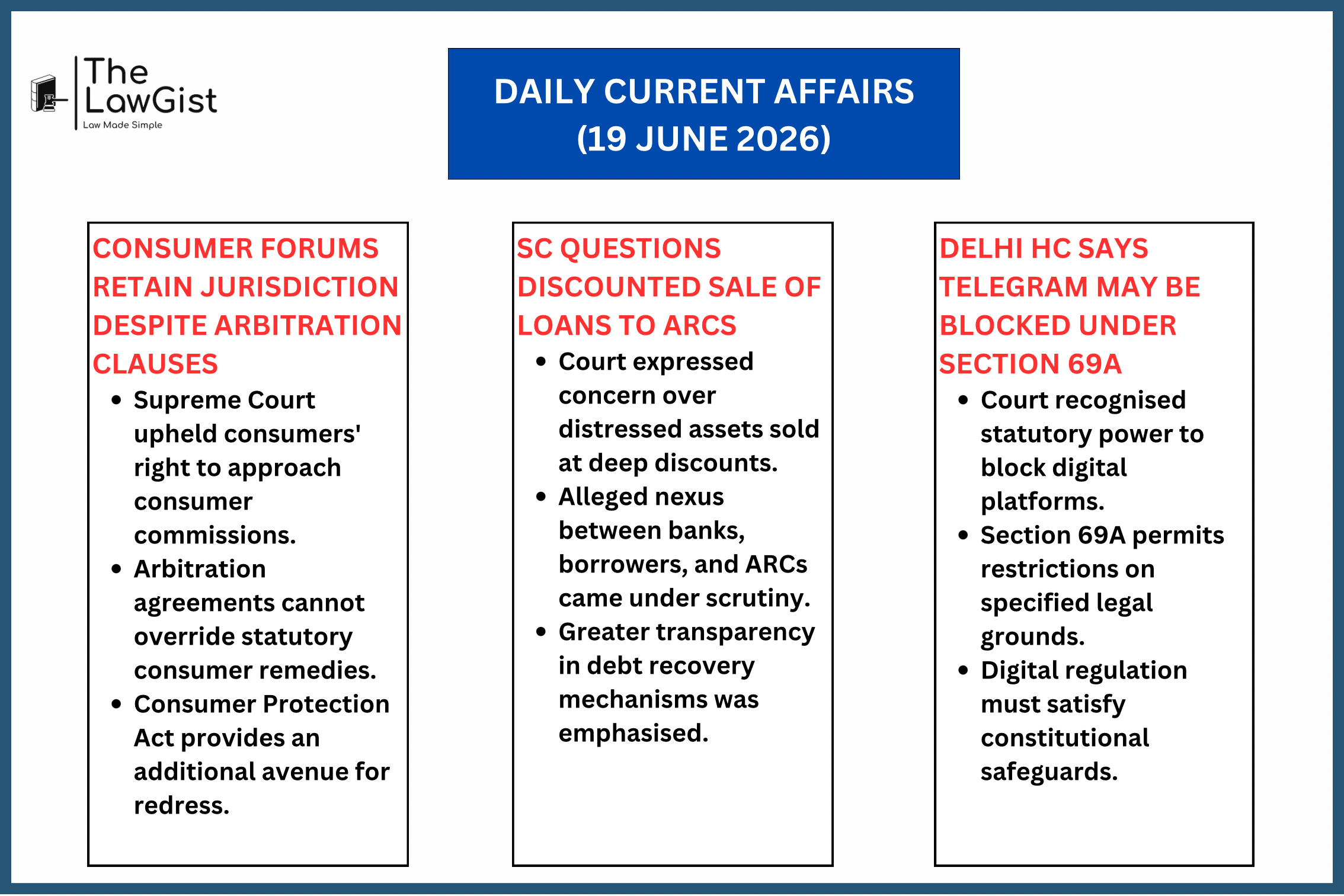
DAILY CURRENT AFFAIRS (19 JUNE 2026)
CONSUMER FORUMS CAN ENTERTAIN DISPUTES DESPITE ARBITRATION CLAUSES: SC
Case Name: M/s Citicorp Finance (India) Ltd. v. Consumer Complainant
The Supreme Court reaffirmed that the presence of an arbitration clause in an agreement does not bar consumers from approaching consumer commissions. The Court observed that remedies under consumer protection laws are supplementary in nature and are intended to provide speedy redressal. Contractual arbitration provisions cannot deprive consumers of statutory rights available under special welfare legislation.
LEGAL PROVISIONS & FRAMEWORK
- Consumer Protection Act, 2019
- Section 100 – Additional remedy under the Act
- Arbitration and Conciliation Act, 1996
- Section 8 – Reference to arbitration
- Consumer welfare jurisprudence
- Access to justice principles
Source: Supreme Court of India
SC FLAGS ALLEGED NEXUS IN SALE OF STRESSED LOANS TO ARCS
Case Overview: Matter concerning sale of stressed assets by Banks to Asset Reconstruction Companies
The Supreme Court expressed concern over the practice of banks transferring distressed loans to Asset Reconstruction Companies (ARCs) at substantially discounted values. The Court observed that such transactions may warrant closer scrutiny, particularly where allegations suggest collusion among lenders, borrowers, and reconstruction entities, potentially undermining recovery mechanisms and public confidence in the banking sector.
LEGAL PROVISIONS & FRAMEWORK
- SARFAESI Act, 2002
- Banking Regulation Act, 1949
- Reserve Bank of India guidelines on stressed assets
- Insolvency and Bankruptcy Code, 2016
- Principles of financial accountability
- Judicial oversight of debt recovery mechanisms
Source: Supreme Court of India
DELHI HC OBSERVES TELEGRAM CAN BE BLOCKED UNDER SECTION 69A OF IT ACT
Case Name: Telegram FZ-LLC v. Union of India & Ors.
The Delhi High Court observed that the legal framework under Section 69A of the Information Technology Act permits blocking of online platforms, including Telegram, where statutory requirements are satisfied. The Court clarified that the provision empowers the Government to restrict access in appropriate cases involving sovereignty, security, public order, or other grounds recognised by law.
LEGAL PROVISIONS & FRAMEWORK
- Information Technology Act, 2000
- Section 69A – Blocking powers of the Central Government
- Information Technology (Procedure and Safeguards for Blocking for Access of Information) Rules, 2009
- Article 19(1)(a) – Freedom of speech and expression
- Article 19(2) – Reasonable restrictions
- Principles of proportionality in digital regulation
Source: Delhi High Court
Also Read: DAILY CURRENT AFFAIRS (17 JUNE 2026)