Supreme Court directs completion of a 19-year-old criminal investigation, emphasizing the constitutional right to speedy justice.
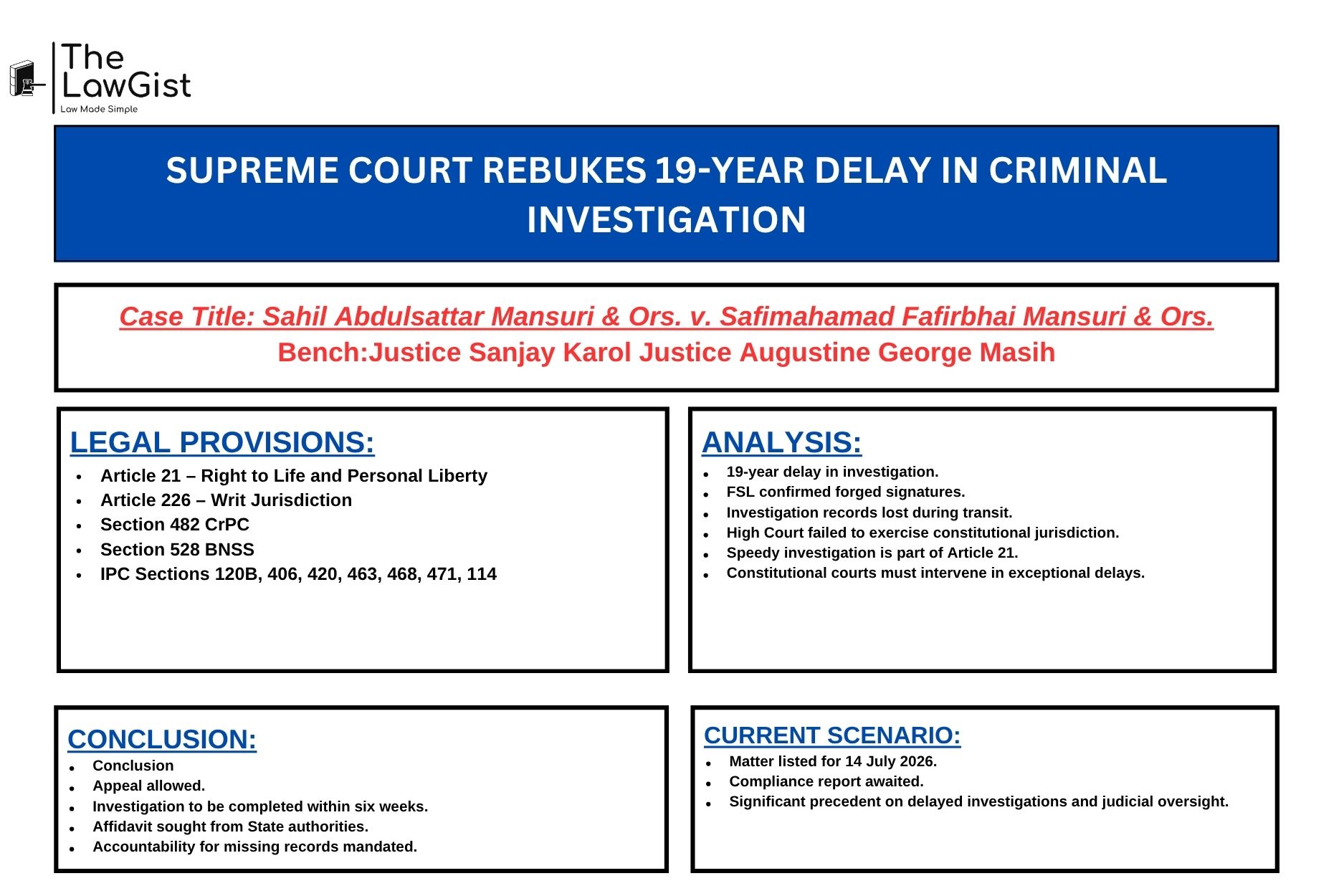
SUPREME COURT REBUKES 19-YEAR DELAY IN CRIMINAL INVESTIGATION
CASE SUMMARY – The Supreme Court in Sahil Abdulsattar Mansuri vs. Safimahamad Fafirbhai Mansuri addressed an extraordinary delay of nearly two decades in investigating allegations of forged property documents. The complainant repeatedly approached judicial authorities seeking completion of the investigation. Despite a forensic report indicating forged signatures, the investigation remained inconclusive due to the loss of records and administrative lapses. The Court held that speedy investigation is an essential component of Article 21 and criticized the High Court for failing to intervene. Directing completion of the investigation within six weeks, the Court reaffirmed the constitutional obligation to ensure timely and effective criminal justice.
| ASPECTS | DETAILS |
| Case Title | Sahil Abdulsattar Mansuri & Ors. vs. Safimahamad Fafirbhai Mansuri & Ors. |
| Introduction | The Supreme Court addressed an extraordinary case involving nearly two decades of delay in the investigation of a criminal complaint concerning alleged forgery and fraudulent transfer of property. The Court emphasized that prolonged investigation violates the constitutional right to speedy justice under Article 21. |
| Factual Background | The original complainant alleged that during his Haj pilgrimage in 2002, the accused forged his signatures and executed forged partition and sale deeds concerning Survey No. 761, Bhiloda Village. Criminal proceedings were initiated alleging offences under Sections 120B, 406, 420, 463, 468, 471 and 114 IPC. Despite multiple directions from the JMFC and the High Court, the investigation remained incomplete for nearly 19 years. The FSL report confirmed forged signatures, but investigation records were reportedly lost during transit. |
| Legal Issues | 1. Whether the High Court erred in refusing to exercise jurisdiction under Article 226 despite prolonged delay in investigation. 2. Whether constitutional courts should intervene when investigations remain pending for an unreasonable period. 3. Whether delay in investigation violates the right to speedy justice under Article 21. |
| Applicable Law | Constitution of India: Article 21, Article 226. IPC, 1860: Sections 120B, 406, 420, 463, 468, 471, 114. BNSS/CrPC: Section 528 BNSS / Section 482 CrPC. Precedent: Robert Lalchungnunga Chongthu v. State of Bihar (2025 SCC OnLine SC 2511). |
| Analysis | The Supreme Court held that the High Court should not have remained a passive observer when faced with an investigation pending for almost two decades. The Court reiterated that speedy investigation forms an integral part of the right to life and personal liberty under Article 21. The loss of case records and inability to trace witnesses could not justify indefinite pendency. Even if the investigation could not proceed, an appropriate closure report ought to have been filed before the JMFC. Constitutional courts have a duty to intervene where investigative delays undermine justice. |
| Conclusion | The Supreme Court allowed the appeal, set aside the High Court’s approach, and directed the State of Gujarat and Bhiloda Police Station to complete the investigation within six weeks and file an appropriate report before the JMFC. The State was also directed to file an affidavit explaining the loss of records, action taken against responsible officers, and compliance with the Court’s directions. |
| Current Scenario | The matter remains pending before the Supreme Court. Compliance affidavits have been sought from the State of Gujarat, and the matter has been listed as part-heard for 14 July 2026. The judgment reinforces judicial scrutiny over delayed investigations and strengthens the constitutional guarantee of speedy justice. |
“Constitutional courts cannot remain mute spectators when investigations remain pending for decades and justice is denied through delay.”
SOURCE – SUPREME COURT OF INDIA