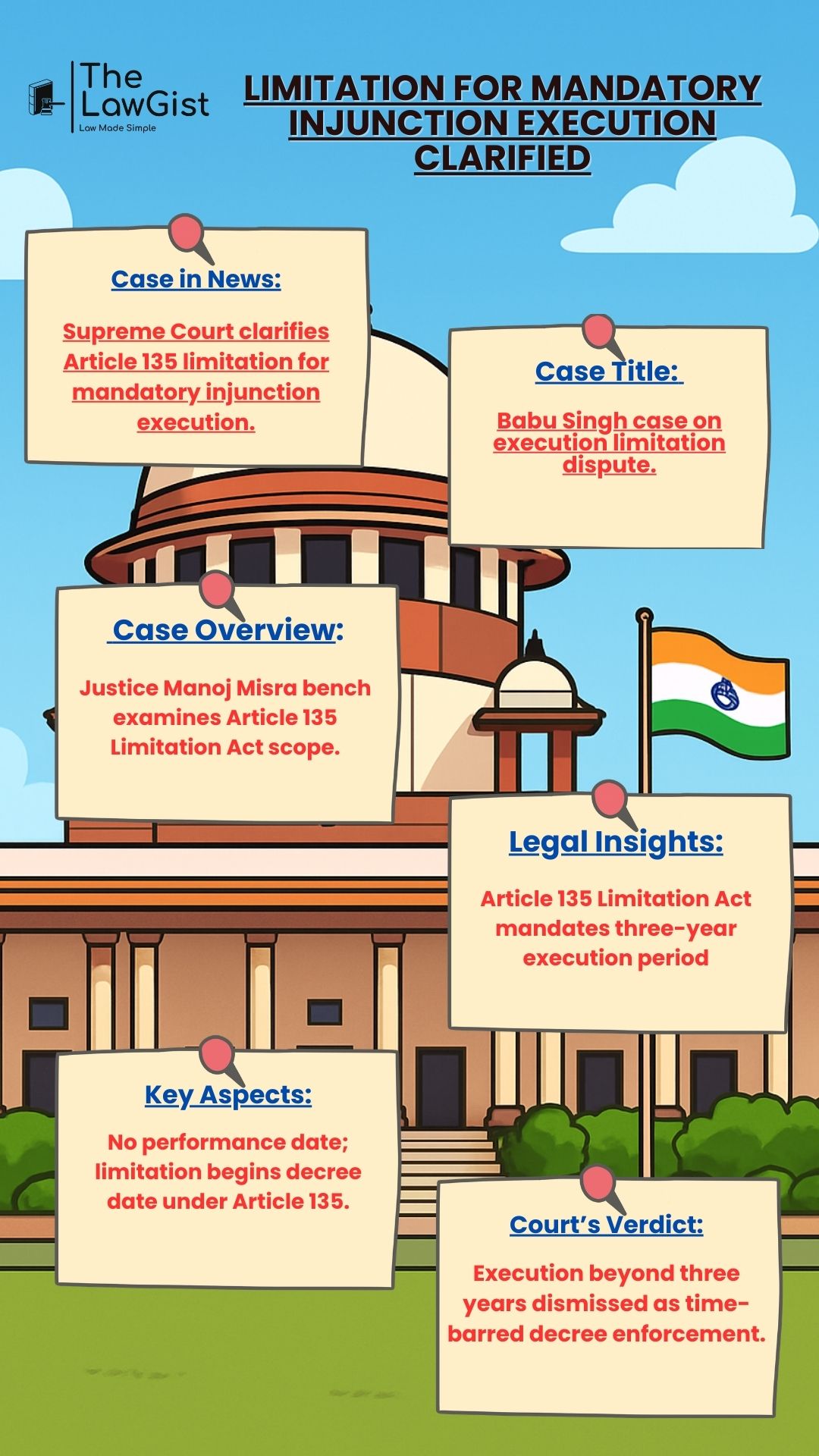
Supreme Court bench clarifies that Article 135 of Schedule To Limitation Act fixes three-year limitation from decree date when no performance date is specified.
Case in NewsLimitation For Mandatory Injunction Execution Clarified by Supreme Court of India under Article 135 Limitation Act. |
Discover powerful Latin Maxims and simplify complex legal terms in seconds.
Case Overview
Case Name: Babu w (D) Thr. Lrs & Anr. Versus Jalandhar Improvement Trust & Anr.
The Supreme Court of India bench comprising Justice Manoj Misra & Justice Manmohan examined whether an execution application filed for enforcement of a mandatory injunction decree was within limitation.
The 1st Appellate Court had granted a mandatory injunction on 06.01.2005 but did not specify any date for performance. The petitioners filed an execution application on 12.08.2010 seeking enforcement. The Executing Court dismissed it as time-barred a decision later affirmed by the High Court leading to the present appeal.
Key Aspects
The dispute centered on computation of limitation for executing a decree granting mandatory injunction. The core issue was whether limitation begins from the decree date or from a later date when no performance timeline is mentioned.
- Mandatory injunction decree passed on 6th January 2005.
- No specific date fixed for performance in decree.
- Execution application filed on 12th August 2010.
- The Executing Court dismissed the plea as barred by limitation .
- Question: When does limitation begin under Article 135 of Schedule To Limitation Act?
Legal Insights
The matter involved interpretation of limitation provisions governing execution of decree. The Court strictly applied statutory timelines.
Article 135 of Schedule To Limitation Act, 1963:
- Provides 3 years limitation for enforcing a mandatory injunction.
- Period begins from decree date or from date fixed for performance if specified.
Principle of Finality in Execution Proceedings:
- The Executing Court cannot travel beyond decree terms.
- Limitation statutes must be strictly construed.
Court’s Verdict
The Supreme Court of India upheld the dismissal of the execution application. It held that since no date was fixed for performance, limitation commenced from the date of decree. Filing beyond 3 years rendered the execution time-barred. The Court found no reason to interfere with the concurrent findings.
Source – Supreme Court of India
Read also-Legal Glossary- Injunction
The LawGist ensures exam success with quality notes—TPL, Current Affairs, Recent Judgments, and more. Backed by trusted resources and videos, The LawGist is every aspirant’s first choice.