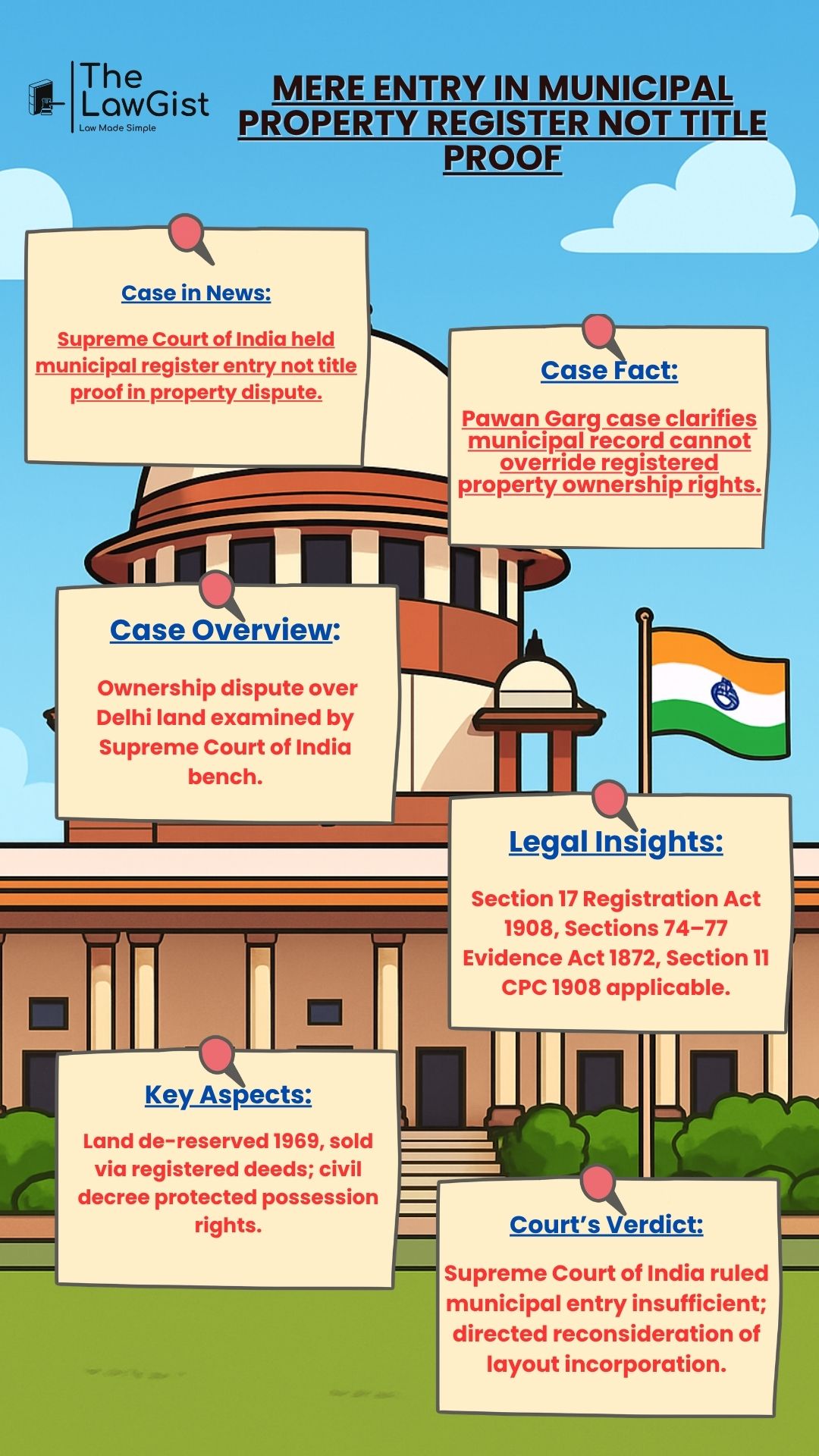
Case in NewsThe Mere Entry In Municipal Property Register Not Title Proof stated by the Supreme Court of India clarifies ownership disputes involving municipal records. |
Discover powerful Latin Maxims and simplify complex legal terms in seconds
Case Overview
Case Name: Pawan Garg & Ors. v. South Delhi Municipal Corporation
In the case of Pawan Garg & Ors. v. South Delhi Municipal Corporation the Supreme Court of India dealt with the question of whether entries in municipal property records could be treated as proof of ownership. The judgment was given by a bench comprising Justice Vikram Nath & Justice Sandeep Mehta.
The dispute related to approximately 1600 square yards of land located in Yusuf Sarai Jat, New Delhi. The land was initially reserved for construction of a high school in 1958 but was de-reserved in 1969 due to insufficient area. Subsequently, in 1975 the property was sold to private purchasers through registered sale deeds. Despite this the municipal authority continued to rely on entries in its property register to claim rights over the land leading to prolonged litigation.
Key Aspects
The dispute revolved around ownership rights over land & the evidentiary value of municipal records. The Court examined historical facts & prior judicial findings before arriving at its conclusion.
- The disputed land was reserved for a high school in 1958 but de-reserved in 1969.
- Private individuals purchased the land in 1975 through registered sale deeds.
- In 1988 a civil court granted a perpetual injunction protecting the possession of the owners.
- Appeals filed by the municipal authority were dismissed in 1992 making the decree final.
- In 2014 the municipal corporation rejected the owners’ request to incorporate the plots into the layout plan.
- The Delhi High Court Division Bench accepted the claim of corporation based on property register entries.
Legal Insights
The case shows the legal distinction between administrative records & legally recognized proof of ownership. The Supreme Court of India examined statutory provisions governing title & evidentiary value of documents.
- Section 17 of the Registration Act, 1908 – Mandates compulsory registration of documents like sale deeds transferring rights in immovable property making registered deeds primary proof of ownership.
- Sections 74 & 77 of the Indian Evidence Act, 1872 – Recognize public documents & allow their proof in court; however such records only carry evidentiary value and do not independently establish title.
- Section 11 of the Code of Civil Procedure, 1908 (Doctrine of Res Judicata) – Once a competent civil court decides an issue & the decision attains finality, the same issue cannot be reopened in subsequent proceedings.
- Section 38 of the Specific Relief Act, 1963 – Provides for grant of perpetual injunctions by civil courts to protect lawful possession & property rights of parties
Court’s Verdict
The Supreme Court of India allowed the appeal & set aside the Delhi High Court Division Bench judgment. The Court held that mere entry in municipal property records cannot establish legal title especially when registered sale deeds & civil court decrees exist.
Accordingly the Court directed the municipal corporation to reconsider the appellants’ request for incorporation of the plots into the colony layout plan within 60 days by passing a reasoned & speaking order.
Source – Supreme Court of India
Read also – Code of Civil Procedure, 1908
The LawGist ensures exam success with quality notes—TPL, Current Affairs, Recent Judgments, and more. Backed by trusted resources and videos, The LawGist is every aspirant’s first choice