CJI Surya Kant-led Bench questions pre-election freebies, stressing Article 14 equality and fiscal responsibility in welfare governance.
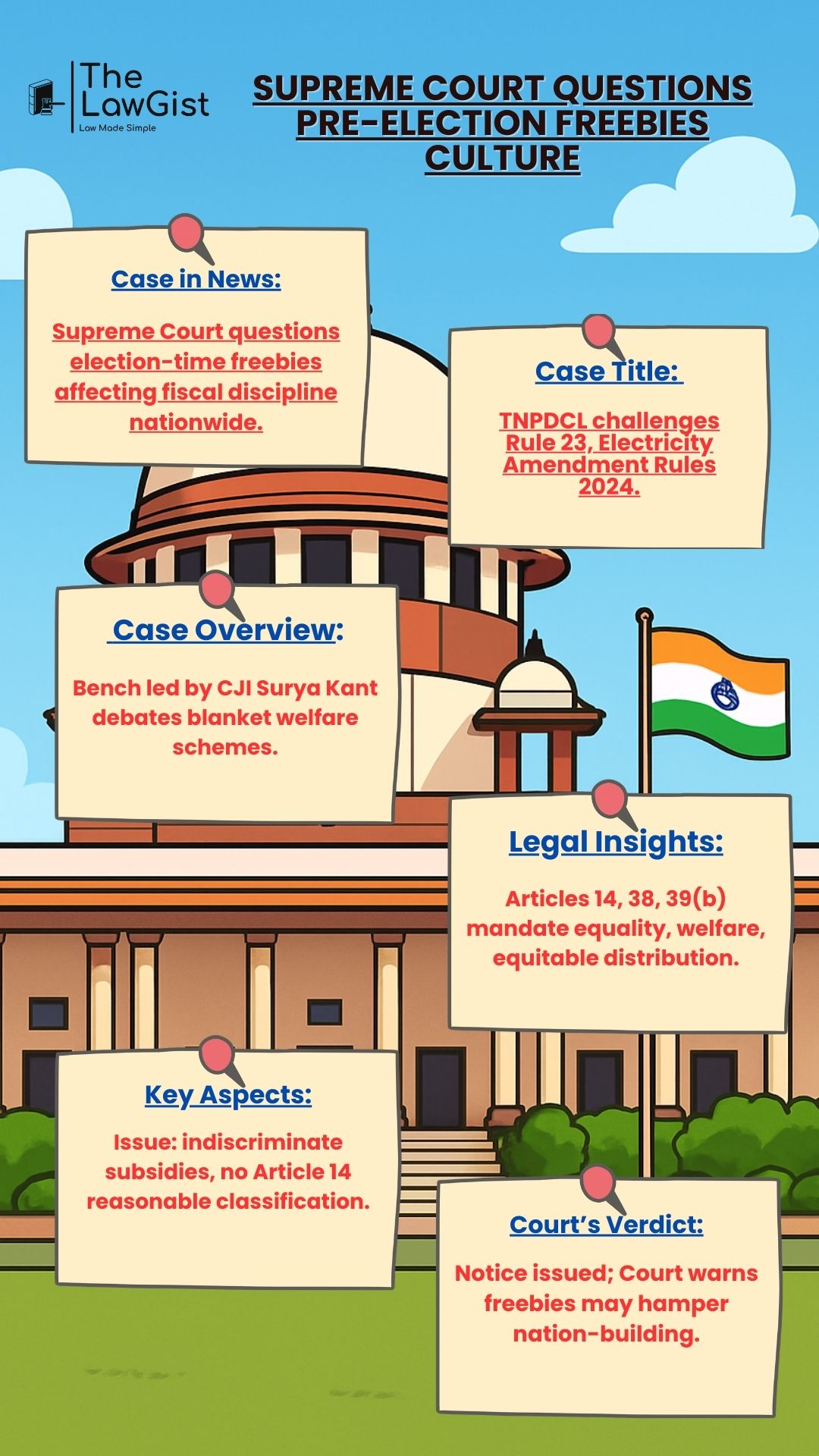
Case in NewsSupreme Court Questions Pre-Election Freebies Culture sparks national debate on fiscal discipline & welfare governance. |
Discover powerful Latin Maxims and simplify complex legal terms in seconds.
Case Overview
Case Name: Tamil Nadu Power Distribution Corporation Limited Vs Union Of India | W.P.(C) No. 158/2026
A Bench of the Supreme Court of India comprising Chief Justice of India Surya Kant, Justice Joymalya Bagchi & Justice Vipul Pancholi heard a writ petition filed by Tamil Nadu Power Distribution Corporation Limited challenging Rule 23 of the Electricity Amendment Rules, 2024.
During the hearing the Court made significant oral observations regarding the increasing culture of pre-election Freebies & direct cash transfer schemes. The Bench questioned whether indiscriminate welfare distribution without proper economic classification undermines fiscal stability & long-term nation-building.
Key Aspects
The matter primarily revolves around the constitutional validity & policy implications of State-sponsored welfare measures. The Court expressed concern about blanket distribution of benefits without distinguishing between economically weaker sections & affluent beneficiaries. It also questioned the financial sustainability of such schemes especially in deficit-running States.
- Challenge to Rule 23 of Electricity Amendment Rules, 2024 .
- State absorbing electricity bills across categories.
- Lack of economic classification between rich & marginalized consumers.
- Pre-election announcement of welfare schemes.
- Impact of direct cash transfers on employment & dignity of labour.
Legal Insights
The case raises important constitutional & fiscal questions concerning welfare governance. While India is a welfare state, benefits must align with constitutional principles of equality, reasonableness & responsible financial management.
- Article 14 of Constitution of India – Equality Before Law: Mandates reasonable classification; prohibits arbitrary distribution of State benefits.
- Article 38 – Promotion of Welfare of People: Directs the State to secure social, economic, and political justice.
- Article 39(b) – Distribution of Material Resources: Requires equitable allocation of resources for the common good.
- Doctrine of Public Interest & Fiscal Responsibility Principles: Emphasize sustainable governance and responsible public spending.
Court’s Verdict
The Supreme Court of India issued notice to the Union Government and agreed to examine the broader constitutional & policy implications. Though no final ruling was delivered the Bench led by Surya Kant cautioned that unchecked Freebies culture may hamper economic development & long-term nation-building.
SOURCE –
Read also – Constitution of India
The LawGist ensures exam success with quality notes—TPL, Current Affairs, Recent Judgments, and more. Backed by trusted resources and videos, The LawGist is every aspirant’s first choice.