 SUPREME COURT JUDGMENT ON PROMOTION RULES, APR/PMS & WORK REPORT ANALYSIS
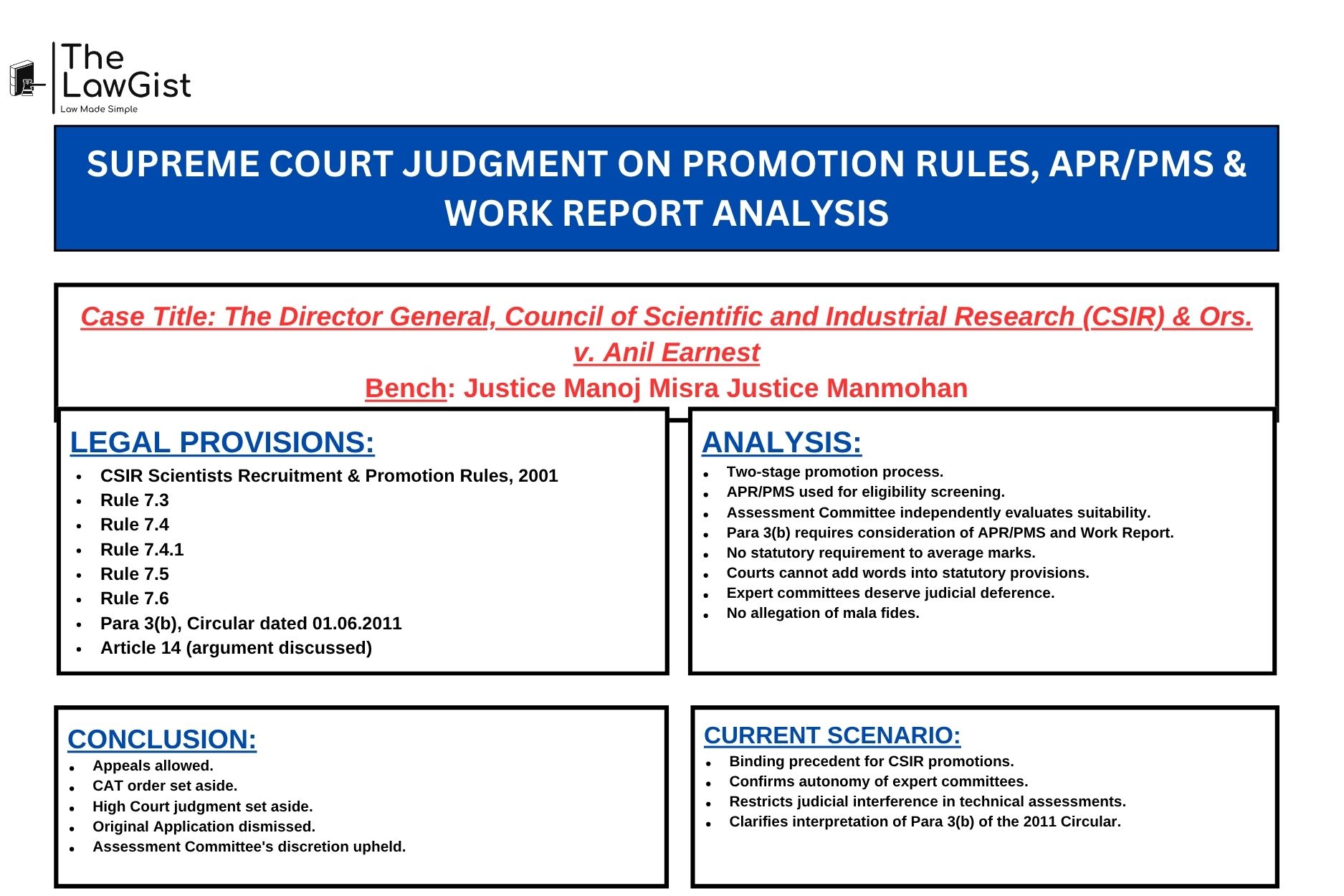
CASE SUMMARY – The Supreme Court in The Director General, CSIR vs. Anil Earnest held that the CSIR Scientists Recruitment & Promotion Rules, 2001 do not require averaging APR/PMS scores with Work Report marks while determining promotion. The Court clarified that APR/PMS scores primarily determine eligibility for assessment, whereas the Assessment Committee independently evaluates a candidate’s overall suitability using both APR/PMS and the Work Report. Since the Rules do not prescribe any averaging formula, courts cannot introduce one through interpretation. Upholding the discretion of expert committees, the Supreme Court set aside the Karnataka High Court and CAT decisions and dismissed the respondent’s claim for retrospective promotion.
| Particulars | Details |
| Case Title | The Director General, Council of Scientific and Industrial Research (CSIR) & Ors. vs. Anil Earnest |
| Introduction | The Supreme Court examined whether, under the CSIR Scientists Recruitment & Promotion Rules, 2001 as amended in 2011, the Assessment Committee must calculate the average of APR/PMS scores and Work Report marks while deciding promotion. The Court clarified the scope of discretion vested in expert assessment committees. |
| Factual Background | The respondent sought retrospective promotion as Senior Scientist from 2012/2013, claiming that his APR/PMS average exceeded 90%, while the Assessment Committee awarded only 82% based on his Work Report. CAT accepted his contention that averaging 92% and 82% would exceed the required 85% threshold. The Karnataka High Court substantially agreed and ordered a review DPC. CSIR challenged these decisions before the Supreme Court. |
| Legal Issues | 1. Whether Para 3(b) of the 2011 Circular requires averaging APR/PMS scores and Work Report marks.
2. Whether the Assessment Committee possesses discretion to determine promotion suitability. 3. Whether CAT and the High Court wrongly interpreted the promotion rules. |
| Applicable Law | • CSIR Scientists Recruitment & Promotion Rules, 2001
• Rules 7.3, 7.4, 7.4.1, 7.5, 7.6 • CSIR Circular dated 01.06.2011 (Para 3(b)) • Article 14 of the Constitution (argument raised by respondent). |
| Analysis | The Supreme Court held that Rule 7.4 governs screening through APR/PMS, while Rule 7.6 entrusts the Assessment Committee with evaluating suitability based on APR/PMS and Work Report. Para 3(b) merely requires consideration of both factors; it nowhere mandates averaging their numerical scores. Reading such a formula into the Rules amounts to judicial legislation. The Court emphasized that expert committees possess discretion in technical evaluations and courts should avoid substituting their own assessment in the absence of mala fides or statutory violation. |
| Conclusion | The Supreme Court allowed the appeals, set aside the judgments of CAT and the Karnataka High Court, and dismissed the respondent’s Original Application. The Court ruled that the Assessment Committee’s expert evaluation could not be replaced by a mathematical averaging formula not contemplated by the Rules. |
| Current Scenario | This judgment is the governing precedent on interpreting CSIR promotion rules. It reinforces judicial restraint in matters involving expert evaluation and clarifies that promotion committees are not bound to average APR/PMS and Work Report scores unless the governing rules expressly require it. |
“Courts cannot add words to statutory provisions merely because a different interpretation appears more equitable.”
SOURCE – SUPREME COURT OF INDIA