
The Supreme Court’s 2026 bail verdict in the Delhi riots case highlights the ongoing tension between national security laws and personal liberty.
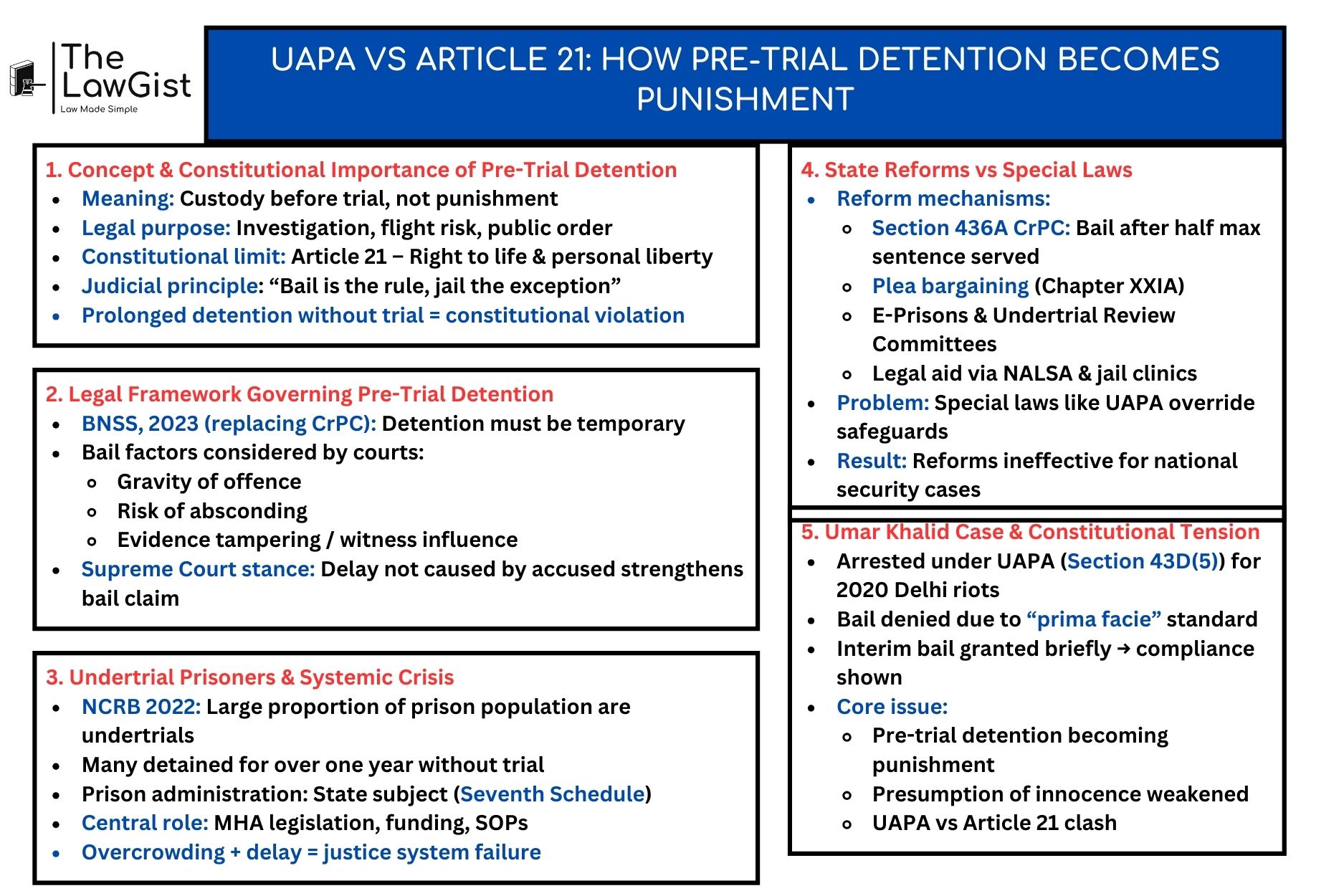
WHY PRE-TRIAL MATTERSPre-trial detention keeps accused people in jail before their trial starts. Indian law allows it to aid investigations, stop suspects from fleeing, or protect public order. But when it drags on without a trial, it clashes with basic rights to life and liberty under Article 21 of the Constitution.Umar Khalid’s case highlights this tension. Arrested under the tough Unlawful Activities (Prevention) Act, 1967 (UAPA) for the 2020 Delhi riots, he’s been in jail for years without his trial beginning. This article breaks down the rules, stats, reforms, and why his story reflects bigger problems in India’s justice system. |
THE BASIS OF PRE-TRIAL DETENTION
The Bharatiya Nagarik Suraksha Sanhita, 2023 (BNSS)—now replacing the CrPC since July 1, 2024—keeps pre-trial jail as temporary, not punishment. Supreme Court rule: bail first, jail only if needed, especially with delays. Courts check crime severity, flight risk, evidence tampering, or witness threats.
Courts weigh key factors before jailing someone pre-trial:
- How serious is the crime?
- Will the accused run away or tamper with evidence?
- Could they influence witnesses?
Long detention without the accused’s fault violates Article 21. It’s not just theory—the courts enforce this.
The Undertrial Crisis Nationwide
Millions languish as undertrial prisoners—people awaiting trial. National Crime Records Bureau (NCRB) data from “Prison Statistics India 2022” shows thousands detained over a year by December 31, 2022, with full state-wise breakdowns in PIB reports.
Prisons are a state matter (Entry 4, List II, Seventh Schedule), so states run them. But the central Ministry of Home Affairs steps in with laws and support.The legal context in India has rolled out real fixes for undertrials:
- Section 436A, CrPC: Bail after half the maximum sentence if you’ve served that much pre-trial. It protects liberty head-on.
- Plea Bargaining (Chapter XXIA, CrPC): Negotiate a deal pre-trial (Sections 265A–265L) to cut jail time and clear backlogs.
- E-Prisons and Review Committees: Digital tools flag eligible undertrials; committees check bail options.
- Legal Aid Boost: The 2016 Model Prison Manual covers lawyer access and free aid. State Legal Services Authorities run jail clinics; NALSA runs awareness on bail and rights, plus SOPs for review committees shared by the Ministry of Home Affairs.
These help, but special laws like UAPA often override them.
UAPA’s Tough Bail Rules
UAPA flips normal bail logic. Section 43D(5) blocks bail if the court sees a prima facie case from the charge sheet or case diary—no deep evidence dive needed.
This means:
- Bail hearings stay shallow.
- The bar for denying bail is low.
- People stay locked up while trials crawl.
The Supreme Court upholds it but warns of Article 21 risks from endless delays.
DELHI RIOTS CONSPIRACY CASE 2020
As per the AIR report , riots in February 2020 amid CAA-NRC protests killed 53 and injured over 700. Delhi Police calls it a planned attack on India’s security, filing a “larger conspiracy” case under UAPA. They finger Umar Khalid, Sharjeel Imam, and others as key planners.
Arrested September 13, 2020, on IPC and UAPA charges. Evidence cited: an Amravati speech, WhatsApp chats, protected witness statements.A 2022 acquittal in a related stone-pelting case slammed police witnesses, but it didn’t touch the main case. In December 2025, he got 14 days’ interim bail for his sister’s wedding and returned on time.
Trial courts and Delhi High Court denied bail under Section 43D(5). In a key development, the Supreme Court on January 5, 2026, ruled on bail pleas in the alleged larger conspiracy case linked to the 2020 North-East Delhi riots.
As per Press Trust of India report – The Court denied bail to Umar Khalid and Sharjeel Imam, holding that they stand on a “qualitatively different footing”, while granting conditional bail to five co-accused under 12 strict conditions.
The Court reiterated that Article 21 and personal liberty are central, but upheld UAPA’s stringent bail framework, noting Parliament’s intent in national security cases. It directed that the trial proceed without delay, particularly the examination of protected witnesses, and allowed Khalid and Imam to seek bail after one year or upon completion of key witness examination.
The ruling reflects the enduring tension between liberty and security, where prolonged pre-trial detention remains permissible under UAPA if a prima facie case exists.
What It Means for the Constitution
Does UAPA’s strict bail rule square with Article 21 when trials never start? Years in jail without a verdict turns “pre-trial” into punishment, eroding innocence until proven guilty.
CONCLUSION
Umar Khalid’s saga shows how special laws strain India’s balance between security and freedom. The state must probe serious crimes, but not at liberty’s endless cost. How courts resolve this will shape bail, detention, and rights for years ahead.
“Prolonged pre-trial detention tests the constitutional promise of personal liberty.”
SOURCE
READ ALSO –
- SECTION 479 BNSS TO UNDERTRIALS CASES REGISTERED BEFORE JULY 1 2024 ALLOWED BY SC
- Section 436A, CrPC
- Plea Bargaining
- Article 21
Discover insighs on Latin Maxims and Legal Glossary and simplify complex legal terms in seconds.The LawGist ensures exam success with quality Blogs and Articles on — Top Legal Picks (TLP), Current Affairs, latest Supreme Court judgments as Courtroom Chronicles. Backed by trusted resources and videos, The LawGist is every Professionals and Aspirant’s first choice. Discover more at thelawgist.org


