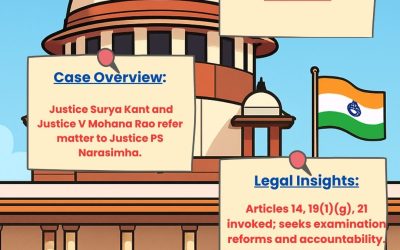
The Supreme Court will hear a crucial case on March 18 to decide if the Lokpal can investigate sitting high court judges, a decision that could impact judicial independence.
Headline
The Supreme Court to Review Lokpal’s Authority Over Sitting High Court Judges on March 18
Summary
On March 18, the Supreme Court will commence hearings in the case it registered on its own motion on the question regarding the powers of Lokpal to look into complaints against sitting judges of high courts. The matter will be examined by a three-pronged bench consisting of Justice B R Gavai and other members of the court who stayed it previously due to the reasons pertaining to the independence of the judiciary. This case has arisen because of an order issued by the Lokpal on January 27, in which it forwarded complaints against a judge of a high court to the Chief Justice of India. The contention of the Centre is that the Lokpal and Lokayuktas Act 2013, does not apply to judges of high courts.
Key Aspects
- The matter before the Supreme Court is the question of whether the Lokpal can receive complaints against high court judges who are sitting members of that court.
- The Lokpal had, at its instance, directed that two complaints against an additional high court judge be sent to the Chief Justice of India.
- The complaints allege judicial misconduct in that the judge unduly influenced decision-making in favor of a private company he previously represented as a lawyer.
- The order passed by the Lokpal regarding the issue has been put on hold by the Apex Court, which also mentioned it “very, very disturbing.
- The major concern that this case has arisen is about the independence of the judiciary versus accountability.
Legal Insights
- Scope of Lokpal’s Authority: The Lokpal and Lokayuktas Act, 2013, primarily deals with complaints against public servants, but its applicability to sitting judges is contested.
- Section 14(1)(f) of the Act: The Lokpal held that high court judges fall within the definition of “any person” under this section, a view challenged by the Centre.
- Judicial Independence: The Supreme Court’s intervention highlights the judiciary’s concern about external bodies reviewing judicial conduct.
- Precedent on Judicial Accountability: Previous rulings suggest that complaints against judges should be addressed through in-house mechanisms under the Supreme Court’s oversight.
Impact
- There is a potential for a different balance of judicial accountability and independence to be created in the wake of the ruling.
- Should the Supreme Court affirm the Lokpal’s purview, the ruling might establish a precedent for future inquiries into sitting judges.
- On the flip side, a ruling against the Lokpal’s jurisdiction might strengthen the independence of the judiciary but sharpen issues of oversight and accountability.
- This case may result in changes to the law that could lay down the jurisdiction of the Lokpal concerning the judiciary.
Why It Matters
- This case brings the very heart of judicial integrity and transparency under attack.
- The ruling of the Supreme Court will clarify the ambit of Lokpal in considering complaints against the higher judiciary.
- The result may have wider implications on the dialogue regarding reforms in judicial oversight mechanisms in India.
Also Read: BENGALURU GOLD SMUGGLING CASE: RANYA RAO’S BAIL DENIED