Supreme Court demands immediate notification of Cashless Treatment Scheme for Road Accident Victims under Motor Vehicles Act.
Case in News:
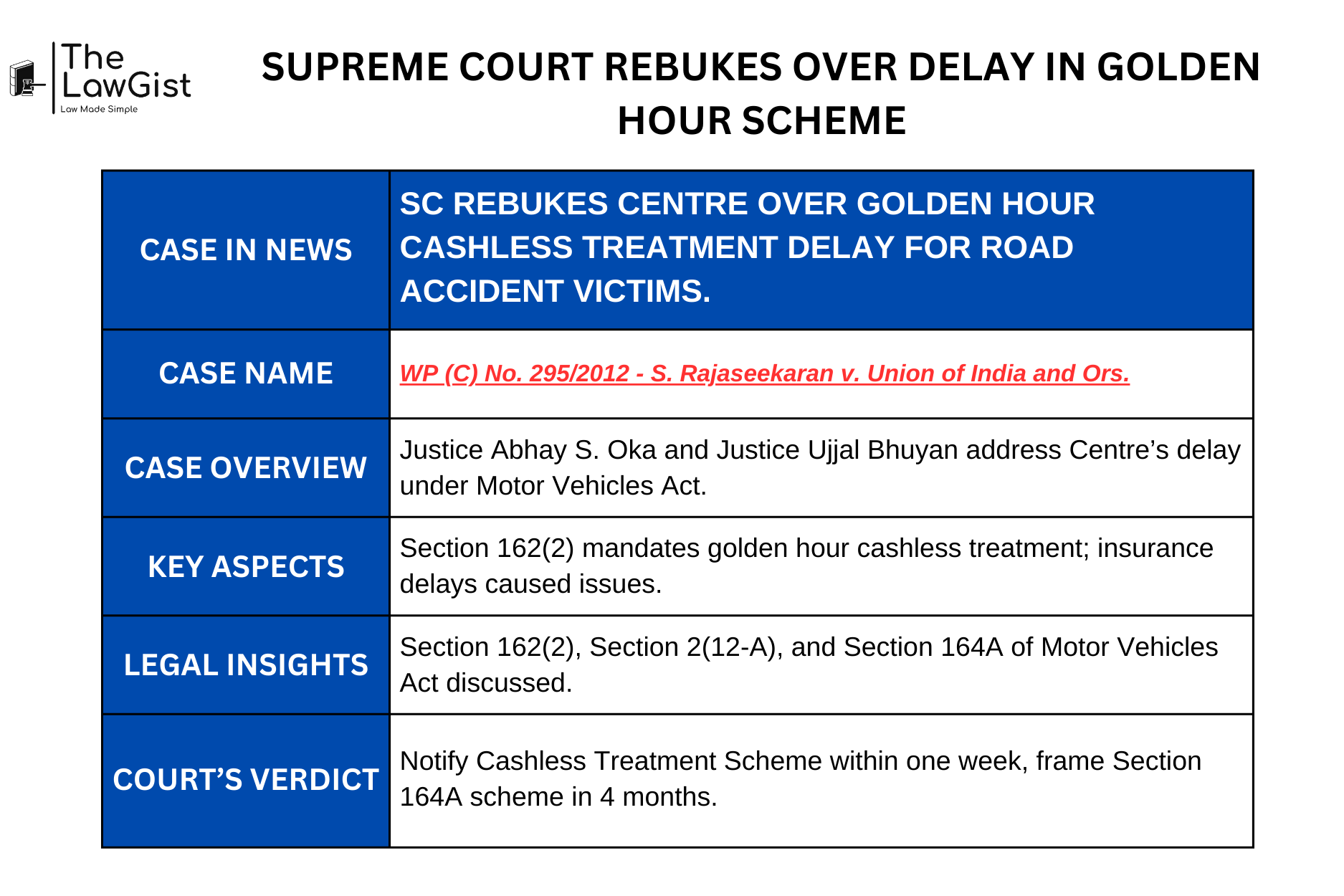
Supreme Court of India rebukes Centre for delay in implementing Cashless Treatment Scheme for Road Accident Victims.
Case Overview:
Case Name: S. Rajaseekaran v. Union of India and Ors.
The Supreme Court of India comprising Justice Abhay S. Oka and Justice Ujjal Bhuyan addressed the delay of the centre in implementing the Cashless Treatment Scheme under the Motor Vehicles Act . Despite Section 162(2) being in force since 1st April 2022 the government had not framed the mandatory scheme for Road Accident Victims . The Supreme Court summoned the MoRTH Secretary who assured compliance within 1 week and tendered an apology for non-compliance .
Key Aspects:
- Section 162(2) of the Motor Vehicles Act mandates a scheme for cashless treatment during the “golden hour .”
- Despite the law being operational from 2022 the scheme was delayed due to insurance related issues .
- Justice Abhay S. Oka condemned the Centre for risking lives despite highway expansions .
- GIC’s disagreement over fund disbursement was a major problem .
Legal Insights :
- Section 162(2), Motor Vehicles Act : Cashless treatment for Road Accident Victims during the “golden hour .”
- Section 2(12-A), Motor Vehicles Act : Explains “golden hour.”
- Section 164A, Motor Vehicles Act : Interim relief for accident claimants and scheme pending for 3 years.
Court’s Verdict:
The Supreme Court of India ordered that the Cashless Treatment Scheme must be notified within 1 week. Further it ordered that the scheme under Section 164A be framed within 4 months . The Supreme Court criticised the prolonged delay and stressed the requirement for immediate action to save lives of Road Accident Victims .
Source