Supreme Court Bench led by CJI Surya Kant proposes closing decades-old MC Mehta environmental PILs while restructuring applications under Articles 32 and 142.
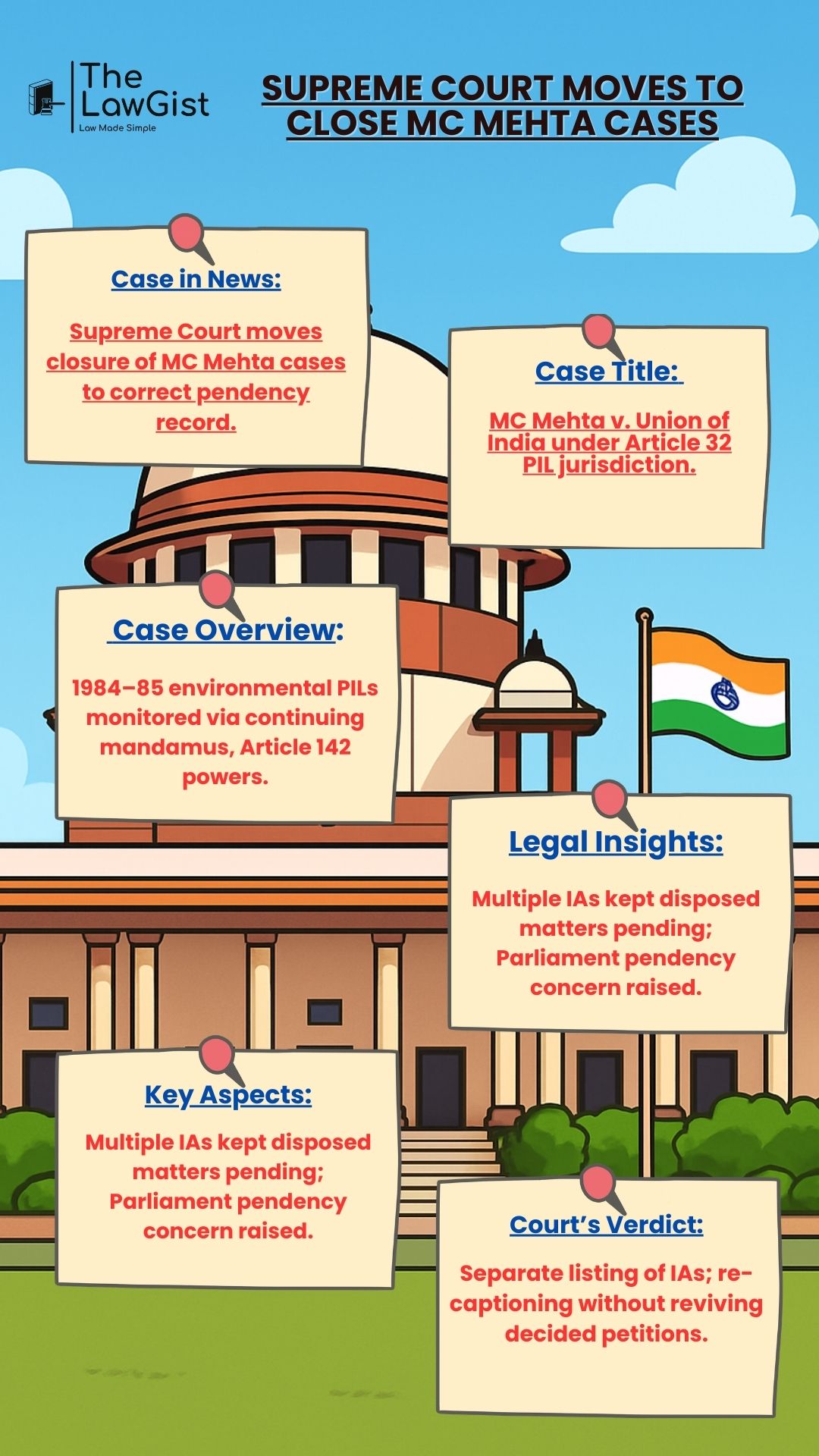
Case in NewsSupreme Court Moves To Close MC Mehta Cases to avoid misleading pendency impression regarding the case. |
Discover powerful Latin Maxims and simplify complex legal terms in seconds.
Case Overview
Case Name: MC Mehta v. Union of India, W.P.(C) No. 13381/1984 and connected matters
A Bench of the Supreme Court of India comprising CJI Surya Kant, Justice Joymalya Bagchi & Justice Vipul Pancholi considered the long-pending MC Mehta Case matters filed in 1984–85. Though the substantive grievances in the environmental PILs were resolved decades ago the petitions remained pending due to continuous interim applications. These matters broadly relate to Environmental Issues in Delhi-NCR, land ceiling disputes & protection of the Taj Trapezium Zone. The Court noted that repeated listings created an impression that 40-year-old cases were still undecided raising concerns when pendency data is shared with Parliament.
Key Aspects
The Court examined the procedural handling of decades-old PILs & the continued listing. The issue was not about unresolved disputes but about administrative & judicial propriety in maintaining old captions.
- Multiple writ petitions titled MC Mehta v. Union of India (Delhi Air Pollution Matter) pending since 1984–85 .
- Original writs substantially decided; fresh IAs/MAs kept matters alive .
- Continuous monitoring of environmental compliance in Delhi & Taj Trapezium Zone.
- Concern over misleading pendency records before Parliament.
- Proposal to list applications separately without reviving old petitions .
Legal Insights
The matter showcases procedural discipline in Public Interest Litigation (PIL) jurisdiction. It reflects judicial powers to regulate listings & prevent misuse of continuing mandamus.
- Article 32 of Constitution of India –Empowers filing of PILs for enforcement of fundamental rights.
- Article 142 of Constitution of India -Grants plenary powers to pass orders for complete justice.
- Doctrine of Continuing Mandamus– Allows courts to monitor compliance in environmental matters .
Court’s Verdict
The Supreme Court of India directed that all pending applications in the MC Mehta Case matters be listed separately on different dates. Counsels were asked to suggest re-captioning mechanisms without reviving disposed matters & to explore referring appropriate issues to jurisdictional High Courts . The Bench indicated that the matters may be formally closed to avoid incorrect pendency impressions.
Source – Supreme Court of India
Read also – Constitution of India
The LawGist ensures exam success with quality notes—TPL, Current Affairs, Recent Judgments, and more. Backed by trusted resources and videos, The LawGist is every aspirant’s first choice.