Supreme Court lays down four-step test under Section 482 CrPC to quash false complaint and protect against vexatious proceedings.
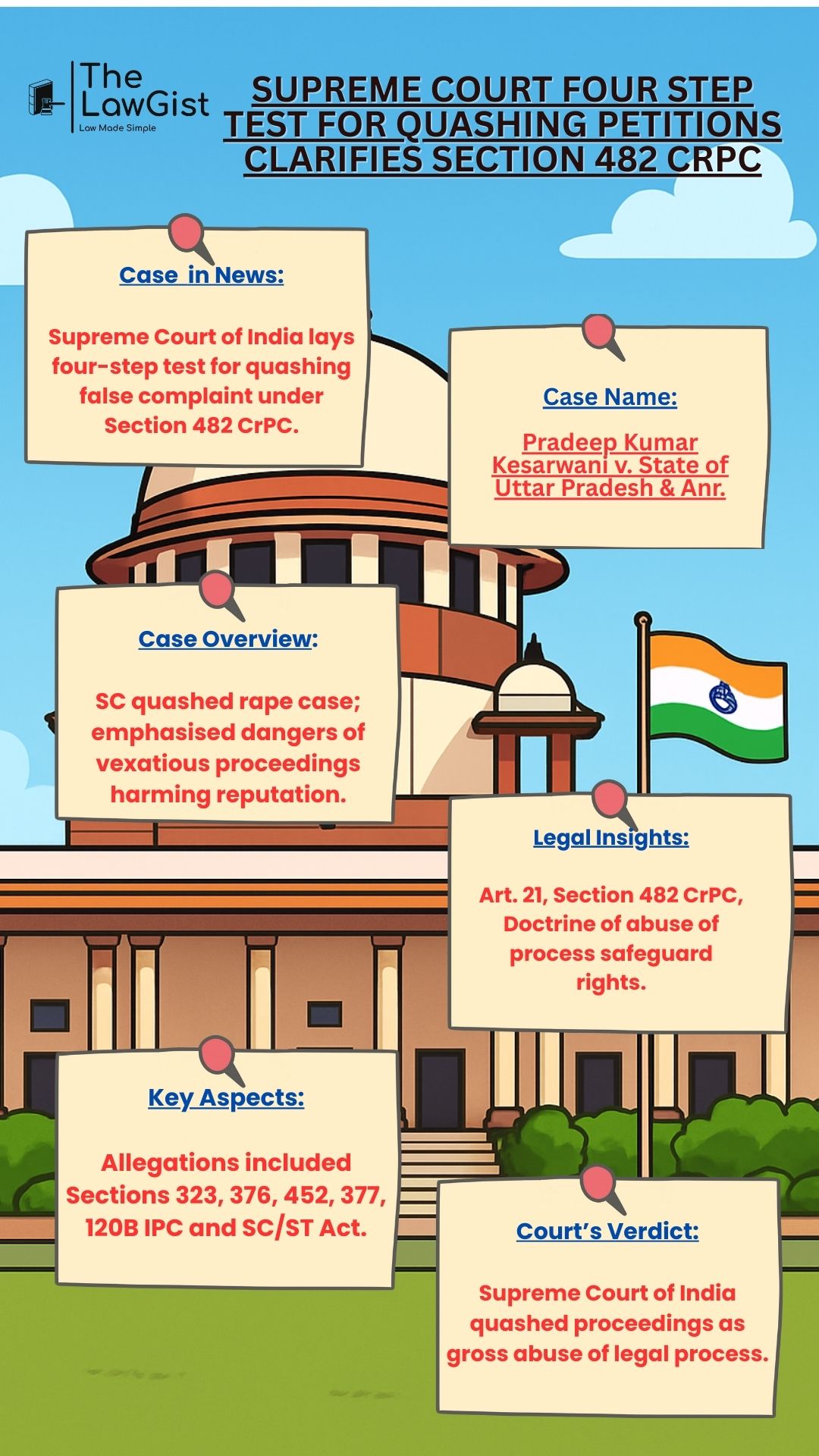
Case in NewsThe Supreme Court of India in supreme court four step test for quashing petitions addressed false complaint and vexatious proceedings under Section 482 CrPC . |
Discover powerful Latin Maxims and simplify complex legal terms in seconds.
Case Overview
Case Name: Pradeep Kumar Kesarwani vs. The State of Uttar Pradesh & Anr.
A Bench of Justice JB Pardiwala and Justice Sandeep Mehta of the Supreme Court of India quashed criminal proceedings against a man accused of rape on the false pretext of marriage . The Court observed that summoning a person on the basis of a false complaint is a serious matter that can tarnish an individual’s reputation . The matter arose from an Allahabad High Court refusal to quash charges framed under various IPC sections and the SC/ST Act .
Step into the world of justice with Courtroom Chronicles.
Key Aspects
Before framing its directions, the Court noted the significance of preventing misuse of law . It emphasised that continuation of vexatious proceedings is a gross abuse of process .
- The woman alleged rape, blackmail and caste-based abuse .
- FIR cited Sections 323, 376, 452, 377, 120B IPC and SC/ST Act .
- Magistrate took cognizance under Section 202 CrPC and summoned the accused .
- The Supreme Court found the complaint vague, missing key details and unsupported by evidence .
Legal Insights
The Court laid down a four-step test for High Courts exercising inherent powers under Section 482 CrPC :
- Article 21, Constitution of India – protects dignity, prevents harassment through false complaint .
- Section 482 CrPC (now Section 528 BNSS) – empowers courts to quash abuse of process .
- Doctrine of abuse of process – prevents wastage of judicial time .
- Judicial conscience must guide quashing of vexatious proceedings .
Court’s Verdict
The Supreme Court of India quashed the criminal proceedings holding that continuation would serve no justice and only perpetuate harassment . It also criticised dragging the accused’s parents into the case .
Source – Supreme Court of India
Read also – Constitution of India
The LawGist ensures exam success with quality notes—TPL, Current Affairs, Recent Judgments, and more. Backed by trusted resources and videos, The LawGist is every aspirant’s first choice. Discover more at thelawgist.org.