SUPREME COURT CLARIFIES TERRITORIAL JURISDICTION AND TRANSFER OF PMLA PROCEEDINGS
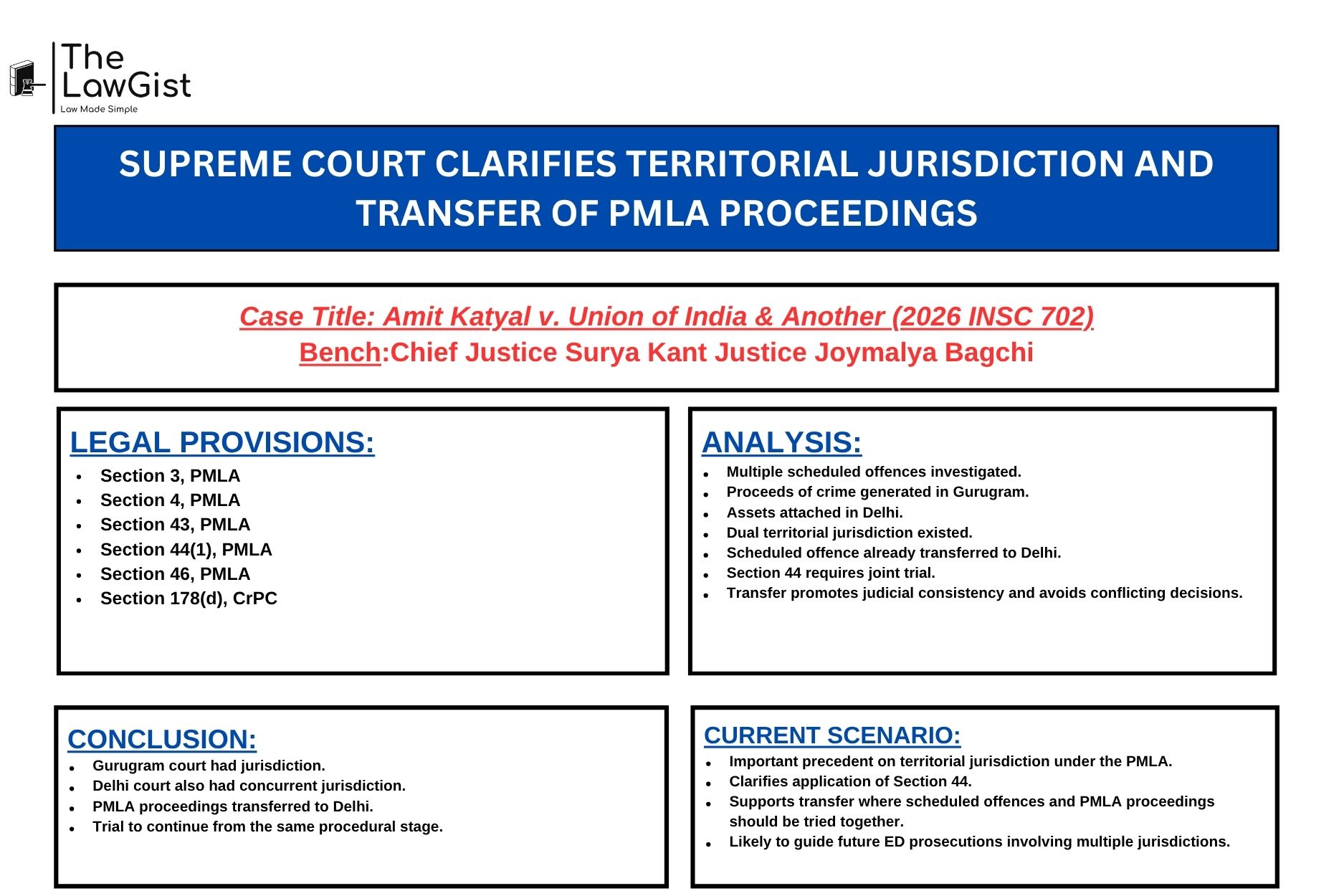
CASE SUMMARY – The Supreme Court in Amit Katyal vs. Union of India & Another (2026) considered a request to transfer a money laundering prosecution from Gurugram to Delhi. Although the petitioner initially sought quashing of the proceedings, the challenge was confined to transfer. The Court held that both Gurugram and Delhi possessed territorial jurisdiction because proceeds of crime originated in Gurugram while certain attached assets were located in Delhi. Since the connected scheduled offence had already been transferred to Delhi, Section 44(1) of the Prevention of Money Laundering Act required the connected PMLA case to be tried there. Accordingly, the Court ordered transfer of the proceedings.
| Heading | Details |
| Case Title | Amit Katyal vs. Union of India & Another |
| Introduction | The Supreme Court considered whether a prosecution under the Prevention of Money Laundering Act, 2002 (PMLA) pending before the Special Court at Gurugram should be transferred to the Special Court at Delhi. The petitioner abandoned the prayer for quashing the PMLA proceedings and sought only transfer of the case. |
| Factual Background | The petitioner was a promoter of Krrish Realtech Pvt. Ltd., which developed the ‘Krrish World’ project in Gurugram. Multiple FIRs alleging cheating of homebuyers led to registration of an ECIR by the Enforcement Directorate. During investigation, additional scheduled offences surfaced, including FIR No. 439/2024. The prosecution alleged diversion of nearly ₹503 crore from homebuyers through shell companies, including transfers to Sri Lanka. Properties and proceeds of crime were attached in both Gurugram and Delhi. |
| Legal Issues | 1. Whether the Special Court at Gurugram had territorial jurisdiction over the PMLA proceedings. 2. Whether simultaneous jurisdiction existed in Delhi and Gurugram. 3. Whether the PMLA proceedings should be transferred to Delhi after the connected scheduled offence was transferred there. |
| Applicable Law | • Sections 3, 4, 43, 44 & 46 of the Prevention of Money Laundering Act, 2002. • Section 178(d), Code of Criminal Procedure, 1973. • Rana Ayyub v. Directorate of Enforcement (2023) 4 SCC 357. • KA Rauf Sherif v. Directorate of Enforcement (2023) 6 SCC 92. |
| Analysis | The Court held that money laundering is a continuing offence involving several processes such as acquisition, concealment, possession and projection of proceeds of crime. Since proceeds of crime were generated in Gurugram and some assets were attached in Delhi, both Special Courts possessed territorial jurisdiction. Considering that the connected scheduled offence had already been transferred to Delhi, Section 44(1) of the PMLA required both the scheduled offence and the money laundering case to be tried by the same Special Court. Therefore, transfer was necessary to avoid conflicting proceedings and to serve the ends of justice. |
| Conclusion | The Supreme Court transferred the pending PMLA prosecution from the Special Judge, PMLA, Gurugram, to the Special Judge, PMLA, Saket Court Complex, Delhi, where proceedings would continue from the existing stage. |
| Current Scenario | This judgment reinforces that multiple Special Courts may simultaneously possess territorial jurisdiction under the PMLA where different components of the money laundering offence occur. However, where the scheduled offence is transferred to another jurisdiction, the connected PMLA prosecution may also be transferred to ensure compliance with Section 44(1) of the PMLA and judicial efficiency. |
“Where proceeds of crime span multiple jurisdictions, judicial consistency demands that connected scheduled offences and PMLA prosecutions be tried before the same Special Court.”
SOURCE – SUPREME COURT OF INDIA