SUPREME COURT UPHOLDS CORPORATE GUARANTEE AS FINANCIAL DEBT
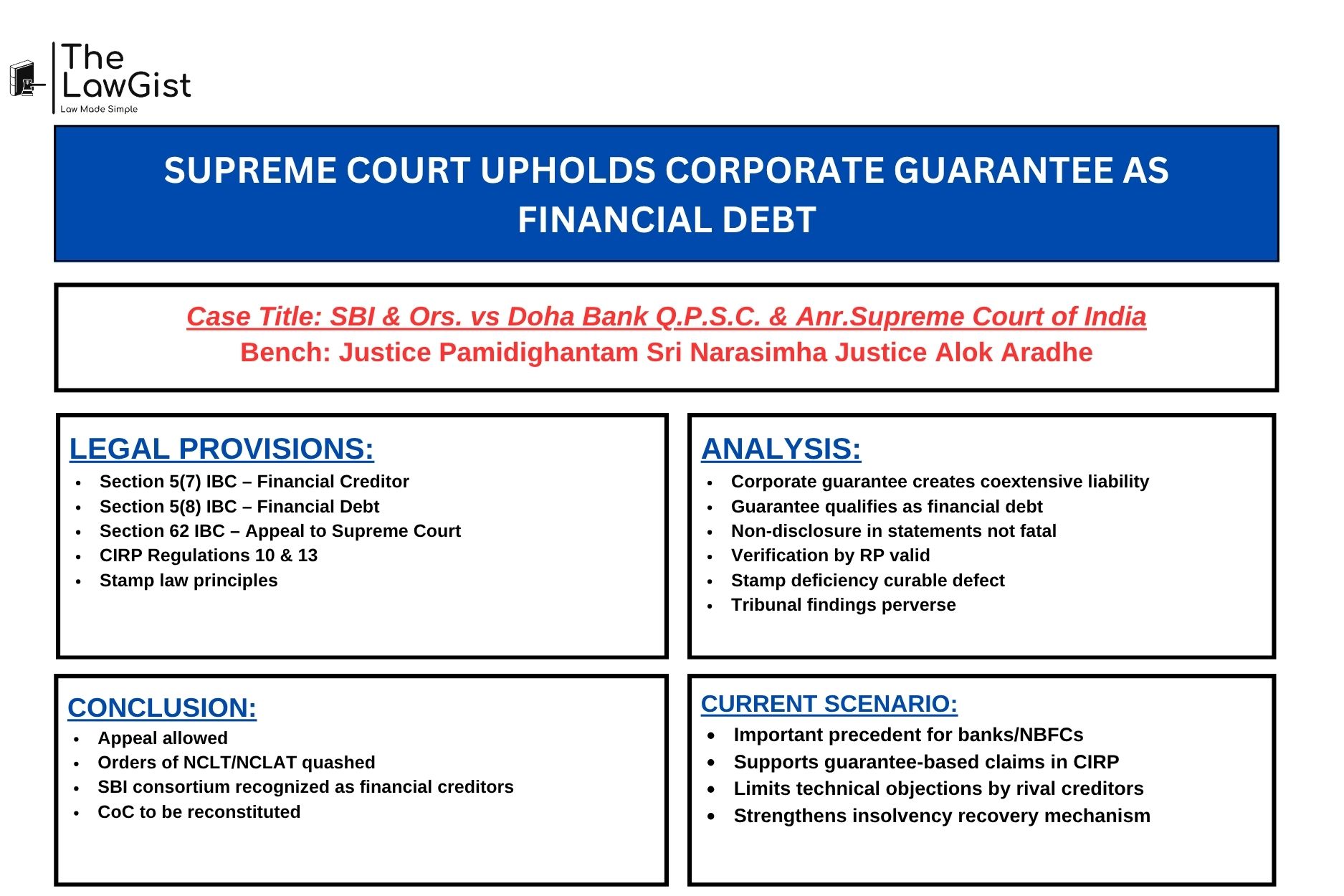
CASE SUMMARY – The Supreme Court in State Bank of India & Ors. vs. Doha Bank Q.P.S.C. & Anr. held that corporate guarantees executed by Reliance Infratel Limited in favour of consortium lenders created “financial debt” under Section 5(8) of the Insolvency and Bankruptcy Code, 2016. The Court found that NCLT and NCLAT wrongly rejected the lenders’ claims on grounds of non-disclosure, timing, verification, and stamp duty objections. It ruled that insufficient stamping is a curable defect and cannot invalidate guarantees. The Court restored the appellants as financial creditors, directed reconstitution of the Committee of Creditors, and allowed the appeal.
| ASPECTS | DETAILS |
| Case Title | State Bank of India & Ors. vs. Doha Bank Q.P.S.C. & Anr. |
| Introduction | This Supreme Court case examined whether corporate guarantees issued by a corporate debtor in favour of lenders qualify as financial debt under the Insolvency and Bankruptcy Code, 2016. |
| Factual Background | Doha Bank gave USD 250 million loan to Reliance Infratel Ltd. SBI consortium separately lent funds to Reliance Communications Ltd. and Reliance Telecom Ltd. Reliance Infratel executed corporate guarantees in favour of consortium lenders. CIRP was initiated against Reliance Infratel. Doha Bank objected to recognition of consortium lenders as financial creditors. |
| Legal Issues | 1. Whether corporate guarantees constitute financial debt under Section 5(8) IBC. 2. Whether claims could be rejected for improper filing/verification. 3. Whether SC should interfere with concurrent findings of NCLT/NCLAT. |
| Applicable Law | Section 5(7), 5(8), 62 IBC; CIRP Regulations 10 & 13; principles relating to stamp duty and guarantees; Companies Act arguments raised. |
| Analysis | SC held liability arising from guarantee is financial debt. Non-disclosure in accounts does not destroy creditor rights. RP validly verified documents. Insufficient stamping is curable and does not void the instrument. NCLT/NCLAT findings were perverse. |
| Conclusion | Supreme Court allowed the appeal, set aside NCLT/NCLAT orders, recognized consortium lenders as financial creditors, and ordered reconstitution of CoC. |
| Current Scenario | This judgment strengthens lender rights in insolvency matters and confirms enforceability of corporate guarantees despite technical objections. It is a major precedent under IBC. |
“A corporate guarantee creates enforceable coextensive liability and constitutes financial debt under Section 5(8) of the IBC.”
SOURCE – SUPREME COURT OF INDIA