SUPREME COURT ON PARA TEACHERS REGULARISATION UNDER SSA
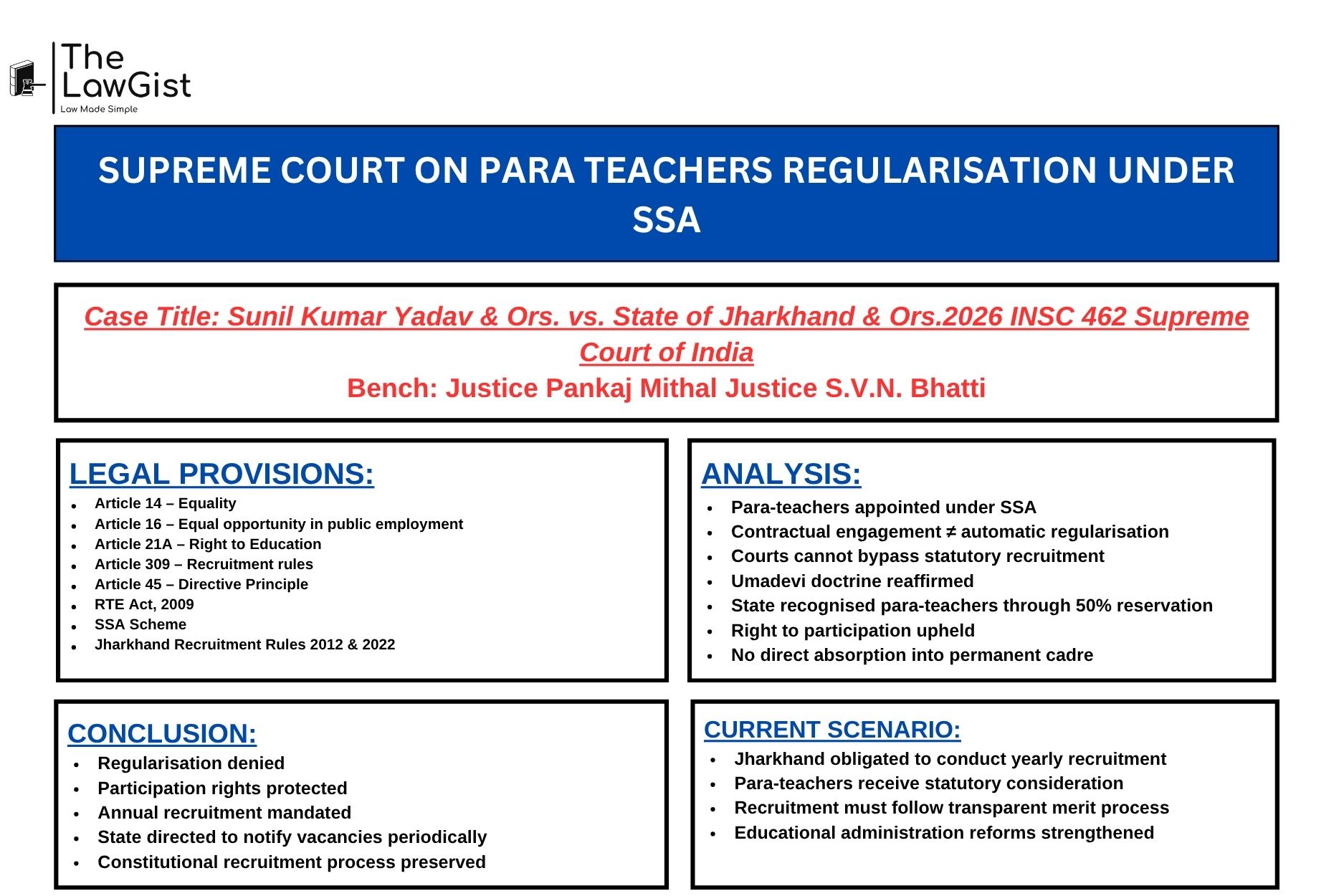
CASE SUMMARY – The Supreme Court in Sunil Kumar Yadav vs. State of Jharkhand (2026 INSC 462) addressed whether para-teachers engaged under the Sarva Shiksha Abhiyan could be regularised as Assistant Teachers. The Court held that regularisation cannot be granted contrary to statutory recruitment rules framed under Article 309 and reaffirmed the principles laid down in Umadevi. However, it recognised that Jharkhand had already created a statutory 50% reservation framework for para-teachers in recruitment to teaching posts. The Court directed the State to conduct periodic recruitment exclusively for para-teachers, ensuring their participation and consideration while denying automatic absorption into permanent government service.
| ASPECTS | DETAILS |
| Case Title | Sunil Kumar Yadav & Ors. vs. State of Jharkhand & Ors., 2026 INSC 462 |
| Bench | Justice Pankaj Mithal and Justice S.V.N. Bhatti |
| Introduction | The Supreme Court examined whether para-teachers appointed under the Sarva Shiksha Abhiyan (SSA) in Jharkhand could claim regularisation as Assistant Teachers/Sahayak Acharyas. The Court balanced constitutional recruitment principles with employment security concerns of long-serving para-teachers. |
| Factual Background | Para-teachers engaged under SSA since 2002 sought regularisation, pay parity, and absorption into permanent teaching posts. They argued they possessed required qualifications and performed duties similar to regular teachers. Jharkhand opposed the plea, stating their appointments were contractual and governed by a separate statutory framework. |
| Legal Issues | 1. Whether para-teachers had a right to regularisation.
2. Whether Courts could direct regularisation under Articles 226 and 142. 3. Whether denial of pay parity violated Articles 14 and 16. 4. Whether the State’s recruitment framework was constitutionally valid. |
| Applicable Law | Articles 14, 16, 21A, 45, and 309 of the Constitution of India; Right to Education Act, 2009; Jharkhand Primary School Teacher Recruitment Rules, 2012; Jharkhand Elementary School Sahayak Acharya Rules, 2022; State of Karnataka v. Umadevi (2006); Jagjit Singh; Vinod Kumar; Bhola Nath. |
| Analysis | The Court held that regularisation cannot occur contrary to statutory recruitment rules. Para-teachers were appointed under a scheme and not against regular State cadre posts. However, Jharkhand itself created a 50% reservation mechanism for para-teachers under statutory rules. The Court recognised their right to participate and be considered for recruitment but denied automatic regularisation. |
| Conclusion | The Supreme Court rejected blanket regularisation but directed Jharkhand to annually notify and fill 50% earmarked vacancies exclusively for para-teachers. The Court emphasised that the State cannot resist regularisation while simultaneously failing to implement its own statutory framework. |
| Current Scenario | Jharkhand must now conduct annual recruitment drives for para-teachers under the 2012 and 2022 Rules. The judgment strengthens the constitutional requirement of transparent recruitment while protecting long-serving contractual educators through statutory participation rights rather than judicial regularisation. |
“Regularisation cannot bypass constitutional recruitment rules, but the State must honour its statutory obligation to provide fair opportunities to para-teachers.”
SOURCE – SUPREME COURT OF INDIA