SUPREME COURT ON DEPARTMENTAL ENQUIRY AND JUDICIAL REVIEW
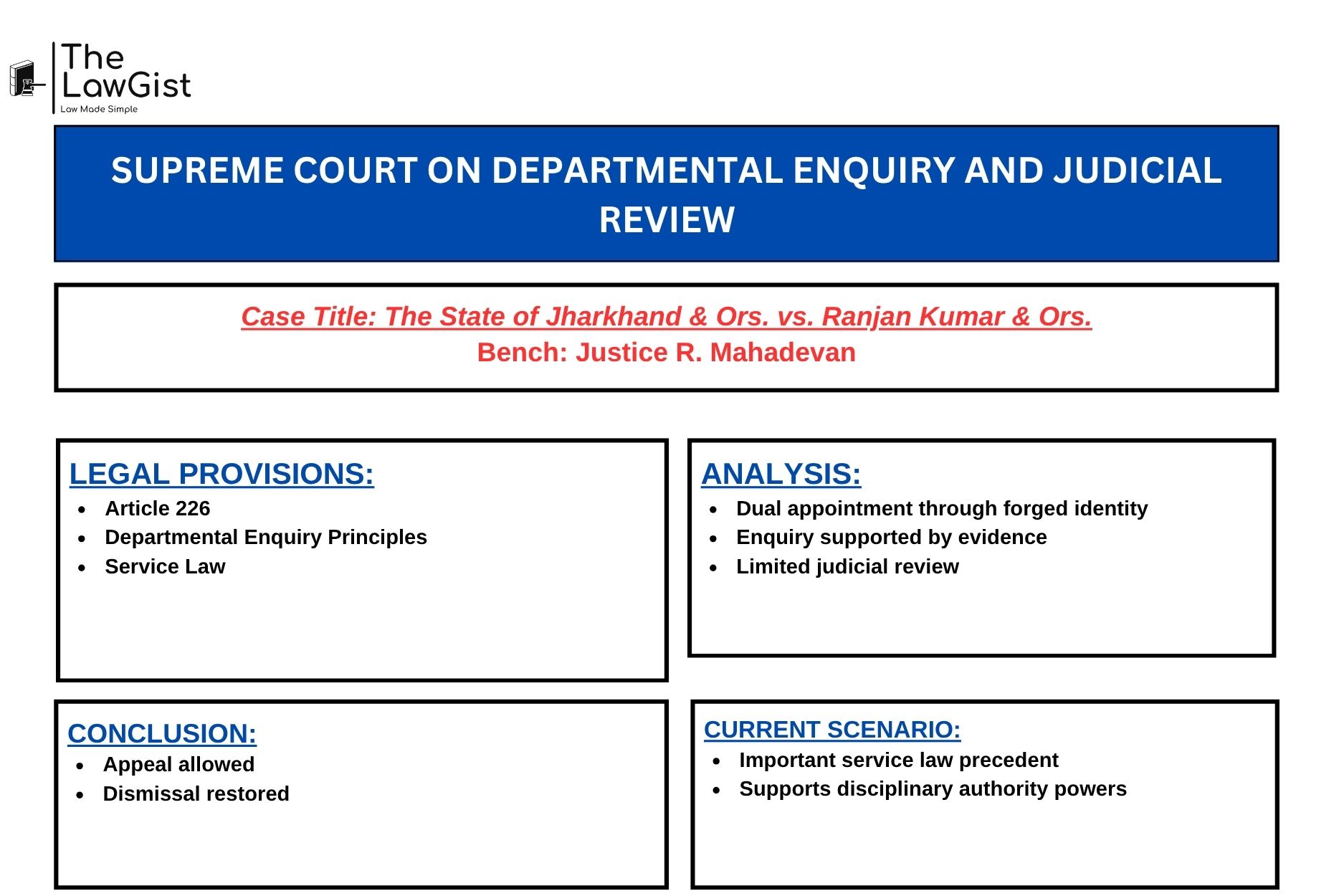
CASE SUMMARY – The Supreme Court in The State of Jharkhand & Ors. vs. Ranjan Kumar & Ors. (2026 INSC 466) examined the validity of disciplinary action against a police constable accused of remaining unauthorisedly absent and securing another police appointment in Bihar under a false identity using forged documents. The disciplinary authority dismissed him from service after a departmental enquiry. Although the High Court Division Bench quashed the dismissal, the Supreme Court restored the punishment, holding that judicial review under Article 226 does not permit re-appreciation of evidence unless findings are perverse or unsupported by evidence. The judgment reinforces integrity and discipline in public service administration.
| ASPECTS | DETAILS |
| Case Title | The State of Jharkhand & Ors. vs. Ranjan Kumar & Ors. |
| Introduction | The case concerns disciplinary action against a police constable accused of securing dual appointments using forged documents and remaining absent from duty. |
| Factual Background | Ranjan Kumar, a Constable in Jharkhand Police, went on leave and failed to rejoin duty. During this period, he allegedly joined Bihar Police under another identity using forged documents. Departmental enquiry found him guilty and he was dismissed from service. |
| Legal Issues | Whether the High Court could interfere with departmental enquiry findings and whether dismissal was justified. |
| Applicable Law | Article 226 of the Constitution of India; principles of judicial review in disciplinary proceedings. |
| Analysis | The Supreme Court held that courts cannot re-appreciate evidence in departmental enquiries unless findings are perverse or unsupported by evidence. Documentary records supported the misconduct charges. |
| Conclusion | The Supreme Court restored the dismissal order and upheld the disciplinary authority’s decision. |
| Current Scenario | The judgment reinforces limited judicial review and strengthens discipline in public service administration. |
“Disciplinary proceedings are sustainable when findings are based on relevant evidence and judicial review cannot re-appreciate evidence as an appellate authority.”
SOURCE – SUPREME COURT OF INDIA