Supreme Court clarifies Section 29 Hindu Succession Act; State cannot invoke escheat against valid will.
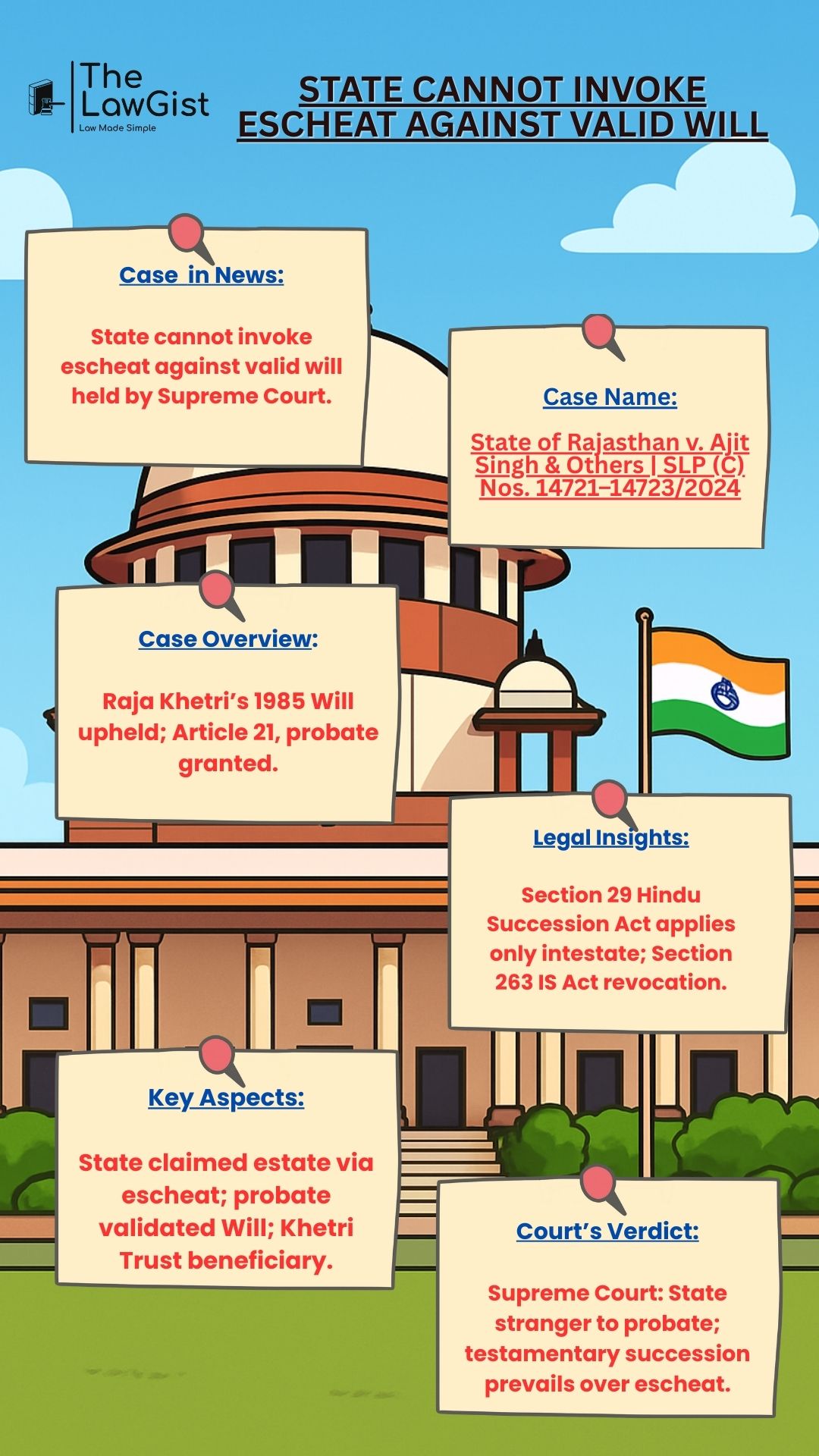
Case in NewsState cannot invoke escheat against valid will held by Supreme Court under Hindu Succession Act Section 29 . |
Discover powerful Latin Maxims and simplify complex legal terms in seconds.
Case Overview
Case Name: State of Rajasthan vs. Ajit Singh & Others | SLP (C) Nos. 14721–14723/2024
The Supreme Court of India, in a bench comprising Justice BV Nagarathna and Justice SC Sharma ruled that a State Government cannot invoke the doctrine of escheat under Section 29 of the Hindu Succession Act, 1956 when a Hindu male has executed a valid Will granted probate . The case concerned the Will of Raja Bahadur Sardar Singh of Khetri, who died in 1987 leaving his estate to the “Khetri Trust.” The State of Rajasthan claiming escheat rights, challenged the Will, but both the Delhi High Court and the Supreme Court upheld its validity .
Step into the world of justice with Courtroom Chronicles.
Key Aspects
Before turning to legal principles, the Court traced the sequence of facts and disputes . It emphasised that the issue was whether the State could claim property through escheat despite probate of the Will .
- Raja Bahadur Sardar Singh died in 1987 leaving a Will dated 1985 .
- Will bequeathed all property to Khetri Trust .
- State of Rajasthan claimed estate under Rajasthan Escheats Act .
- Delhi High Court upheld the Will and granted probate .
- State challenged probate before Supreme Court .
Legal Insights
The Court analysed relevant statutory provisions :
- Article 21, Constitution of India – protects right to property through due process .
- Section 8, Hindu Succession Act, 1956 – governs intestate succession .
- Section 29, Hindu Succession Act, 1956 – doctrine of escheat applies only when no heir exists .
- Section 263, Indian Succession Act, 1925 – only legal heirs can seek revocation of probate .
Court’s Verdict
The Supreme Court held that the State has no locus standi in testamentary succession . It clarified that the government is a “stranger” to probate proceedings unless intestacy arises . Since probate was granted, Section 29 Hindu Succession Act was inapplicable . The estate validly vested with Khetri Trust .
Source- Supreme Court of India
Read also – Constitution of India
The LawGist ensures exam success with quality notes—TPL, Current Affairs, Recent Judgments, and more. Backed by trusted resources and videos, The LawGist is every aspirant’s first choice. Discover more at thelawgist.org.