SUPREME COURT ON FUNCTIONAL DISABILITY, PROSTHETIC LIMB COMPENSATION & MOTOR ACCIDENT CLAIMS
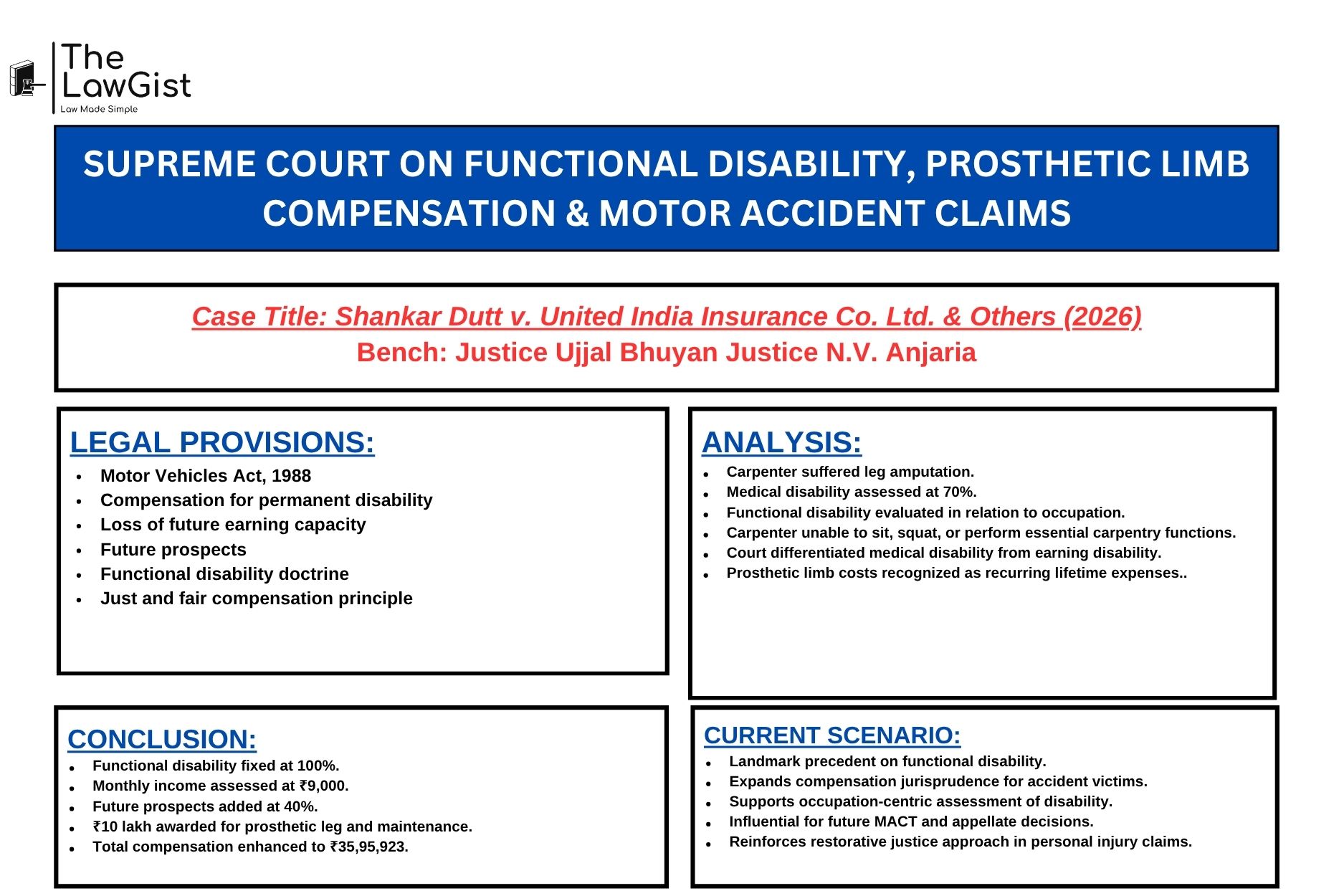
CASE SUMMARY – Shankar Dutt vs. United India Insurance Co. Ltd. (2026) concerned a carpenter who lost his right leg in a motor accident caused by a negligently driven Jeep. The Supreme Court examined whether compensation should be based on 70% medical disability or the actual impact on his profession. Holding that a carpenter unable to sit, squat, or perform carpentry work effectively suffers complete loss of earning capacity, the Court treated the disability as 100% functional disability. It enhanced the claimant’s income assessment, added future prospects, awarded ₹10 lakh for prosthetic limb replacement and maintenance, and increased total compensation to ₹35,95,923 with interest.
| ASPECTS | DETAILS |
| Case Title | Shankar Dutt vs. United India Insurance Co. Ltd. & Others |
| Introduction | The Supreme Court considered whether compensation awarded to a carpenter who lost his right leg in a motor accident was adequate. The Court examined the distinction between medical disability and functional disability and the entitlement to compensation for future prosthetic limb expenses. |
| Factual Background | On 09.11.2004, the appellant, a 38-year-old carpenter, suffered severe injuries when a rashly driven Jeep hit his motorcycle. His right leg was amputated above the knee. The MACT awarded ₹4,77,823. The High Court enhanced it to ₹11,51,423. Dissatisfied, the claimant approached the Supreme Court seeking further enhancement. |
| Legal Issues | 1. Whether the appellant’s disability should be treated as 70% or 100% functional disability.
2. What should be the appropriate notional income of a skilled carpenter. 3. Whether compensation should include future prosthetic limb replacement and maintenance costs. 4. Whether additional heads such as attendant charges, transportation, and loss of amenities should be awarded. |
| Applicable Law | Motor Vehicles Act, 1988; principles laid down in Sarla Verma v. DTC (multiplier), Pranay Sethi (future prospects), Raj Kumar v. Ajay Kumar (functional disability), Jagdish v. Mohan, Mohd. Sabeer v. UPSRTC, Anant v. Pratap, and S. Ettiappan v. D. Kumar. |
| Analysis | The Court emphasized that functional disability depends on the claimant’s profession. Although the medical certificate assessed disability at 70%, the Court held that a carpenter requires the ability to sit, squat, and maintain balance. Since the appellant could no longer perform carpentry effectively, his functional disability was treated as 100%. The Court also recognized that prosthetic limbs require periodic replacement and maintenance throughout life and therefore awarded a separate amount for future expenses. |
| Conclusion | The Supreme Court enhanced compensation from ₹11,51,423 to ₹35,95,923 with 6% interest. It held that the appellant suffered 100% functional disability, fixed monthly income at ₹9,000, granted future prospects, and awarded ₹10 lakh for prosthetic limb expenses. |
| Current Scenario | The judgment is a significant precedent in motor accident compensation law. It strengthens the principle that compensation must be based on actual loss of earning capacity and occupational impact rather than merely medical disability percentages. Courts are likely to rely on this decision when assessing compensation for injured workers suffering permanent disabilities. |
“Functional disability must be assessed in the context of the victim’s occupation; medical disability and loss of earning capacity are not always identical.”
SOURCE – SUPREME COURT OF INDIA