SC reinstates tree-felling restrictions in Taj Trapezium Zone, ensuring environmental protection and judicial oversight.
Headline
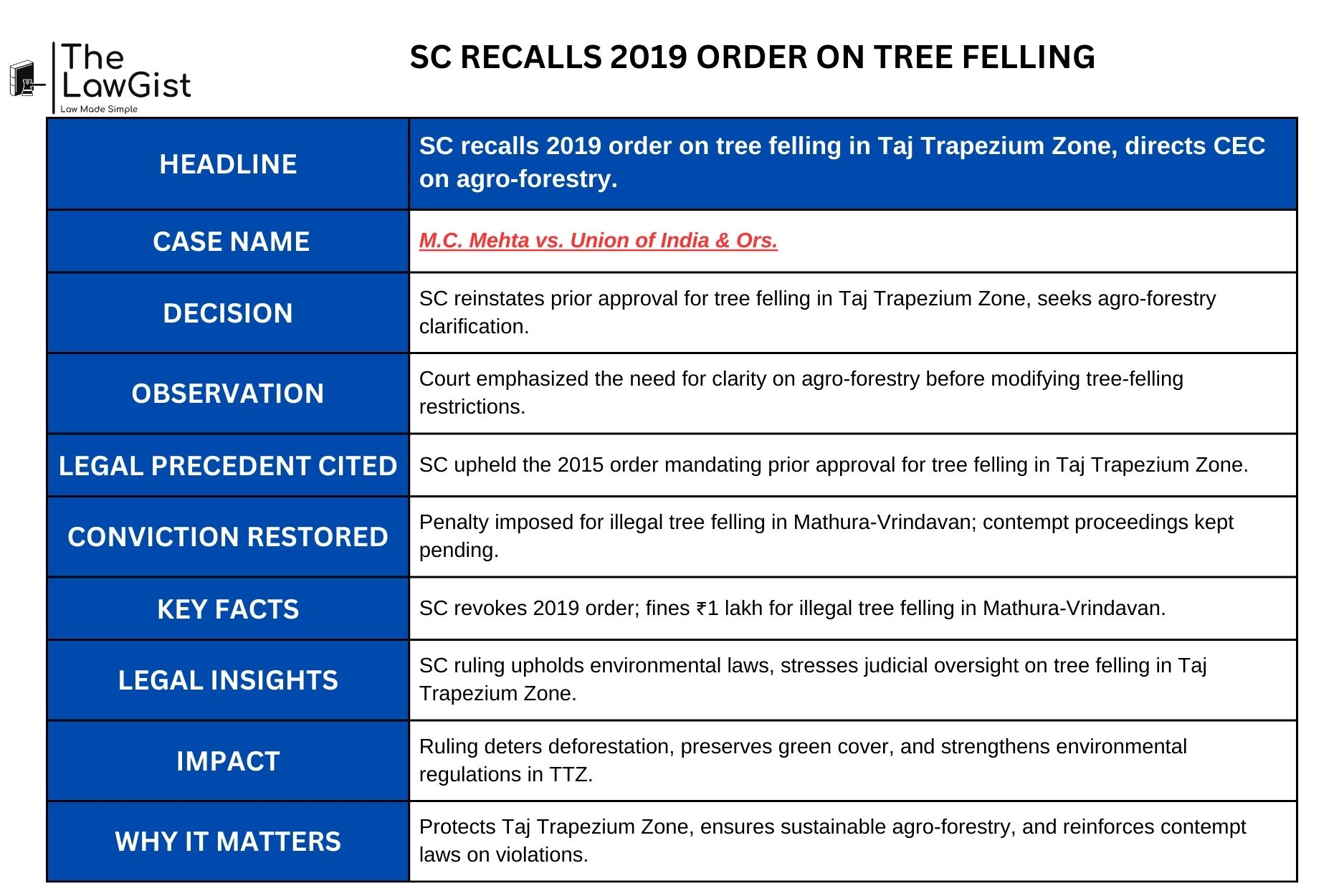
SC Recalls 2019 Order on Tree Felling in Taj Trapezium Zone and orders Central Empowered Committee on Agroforestry.
Summary
The Supreme Court of India has recalled its 2019 order permitting tree felling in the Taj Trapezium Zone (TTZ) without prior court approval. Justices Abhay Oka and Ujjal Bhuyan noted that the plea does not show clarity on agro-forestry and may have misled the Court into lifting restrictions. The Central Empowered Committee (CEC) was asked to explain the concept of agroforestry and give recommendations. Additionally, the Supreme Court imposed a penalty on a private individual for the illegal felling of 454 trees in Mathura-Vrindavan by terming it equivalent to mass human loss.
Key Facts
- Case Name: MC Mehta vs. Union of India & Ors.
- Judges: Justice Abhay Oka and Justice Ujjal Bhuyan
- Decision: The order of 2019 removing earlier approval for tree felling in Taj Trapezium Zone was recalled.
- Observations: Court stressed on the requirement for clarity on agro-forestry before changes in policy.
- Legal Precedent: The order of 2015 mandating prior approval for tree felling in TTZ remains in force.
- Contempt of Court: Shiv Shankar Agarwal fined ₹1 lakh for illegal tree felling in Mathura-Vrindavan.
Legal Insights
The decision of the Supreme Court of India upholds the 2015 decision requiring prior court permission for tree felling in Taj Trapezium Zone for environmental protection. The Supreme Court referenced the doctrine of contempt of court in penalizing illegal acts. The Central Empowered Committee has an important role in advising environmental policy.
Impact
The ruling focuses on strict environmental oversight in the Taj Trapezium Zone and deters unauthorized and unlawful deforestation. The penalty for Mathura-Vrindavan violations sets a precedent against offenses relating to the environment.
Why It Matters
The interference of the Supreme Court of India protects ecological balance in the Taj Trapezium Zone, home to the Taj Mahal. The decision also explains agro-forestry regulations while upholding environmental conservation laws.
Source