Headline
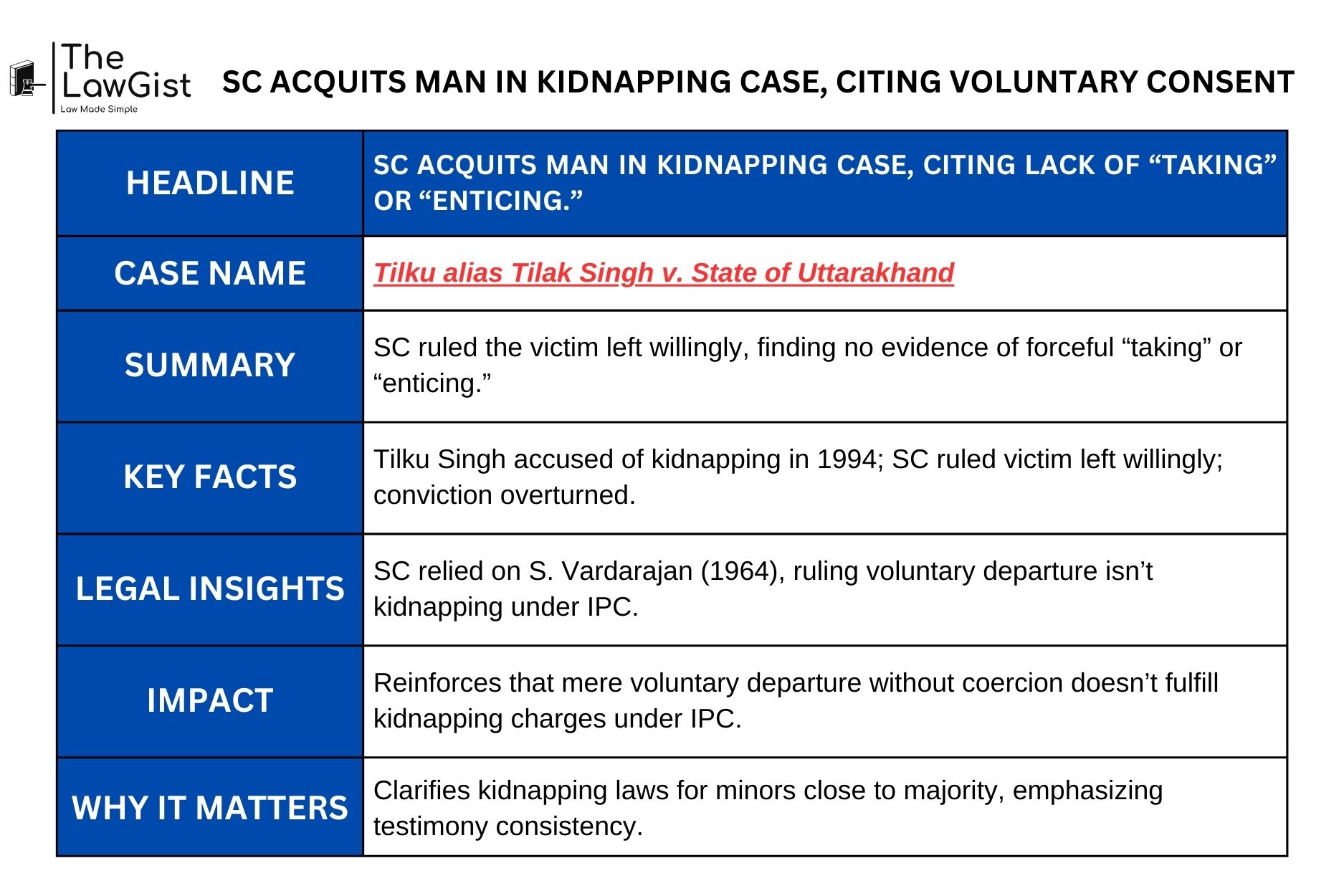
The Supreme Court of India acquits man in the case of kidnapping, stating lack of “Taking” or “Enticing”.
Summary
The Supreme Court of India acquitted Tilku alias Tilak Singh in a kidnapping case of 1994, stating that the victim had voluntarily left with him and lived as his wife. The Court found no evidence of “taking” or “enticing” forcefully which is necessary for the charge of kidnapping under Sections 363 and 366 of Indian Penal Code (IPC).
Key Facts
- Case Name: Tilku alias Tilak Singh vs. State of Uttarakhand
- Judges Name: Justice B.R. Gavai and Justice K. Vinod Chandran
- The prosecution alleged that Singh kidnapped a minor girl in 1994.
- The trial court convicted him U/S 363, 366, and 376 of Indian Penal Code (IPC).
- The High Court acquitted him of rape (Section 376 IPC) but upheld the charges of kidnapping.
- The Supreme Court of India , stating inconsistencies in the testimony of a girl, ruled that she voluntarily left and lived with the appellant as his wife.
Legal Insights
- The Supreme Court of India relied on the case of S. Varadarajan v. State of Madras (1964), stating that voluntary departure by a minor close to majority does not constitute “taking.”
- The Supreme Court discovered conflicting evidence on the age of the girl and granted the benefit of the doubt.
Impact
- This ruling shows that mere departure by a minor, without coercion, does not fulfill the charges of kidnapping.
- It sets a precedent for interpreting “taking” or “enticing” under Sections 363 and 366 of Indian Penal Code (IPC).
Why It Matters
- The judgment sheds light on the legal nuances in the case of kidnapping involving minors close to majority.
- It shows the significance of evaluating testimony inconsistencies before convicting under the laws of kidnapping.
Source:
Legal Glossary–Testimony