Supreme Court upholds that right to appeal is not merely statutory, but a constitutional safeguard for fair trial.
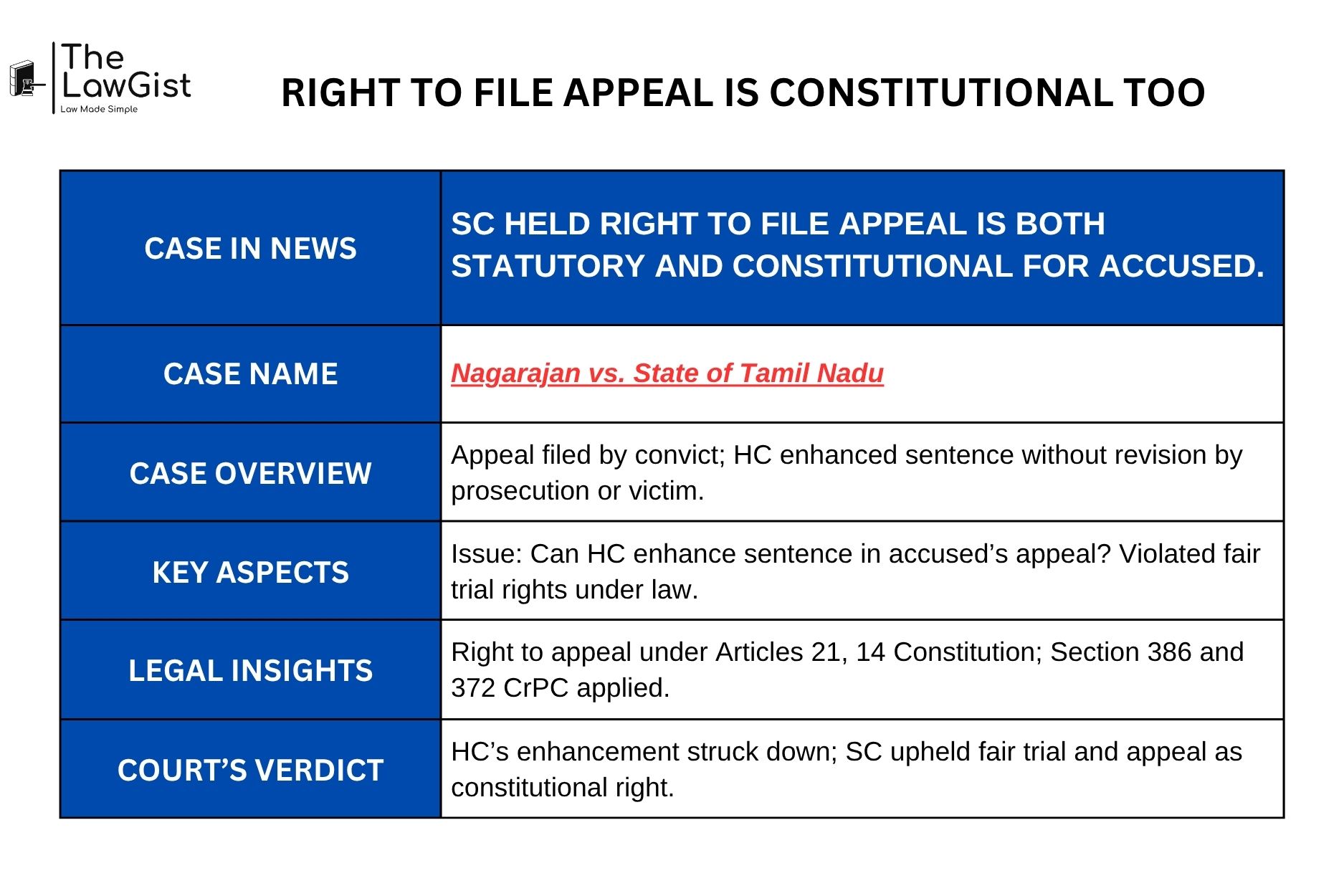
Case in NewsRight to file appeal is constitutional too, rules Supreme Court while setting aside sentence enhancement. |
Case Overview
Case Name –Nagarajan vs. State of Tamil Nadu
In a significant ruling, the Supreme Court reaffirmed the foundational right of an accused to appeal a conviction not just as a statutory entitlement but as a constitutional safeguard . This judgment was delivered by a bench comprising Justice BV Nagarathna and Justice Satish Chandra Sharma which also struck down a High Court’s decision that enhanced the sentence of a convict in his own appeal without any appeal or revision being filed by the prosecution or victim .
Key Aspects
Before diving into the legal interpretations, the Court considered various facts surrounding the convict’s appeal and the questionable power exercised by the High Court. These are outlined below :
- Accused had filed an appeal against his conviction and sentence before the High Court .
- High Court, without any appeal from the State or complainant, increased the sentence .
- Issue : Whether High Court could enhance punishment suo motu under appellate powers .
- Also examined : whether denial of appeal remedies violates principles of natural justice and fair trial .
Legal Insights
The Court based its decision on key constitutional protections and provisions under the Criminal Procedure Code reinforcing that procedural fairness must govern criminal appeals :
- Article 21 of the Constitution – Protects right to life and liberty; ensures appeal as part of fair process .
- Article 14 of the Constitution – Arbitrary denial of appeal violates equality before the law .
- Section 372 CrPC – Grants statutory right to appeal against conviction or sentence .
- Section 386 CrPC – Appellate courts can reverse, modify or reduce sentence—but not enhance it without appeal .
- Sections 397–401 CrPC – Revisional powers must be exercised through a separate revision, not via appellate jurisdiction .
Courts Verdict
The Supreme Court held that an accused’s right to appeal is both constitutional and statutory . It ruled that enhancing the sentence in the absence of an appeal or revision from the State, victim or complainant is impermissible . The High Court’s action was beyond its appellate power under Section 386 CrPC . Thus, the enhancement was set aside, reaffirming that procedural fairness cannot be bypassed .
Source – Supreme Court of India
Read also – Article 21 of Indian Constitution