
Polity
Indian Polity is a broad domain that encompasses various topics related to the governance of India, including the Constitution of India, which is the supreme law of the country, citizenship, Fundamental Rights, Directive Principles of State Policy, the executive branch of the government, including the President, Prime Minister, Governor, Chief Minister, and other government officials, as well as the local government system.
Indian Polity is an important subject for every citizen of India as it helps them to understand the principles and practices of governance in India, their rights and responsibilities, and how the government works to serve the citizens. A good understanding of Indian Polity is also essential for aspirants who want to join the civil services or other government jobs in India.
Recent Posts
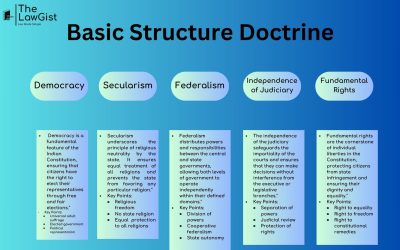
BASIC STRUCTURE DOCTRINE (ARTICLE 13)
The "basic structure doctrine" is a constitutional principle that emerged from the landmark Indian Supreme Court case of Kesavananda Bharati v. State of Kerala (1973). It holds that while the Parliament has the power to amend any provision of the Constitution, it...
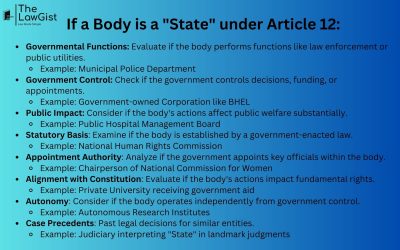
STATE (ARTICLE 12)
Article 12 of the Indian Constitution holds significance in delineating the entities considered as "States" for the purpose of enforcing fundamental rights. This expression is rightly defined by the famous case Ajay Hasia v/s Khalid Mujib. This delineation expands the...
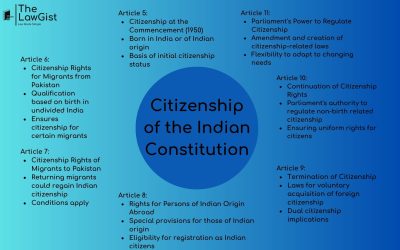
CITIZENSHIP ( ARTICLE 5-11 )
Title and Composition: "Citizenship" (Articles 5-11) Part 2 of the Indian Constitution is titled "Citizenship" and consists of Articles 5 to 11. These articles lay down the rules and principles regarding the citizenship of India. Acquisition of Citizenship: Article 5...
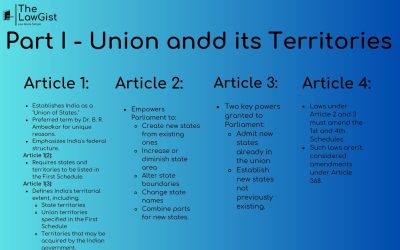
UNION AND ITS TERRITORIES
Part 1 of the Indian Constitution, encompassing Articles 1 to 4, pertains to the concept of the Union and its territories. Despite India's federal constitutional framework, it is referred to as a "Union of States" rather than a "Federation of States." Dr. B. R....
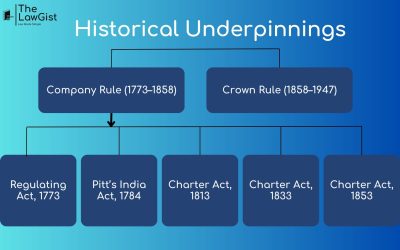
HISTORICAL UNDERPINNINGS
1. British Arrival and Trade (1600): East India Company initiated British presence in India as traders under a charter from Queen Elizabeth I. 2. Transition to Territorial Power (1765): East India Company acquired 'diwani' rights over Bengal, Bihar, and Orissa,...