Supreme Court bans selfies, reels, photographs and videography inside high security zones.
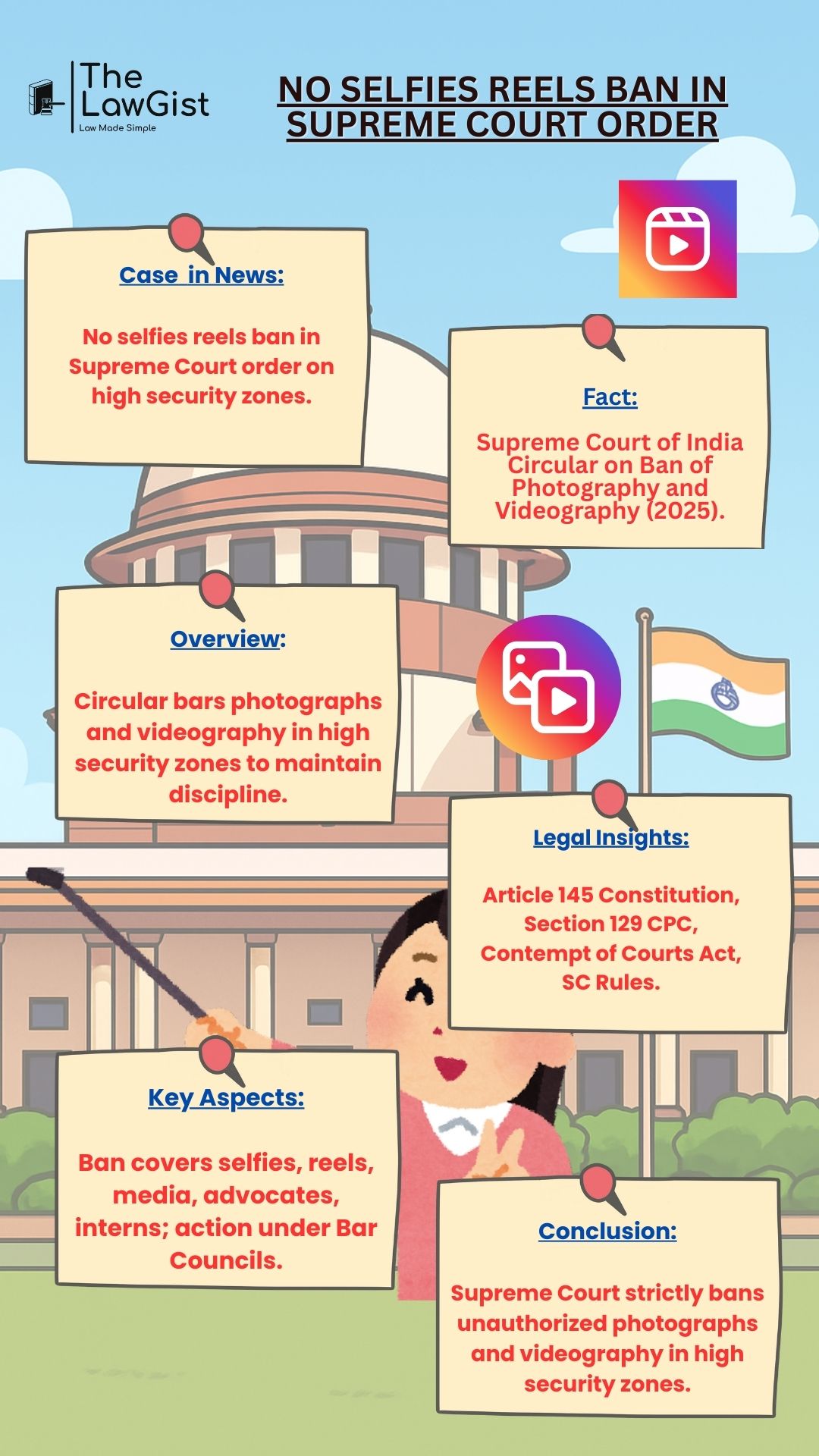
Why in NewsSupreme Court of India Circular on Ban of Photography and Videography (2025) .No selfies reels ban in Supreme Court order issued for high security zones photographs and videography . |
Discover powerful Latin Maxims and simplify complex legal terms in seconds.
Overview
The Supreme Court of India has issued a strict circular restricting photographs and videography in its High Security Zones . The directive was released by the Secretary General and applies to everyone entering the Court premises including lawyers, litigants, clerks, interns, media and staff . The circular emphasizes that cameras, tripods and selfie sticks are completely barred from the restricted zone to ensure decorum and discipline inside the Court .
Step into the world of justice withCourtroom Chronicles.
Key Aspects
The circular highlights why regulating digital activity in the High Security Zones is necessary . It seeks to preserve the Court’s dignity, prevent misuse of sensitive visuals and maintain order in its premises . Some major points are :
- Complete ban on selfies, reels, photographs and videography within restricted areas including lawns .
- Advocates, interns and clerks violating the order face disciplinary action via Bar Associations or State Bar Councils .
- Media allowed interviews only in designated low-security lawn; violations attract one-month suspension .
- Registry staff and government officials will face departmental action for violations .
- Security staff authorized to intervene and prevent attempts of photography or recording .
Legal Insights
The restrictions are grounded in statutory provisions and constitutional powers of the Court . They reinforce judicial decorum and security through :
- Article 145 of the Constitution of India– empowers the Court to regulate its practice and procedureb.
- Section 129 of the Code of Civil Procedure, 1908 – allows High Courts and the Supreme Court to frame rules for regulating their own proceedings .
- Contempt of Courts Act, 1971 – safeguards the dignity of courts against actions that undermine authority .
- Supreme Court Rules, 2013 – enable regulation of access, securityband conduct within the Court’s precincts .
Court’s Verdict
The Supreme Court of India has made it clear that unauthorized photographs and videography in its High Security Zones will not be tolerated . Only official recordings are permitted and violators will face strict disciplinary or departmental action to maintain sanctity of the Court .
Source – Supreme Court of India
Read also – Constitution of India
The LawGist ensures exam success with quality notes—TPL, Current Affairs, Recent Judgments, and more. Backed by trusted resources and videos, The LawGist is every aspirant’s first choice. Discover more at thelawgist.org.