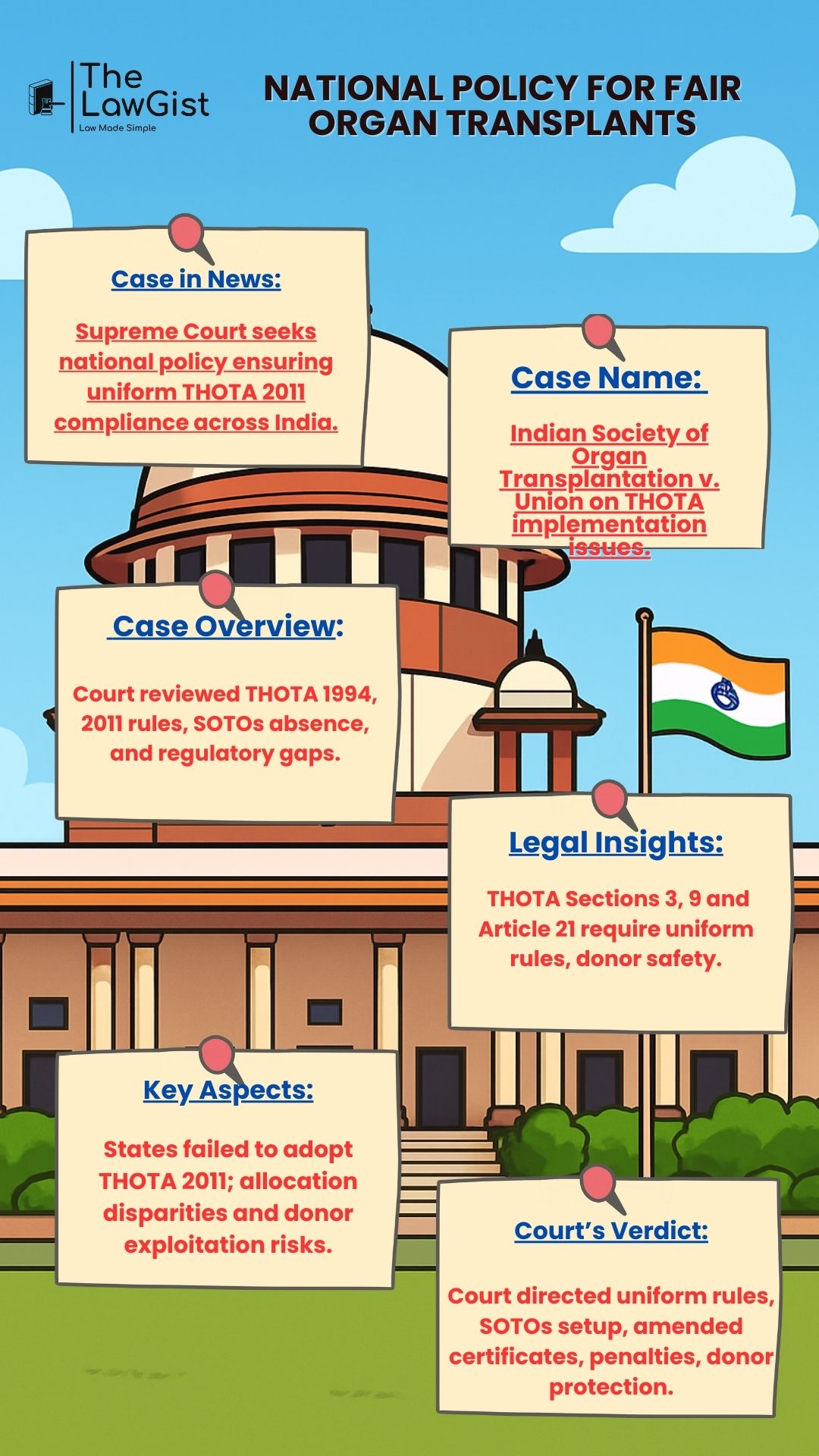
Supreme Court of India directing States and the Union to implement uniform THOTA rules, establish SOTOs, and ensure fair, transparent and exploitation-free organ transplant procedures nationwide.
Case in NewsSupreme Court of India seeks national policy for fair organ transplant under uniform rules . |
Discover powerful Latin Maxims and simplify complex legal terms in seconds.
Case Overview
Case Name: Indian Society of Organ Transplantation vs. Union of India
The Supreme Court of India reviewed gaps in the implementation of the Transplantation of Human Organs and Tissues Act (THOTA), 1994 and its 2011 amendments . The Bench led by CJI BR Gavai and Justice Vinod Chandran noted that several States had not adopted the revised rules causing delays and widening regional disparities . The Court also highlighted the absence of State Organ and Tissue Transplant Organisations (SOTOs) in multiple regions, impacting coordination and transparency in organ allocation .
Step into the world of justice with Courtroom Chronicles
Key Aspects
The case raised significant concerns about uneven regulatory compliance, lack of uniform transplant procedures and donor-related risks . The Court observed that these inconsistencies were obstructing smooth organ allocation and creating opportunities for exploitation . It emphasised the urgent need for a coordinated national approach across all States .
- Large gaps in State adoption of THOTA 2011 rules and procedures .
- Karnataka, Tamil Nadu, Manipur and Andhra Pradesh yet to fully implement revised norms .
- Several regions lack mandatory SOTOs essential for governing organ transplant processes .
- Allocation disparities across States including caste- and gender-based variations .
- Concerns about organised crime linked to illegal harvesting of organs from accident victims .
Legal Insights
The Court’s analysis underscored the binding nature of THOTA and constitutional duties of States . It stressed uniformity to prevent exploitation and ensure dignity for donors and recipients . The need for statutory reporting and standardised allocation criteria was also highlighted .
- Section 3 & 9, THOTA 1994: Regulate authorization and prohibit commercial dealings in human organs .
- THOTA Amendment Rules, 2011: Mandate streamlined approvals, SOTOs and uniform documentation .
- Article 21, Constitution of India : Protects dignity, health and bodily integrity of donors and recipients .
- Entry 6, State List: Places public health within State competence, requiring aligned State action .
- NOTTO Guidelines (statutory framework) : Ensure equitable organ allocation and transparent registry practices .
Court’s Verdict
The Supreme Court of India ordered all non-compliant States to immediately adopt THOTA 2011 rules . The Union must establish SOTOs in Manipur and Nagaland and design uniform donor and allocation criteria to eliminate caste and gender disparities . The Court directed amendments to birth and death certificate forms to capture brain death and donation options . It also mandated strict penalties for hospitals failing to comply and instructed the Union to frame guidelines protecting live donors and preventing exploitation .
Source – Supreme Court of India
Read also – Constitution of India
The LawGist ensures exam success with quality notes—TPL, Current Affairs, Recent Judgments, and more. Backed by trusted resources and videos, The LawGist is every aspirant’s first choice.