Headline
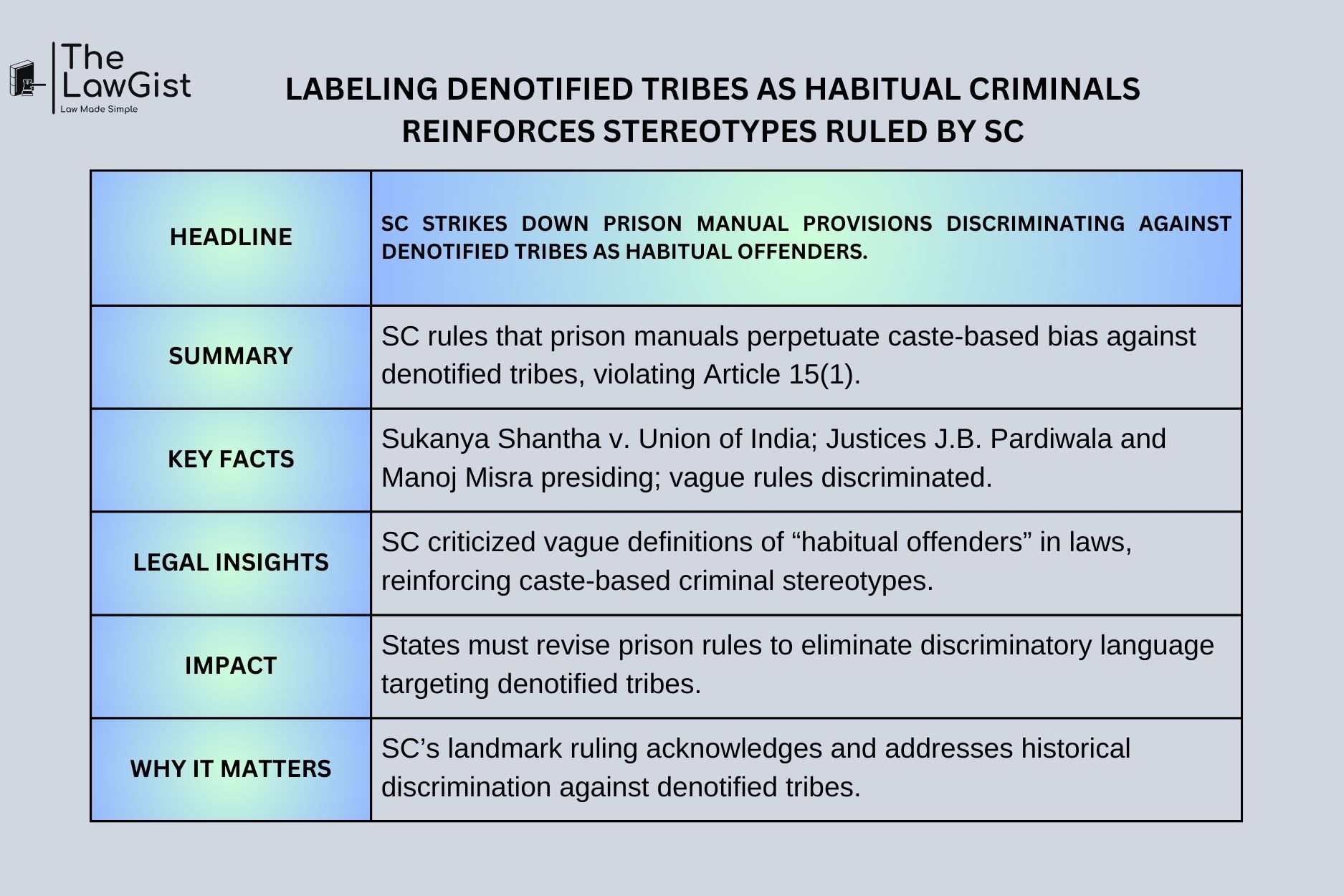
The Supreme Court of India Strikes Down Against Denotified Tribes the Discriminatory Provisions in Manuals of Prison.
Summary
The Supreme Court of India stated that the Model Prison Manual, 2016, and Model Prisons and Correctional Services Act, 2023, perpetuate caste-based discrimination against denotified tribes by tagging them as habitual offenders.The Supreme Court stressed that such discrimination violates Article 15(1) of the Indian Constitution and ordered it to make proper changes in prison rules and manuals.
Key Facts
- Case Name: Sukanya Shantha v. Union of India & Ors., WP (C) No. 1404 of 2023.
- Judges Name: Chief Justice of India, Justice J.B. Pardiwala, and Justice Manoj Misra.
- Through vague prison rules ,discrimination against denotified tribes and treating them as habitual offenders.
Legal Insights
The Supreme Court of India found Section 2(12) of the Model Prisons and Correctional Services Act,2023 troublesome due to its vague and improper definition of “habitual offenders,” reinforcing stereotypes. It also cited the colonial Criminal Tribes Act, 1871, which shows the tribes as born criminals based on caste.
Impact
The judgment mandates that states and the Union alter prison rules to remove discriminatory references to denotified tribes, for fair and just treatment under the law.
Why It Matters
This is the first comprehensive acknowledgment by the Supreme Court of India of the historical and ongoing discrimination faced by denotified tribes, by making sure that their constitutional rights against caste-based bias in prison systems.
Source