Delhi High Court dispute over Sunjay Kapur’s will challenged by Karisma Kapoor’s children.
Case in News
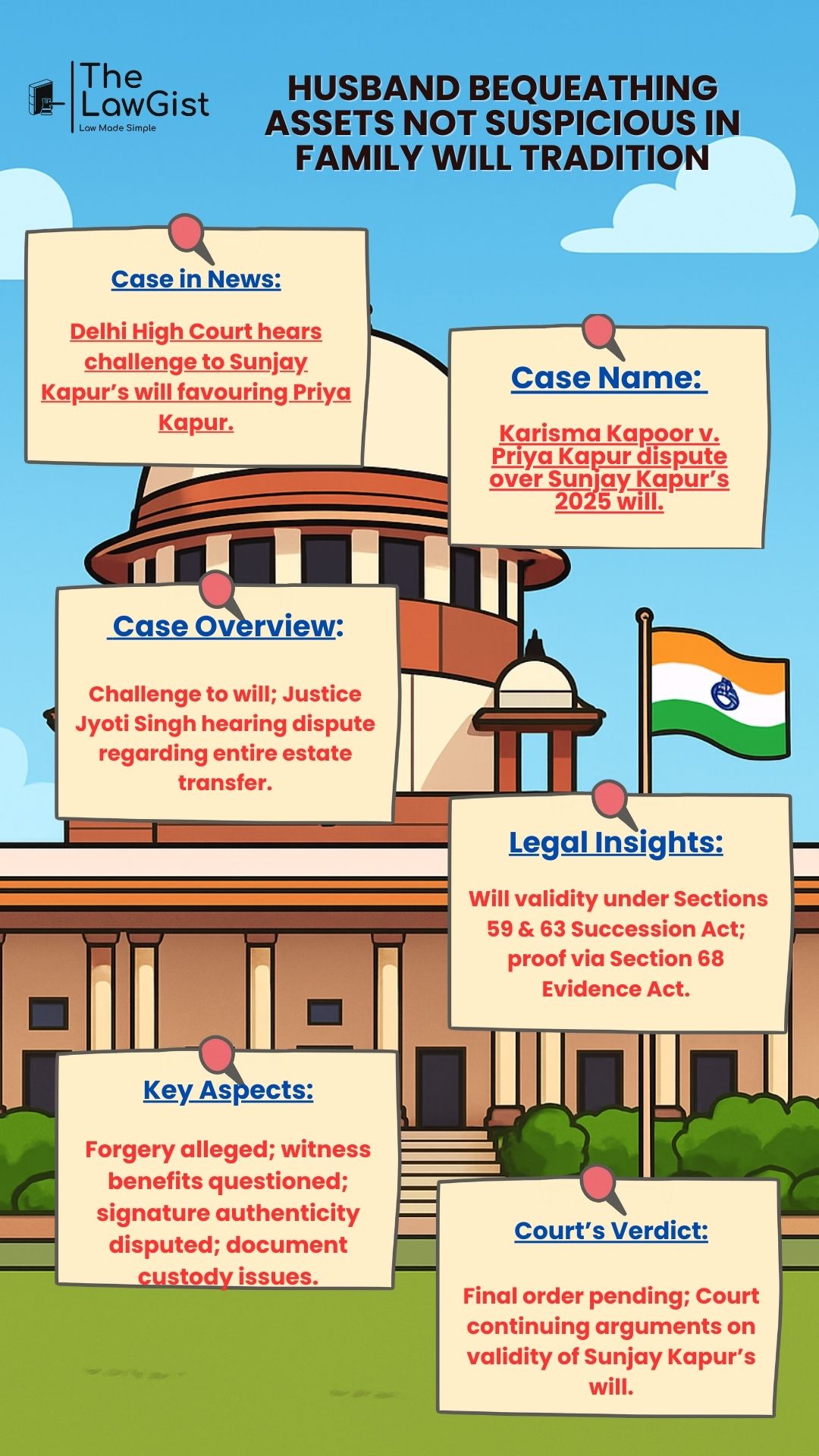
Husband Bequeathing Assets Not Suspicious In Family Will Tradition becomes central in a Delhi High Court dispute over Sunjay Kapur’s will .
Discover powerful Latin Maxims and simplify complex legal terms in seconds.
Case Name
Karisma Kapoor & Ors. v. Priya Sachdev Kapur & Ors., Delhi High Court
Case Overview
A significant succession dispute has reached the Delhi High Court, where the children of Karisma Kapoor have challenged the will of their father, Sunjay Kapur . The case, heard by Justice Jyoti Singh, examines a 2025 will that allegedly transfers Sunjay’s entire personal estate to his widow Priya Kapur . Senior Advocate Rajiv Nayar appearing for Priya, argued that the bequest follows a long-standing family tradition where husbands have historically willed assets to their wives .
Step into the world of justice withCourtroom Chronicles
Key Aspects
Before examining the core legal issues, it is important to understand the factual matrix and concerns raised by both sides . The dispute arises from allegations of forgery, suspicious circumstances and questions surrounding the conduct of attesting witnesses . These elements form the basis on which the validity of the Sunjay Kapur will is being contested .
- Allegation of forgery by Karisma Kapoor’s children regarding Sunjay Kapur’s 2025 will .
- Claim that Priya Kapur gained exclusive control through a suspiciously executed will .
- Dispute over whether attesting witnesses derived pecuniary benefits after Sunjay’s death .
- Debate on the authenticity of Sunjay Kapur’s signature .
- Objections to selective presentation of documents and email exchanges by Karisma’s side .
Legal Insights
Understanding the legal framework is crucial, as the validity of a will is determined by strict statutory requirements . The Court must examine both procedural compliance and any alleged suspicious circumstances before accepting or rejecting a testamentary document .
- Section 63, Indian Succession Act, 1925 – A will must be signed by the testator and attested by at least two witnesses .
- Section 68, Indian Evidence Act, 1872 (BSA)– At least one attesting witness must be examined to prove execution .
- Section 59, Indian Succession Act, 1925 – Testator must be of sound mind and free from coercion .
- Registration Act, 1908 – Registration of a will is optional and not mandatory for validity .
- Burden Principle – The party alleging suspicious circumstances bears the onus to establish them .
Court’s Verdict
The Delhi High Court has not yet issued a final ruling . Justice Jyoti Singh continues to hear arguments on whether the objections raised by Karisma Kapoor’s children are sufficient to cast doubt on the validity of Sunjay Kapur’s will bequeathing his estate to Priya Kapur . The matter will continue in the next hearing .
The LawGist ensures exam success with quality notes—TPL, Current Affairs, Recent Judgments, and more. Backed by trusted resources and videos, The LawGist is every aspirant’s first choice.
Read also-Bharatiya Sakshya Adhiniyam
Source-High Court of Delhi