Major legal and diplomatic developments including global peace initiatives, rural employment legislation, and India–UAE strategic cooperation.
DAILY CUURENT AFFAIRS (19 JANUARY 2026)
TRUMP’S “BOARD OF PEACE” AND INDIA’S ROLE IN GLOBAL CONFLICT RESOLUTION
Summary of the News
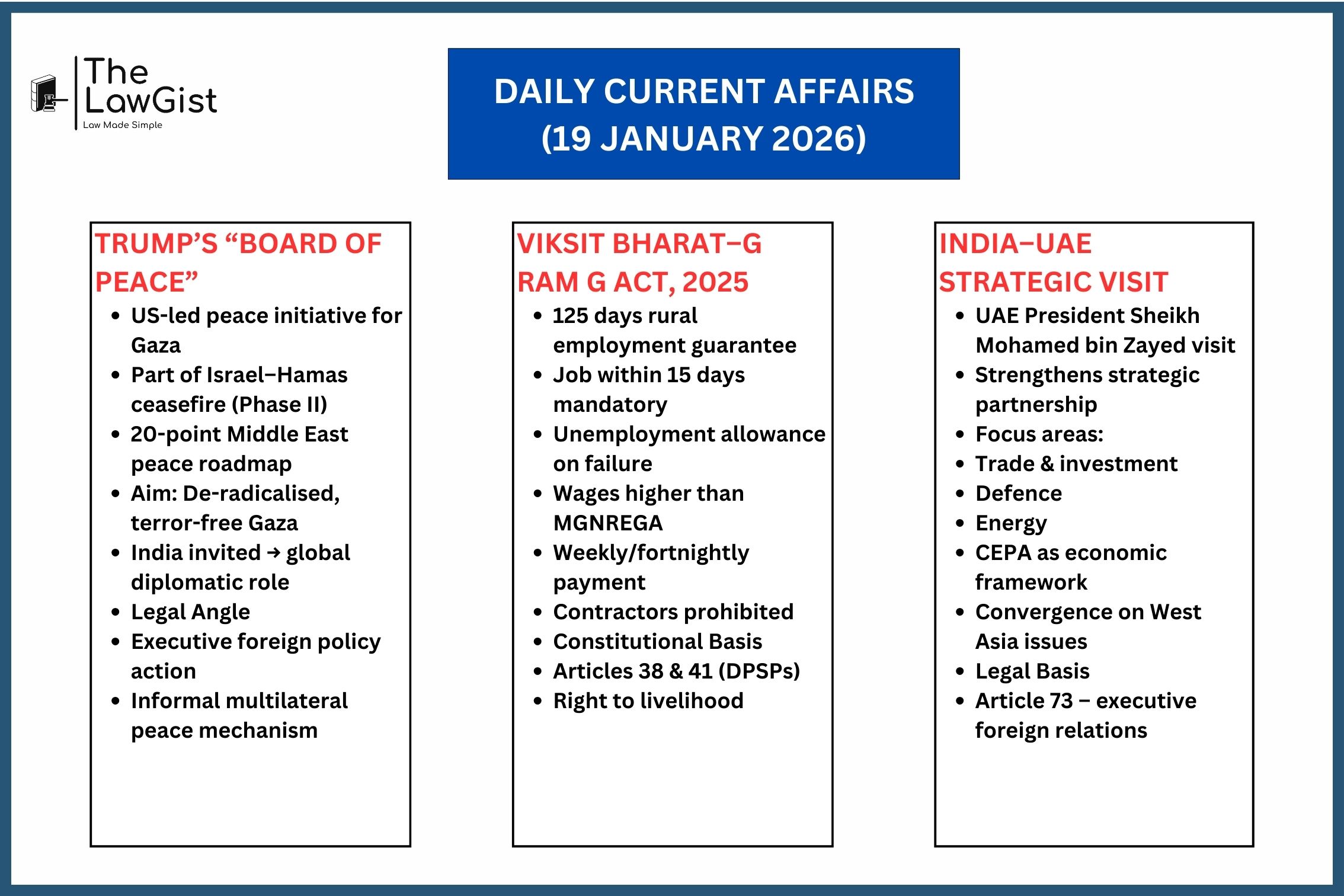
US President Donald Trump has invited Prime Minister Narendra Modi to join a proposed international body titled the “Board of Peace”, aimed at securing lasting peace in Gaza and addressing broader global conflicts. The invitation was conveyed through a formal letter shared publicly by the US Ambassador to India. The initiative has been unveiled as part of the second phase of the ceasefire agreement between Israel and Hamas. President Trump referred to his earlier announcement of a comprehensive peace plan and a 20-point roadmap to stabilise the Middle East, including the objective of transforming Gaza into a demilitarised and terror-free zone. Washington projects the Board as a multilateral platform involving key global leaders to institutionalise peace-building efforts. India’s potential participation reflects its rising diplomatic stature and role in global peace initiatives.
Legal Perspective
The proposal engages principles of international law relating to peacekeeping, conflict resolution, and collective security. India’s participation would fall under executive foreign policy powers exercised through diplomatic engagement rather than treaty obligations.
- Relevant Law: International law on peacekeeping and conflict resolution
- Constitutional Basis: Article 73, executive power over foreign affairs
- Principle Involved: Collective international responsibility for peace
- Impact: Enhances India’s role in global diplomatic and peace frameworks
Why This News Is Important
|
VIKSIT BHARAT–G RAM G ACT, 2025: GOVERNMENT DEFENDS RURAL EMPLOYMENT GUARANTEES
Summary of the News
The Union Government has issued strong rebuttals to criticism surrounding the Viksit Bharat–G RAM G Act, 2025, clarifying that the legislation guarantees at least 125 days of wage employment to every rural household. Responding to opposition claims that the right to work has been diluted, the government stated that employment must be provided within 15 days, failing which an unemployment allowance becomes mandatory. The Act also ensures wages at notified rates, which are to be revised annually and remain higher than those under MGNREGA, with payments made weekly or within a fortnight. Allegations of centralisation and contractor involvement were rejected, with the government emphasising that contractors are expressly prohibited. The funding structure follows a defined cost-sharing pattern, reinforcing fiscal accountability.
Legal Perspective
The Act reinforces the statutory right to employment as part of socio-economic welfare obligations under the Directive Principles of State Policy, particularly Articles 38 and 41 of the Constitution.
- Relevant Law: Viksit Bharat–G RAM G Act, 2025
- Constitutional Basis: Articles 38 and 41 (DPSPs)
- Legal Principle: Right to livelihood through statutory guarantee
- Impact: Strengthens enforceability of rural employment rights
Why This News Is Important
|
INDIA–UAE STRATEGIC PARTNERSHIP DEEPENS WITH PRESIDENT SHEIKH MOHAMED BIN ZAYED’S VISIT
Summary of the News
UAE President Sheikh Mohamed bin Zayed Al Nahyan is visiting India at the invitation of Prime Minister Narendra Modi, marking his third official visit as President and fifth visit in the last decade. The visit builds on sustained high-level exchanges and reflects the growing depth of the India–UAE Comprehensive Strategic Partnership. Discussions are expected to focus on expanding cooperation in trade, investment, defence, energy, and technology, supported by the Comprehensive Economic Partnership Agreement (CEPA). Regional and global developments, particularly in West Asia, are also expected to feature prominently, with both countries sharing strong convergence on security and stability issues. The visit underscores the strengthening legal and institutional frameworks governing bilateral economic and strategic cooperation.
Legal Perspective
The visit highlights the role of bilateral agreements and executive diplomacy in shaping India’s international economic and strategic engagements under constitutional and international law.
- Relevant Law: Article 73, Constitution of India
- Key Instruments: CEPA and bilateral MoUs
- Legal Principle: Sovereign consent and treaty-based cooperation
- Impact: Facilitates cross-border trade, investment, and defence cooperation
Why This News Is Important
|
SOURCE – AIR
READ ALSO – DAILY CURRENT AFFAIRS (16 JANUARY 2026)