DAILY CURRENT AFFAIRS (26 MAY 2026)
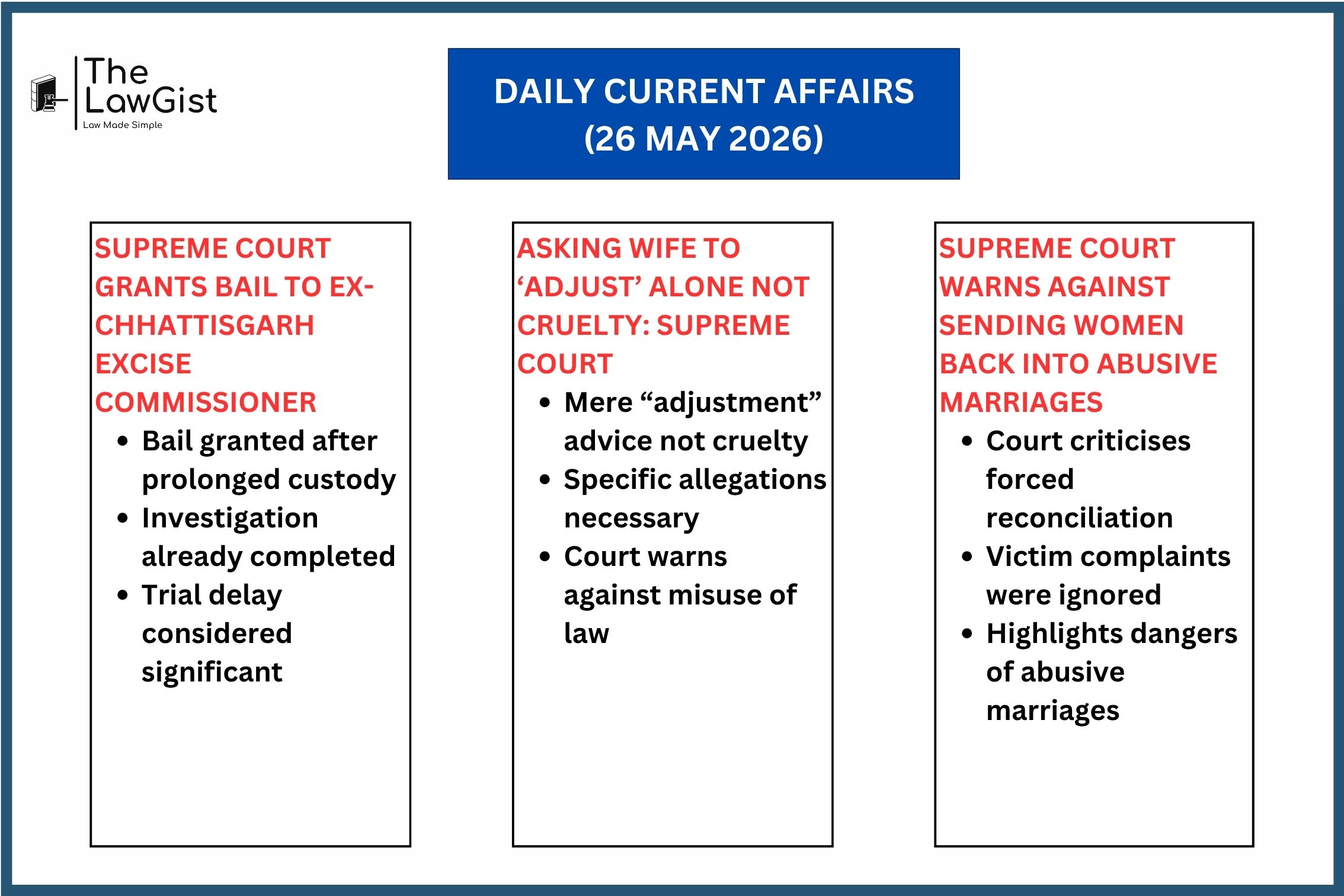
SUPREME COURT GRANTS BAIL TO EX-CHHATTISGARH EXCISE COMMISSIONER
Case Name: Niranjan Das v. Enforcement Directorate & State Authorities
The Supreme Court of India granted bail to former Chhattisgarh Excise Commissioner Niranjan Das in corruption and money laundering cases linked to the alleged liquor scam. The Court considered prolonged custody, completion of investigation, and parity with co-accused already released, observing that trial proceedings are likely to take substantial time.
Legal Provisions & Framework:
- Prevention of Money Laundering Act, 2002
- Prevention of Corruption Act, 1988
- Article 21 – Personal Liberty
- Bail Jurisprudence Principles
- Doctrine against Prolonged Pre-Trial Detention
Source: Supreme Court of India
ASKING WIFE TO ‘ADJUST’ ALONE NOT CRUELTY: SUPREME COURT
Case Name: ARTI MEHTA & ORS. VERSUS THE STATE OF MADHYA PRADESH & ANR. (with connected case)
The Supreme Court of India quashed proceedings against in-laws accused under Section 498A IPC, holding that merely asking a wife to “adjust” in matrimonial life cannot amount to criminal cruelty without specific overt acts. The Court cautioned against misuse of criminal law based on vague and omnibus allegations.
Legal Provisions & Framework:
- Section 498A, Indian Penal Code
- Protection of Women from Domestic Violence Act, 2005
- Abuse of Criminal Process Doctrine
- Principles of Fair Investigation
- Requirement of Specific Allegations
Source: Supreme Court of India
SUPREME COURT WARNS AGAINST SENDING WOMEN BACK INTO ABUSIVE MARRIAGES
Case Name: Gour Acharjee Versus The State of Tripura & Ors.
While upholding a husband’s conviction for murdering his wife, the Supreme Court of India criticised societal tendencies to force women back into abusive marriages despite repeated complaints of violence. Calling the victim’s story “an eye-opener,” the Court highlighted the dangers of trivialising domestic abuse and prioritising forced reconciliation over safety.
Legal Provisions & Framework:
- Section 302, Indian Penal Code
- Section 498A, Indian Penal Code
- Article 21 – Right to life and dignity
- Domestic Violence Protection Principles
- Gender Justice Jurisprudence
Source: Supreme Court of India