Corbett Tiger Reserve: India’s most critical tiger landscape at the centre of major Supreme Court environmental directives.
Corbett Tiger Reserve: India’s most critical tiger landscape at the centre of major Supreme Court environmental directives.
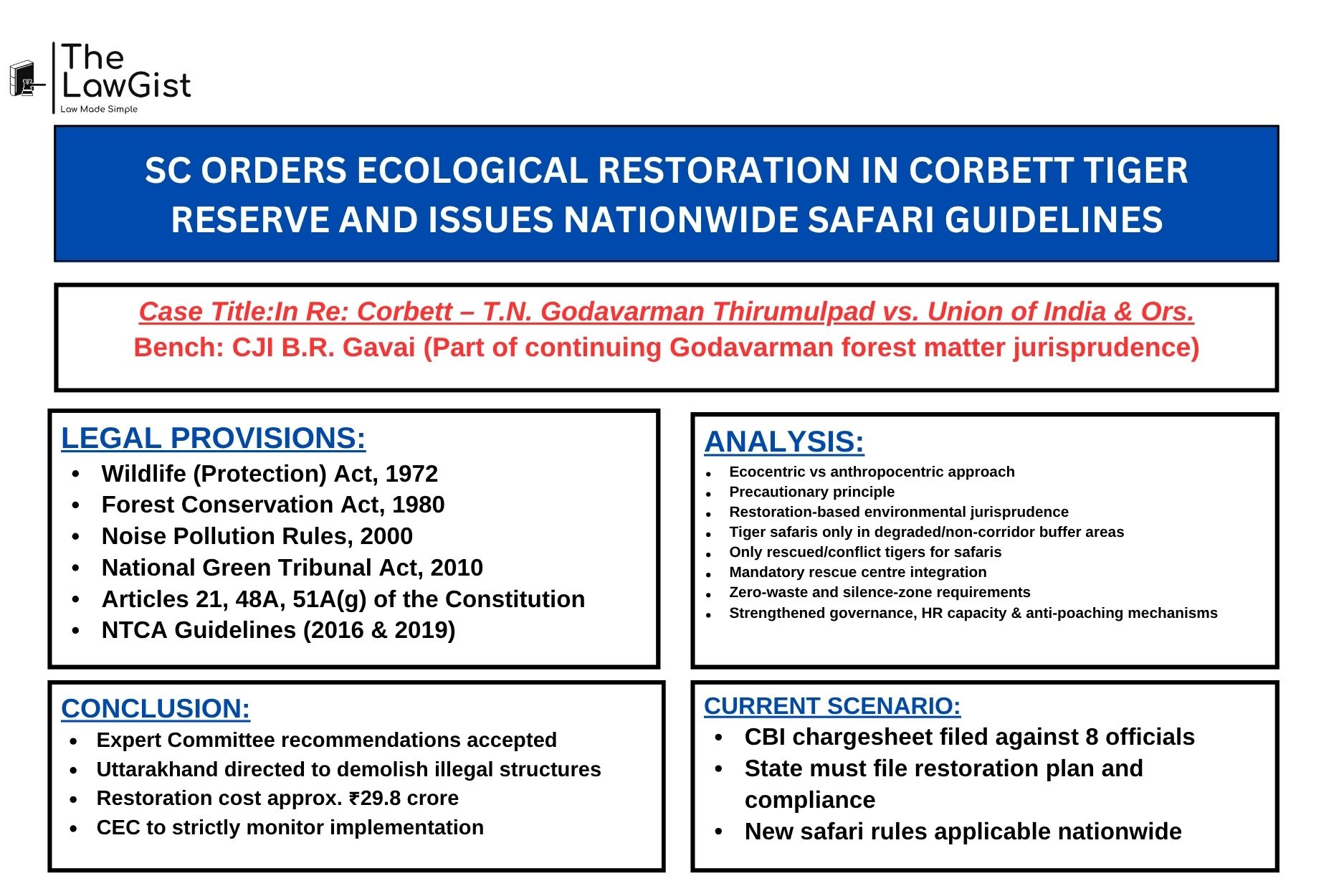
SC ORDERS ECOLOGICAL RESTORATION IN CORBETT TIGER RESERVE AND ISSUES NATIONWIDE SAFARI GUIDELINES
CASE SUMMARY -The Supreme Court addressed severe ecological damage caused in Corbett Tiger Reserve due to illegal construction linked with a proposed tiger safari at Pakhrau. Following the Court’s 2024 directions, an Expert Committee assessed restoration, ecological loss, and guidelines for tiger safaris. The Court endorsed the Committee’s findings, emphasizing ecological restitution, protection of tiger corridors, and an ecocentric approach. It ordered Uttarakhand to demolish unauthorized structures, restore affected sites using native species, and implement strict safari regulations, allowing only rescued/conflict tigers. CBI’s investigation led to chargesheets against officials, while restoration will be supervised by the CEC.
| ASPECTS | DETAILS |
| Case Title | In Re: Corbett (T.N. Godavarman Thirumulpad vs. Union of India & Ors.) – 2025 INSC 1325 |
| Introduction | The Supreme Court examined ecological damage caused in Corbett Tiger Reserve due to illegal construction connected with a proposed tiger safari and issued directions to ensure scientific restoration, accountability of officials, and future regulatory safeguards. |
| Factual Background | Illegal construction, tree felling, and ecological degradation took place in Corbett Tiger Reserve, particularly in Pakhrau range. Earlier orders (06 March 2024) constituted an Expert Committee to assess damage, restoration, and responsibility. CBI and departmental proceedings were simultaneously ordered. |
| Legal Issues | Whether tiger safaris can be permitted in buffer/fringe areas; assessment of ecological loss; restoration methods; responsibility of delinquent officers; applicable statutory framework under the Wildlife (Protection) Act, 1972. |
| Applicable Law |
|
| Analysis | The Court emphasized ecological restitution, “ecocentrism”, precautionary principle, and prohibition of anthropocentric tourism practices. The Expert Committee’s detailed recommendations for restoration, regulation of safaris, and strengthening wildlife administration were upheld. |
| Conclusion | The Court accepted the Expert Committee’s recommendations, directing Uttarakhand to restore Corbett using native species, demolish illegal structures, collect restoration costs, and implement safari and tourism norms. CEC to supervise restoration. |
| Current Scenario | CBI filed chargesheets; departmental proceedings pending completion; the State must implement restoration within deadlines. Safaris allowed only on degraded/non-forest land with strict guidelines and only rescued/conflict tigers. |
“Ecocentrism, not anthropocentrism, must guide the protection and restoration of our natural heritage.”
SOURCE – SUPREME COURT OF INDIA
READ ALSO – Constitutional duties under Articles 21, 48A, 51A(g)
Discover insighs on Latin Maxims and Legal Glossary and simplify complex legal terms in seconds.The LawGist ensures exam success with quality Blogs and Articles on — Top Legal Picks (TLP), Current Affairs, latest Supreme Court judgments as Courtroom Chronicles. Backed by trusted resources and videos, The LawGist is every Professionals and Aspirant’s first choice. Discover more at thelawgist.org