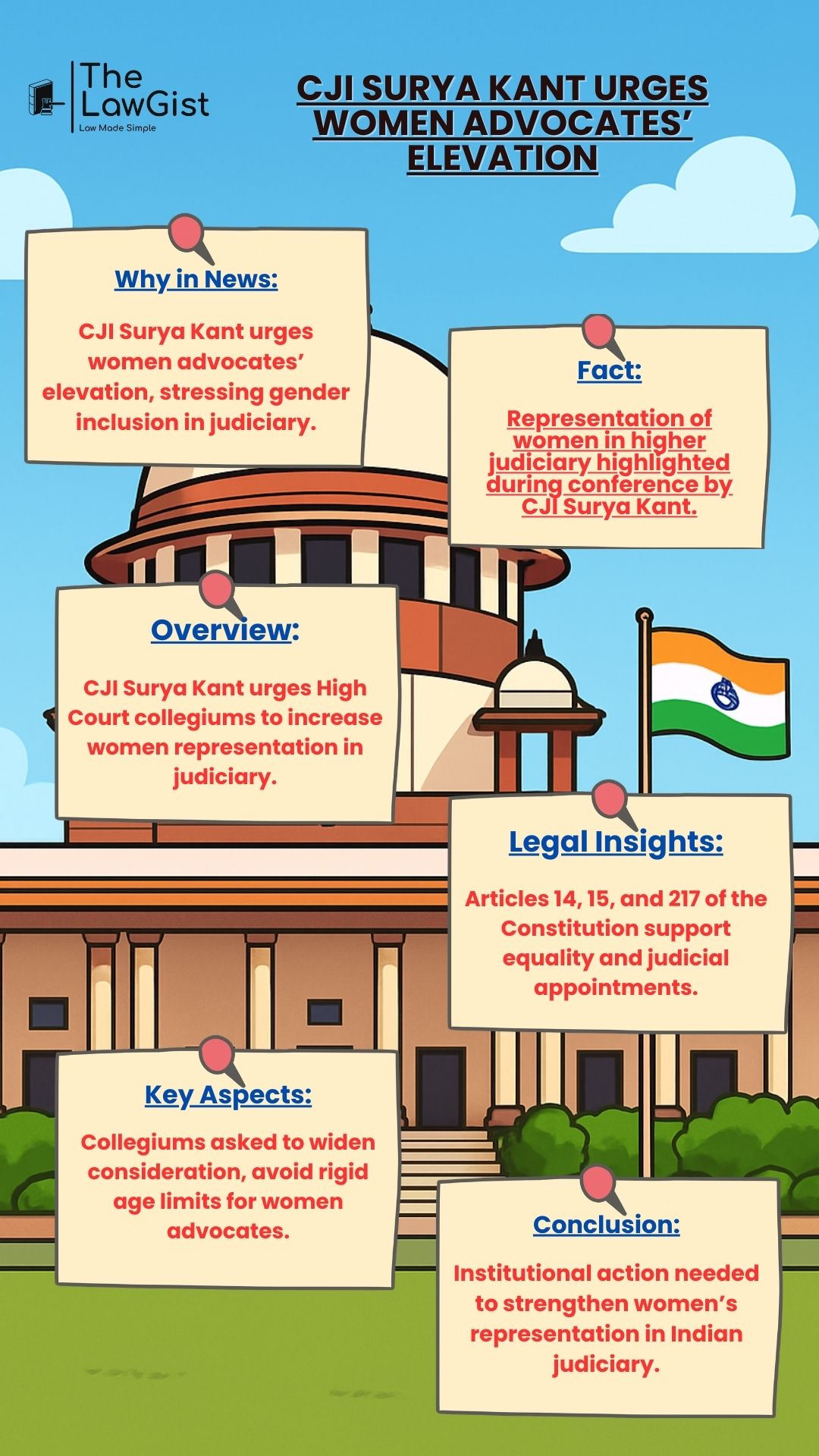
Why in NewsCJI Surya Kant Urges Women Advocates Elevation call highlights urgent requirement for gender representation in judiciary. |
Discover powerful Latin Maxims and simplify complex legal terms in seconds.
Fact
In Re: Representation of Women in Higher Judiciary (Conference Address)
Overview
At the International Women in Law Conference named “Half the Nation, Half the Bench,” the Chief Justice of India, Surya Kant emphasised the urgent need to increase women’s representation in the higher judiciary. The event was organised by senior advocates & attended by members of the Bar & Bench.
During his keynote address CJI Surya Kant urged High Court collegiums across the country to actively recommend women advocates for judicial appointments. He particularly showcased the importance of considering women advocates practising in the Supreme Court of India who belong to different States so that deserving candidates are not overlooked.
Key Aspects
The Chief Justice addressed structural problems that have historically limited participation of women in the higher judiciary. He emphasised that the time has come for the judiciary to move from symbolic representation to meaningful institutional inclusion. The remarks focused on practical steps that collegiums should adopt to strengthen gender diversity on the Bench.
- Encouraging Women Elevation: CJI Surya Kant urged High Court collegiums to actively consider women advocates for judicial appointments.
- Widening Zone of Consideration: Collegiums should include women advocates practising in the Supreme Court who belong to the respective States.
- Flexibility in Age Criteria: Candidates should not be rejected mechanically for not strictly meeting prescribed age limits.
- Historical Barriers: The CJI acknowledged that women were historically denied entry into the legal profession & highlighted the milestone appointment of Fathima Beevi, the 1st woman judge of the Supreme Court.
- Growing Representation: Women currently constitute nearly 37% of the district judiciary indicating progress at the grassroots level.
Legal Insights
The Chief Justice’s remarks were grounded in constitutional values promoting equality & fair representation within public institutions. The legal structure governing judicial appointments & equality principles provides a strong foundation for increasing women’s participation in the judiciary.
- Article 14 of Constitution of India – Equality Before Law: Guarantees equal protection of laws & supports inclusive representation in public institutions.
- Article 15(1) – Prohibition of Discrimination: Prohibits discrimination on grounds including sex reinforcing gender equality in professional opportunities.
- Article 217 – Appointment of High Court Judges: Empowers the President to appoint judges based on collegium recommendations making the role of collegium crucial in promoting diversity.
- Supreme Court Directions on Representation: The Court has mandated 1/3rd reservation for women in Bar Councils & Bar Associations strengthening gender inclusivity in the legal profession.
Conclusion
Although not a judicial ruling CJI Surya Kant issued a significant institutional appeal to High Court collegiums to translate the intent into action. He stressed that improving women’s representation is not about preferential treatment but about creating a fair & equal starting line ensuring that the judiciary shows the diversity of Indian society while strengthening its legitimacy & inclusiveness.
Source – Supreme Court of India
Read also – Constitution of India
The LawGist ensures exam success with quality notes—TPL, Current Affairs, Recent Judgments, and more. Backed by trusted resources and videos, The LawGist is every aspirant’s first choice.