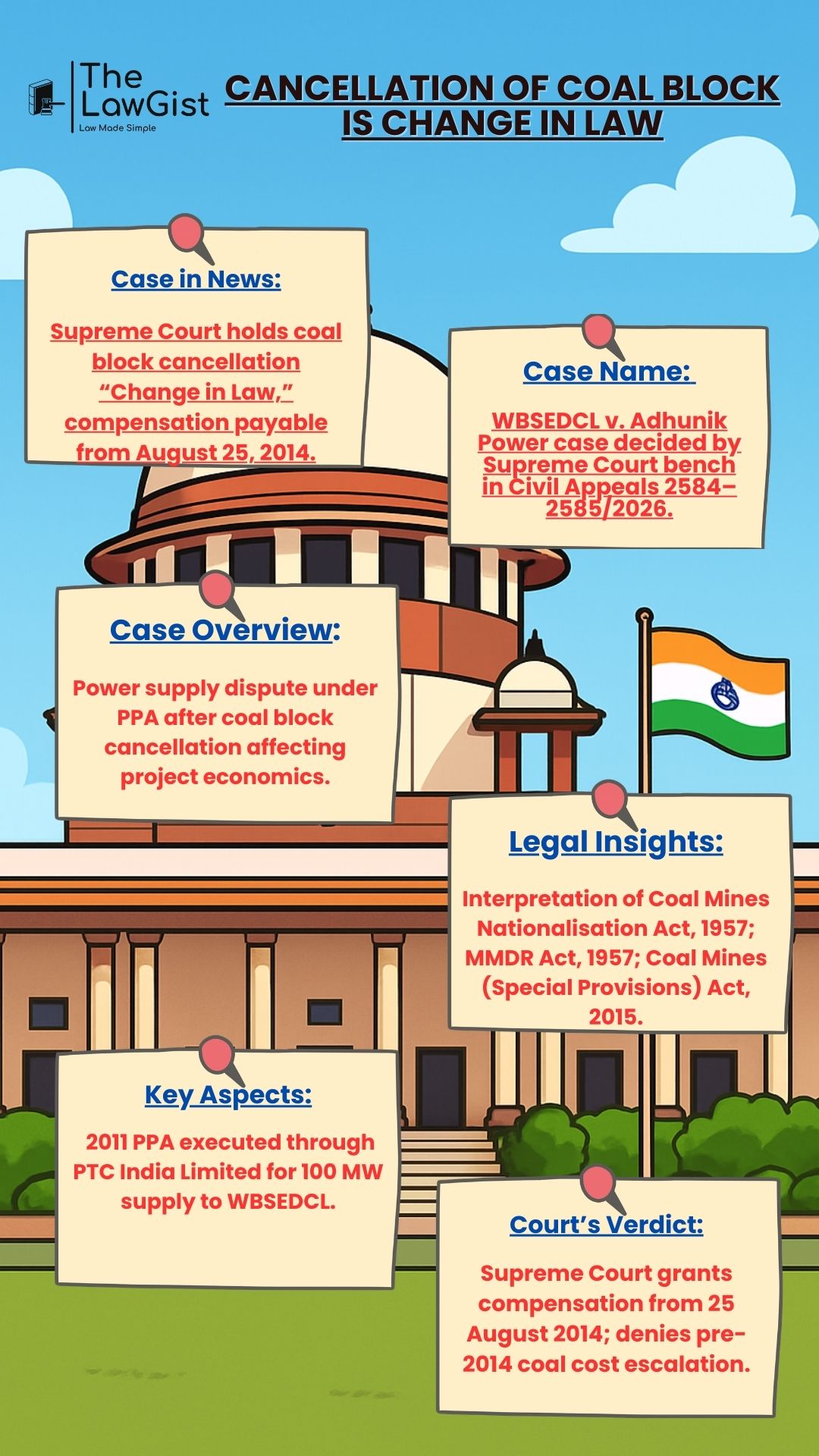
Supreme Court rules cancellation of Ganeshpur coal block qualifies as “Change in Law,” granting compensation to Adhunik Power under Power Purchase Agreement.
Case in NewsCancellation Of Coal Block Is Change In Law: Supreme Court of India grants compensation to power generators from 25th August 2014. |
Discover powerful Latin Maxims and simplify complex legal terms in seconds.
Case Overview
Case Name:West Bengal State Electricity Distribution Co. Ltd. v. Adhunik Power & Natural Resource Ltd. & Ors.
The Supreme Court of India bench comprising Justice Surya Kant, Justice BV Nagarathna & Justice Joymalya Bagchi gave a ruling concerning compensation under a Power Purchase Agreement (PPA). The case involved a dispute between West Bengal State Electricity Distribution Co. Ltd. & Adhunik Power & Natural Resource Ltd. relating increased coal procurement costs.
The dispute came up after the cancellation of the Ganeshpur coal block allocated to Adhunik Power. The company argued that the cancellation following the Court’s 2014 judgment on coal block allocations constituted a “Change in Law,” entitling it to tariff compensation.
Key Aspects
The dispute arose from a long-term power supply arrangement & the financial consequences of losing a captive coal block. The Supreme Court of India examined contractual obligations, the intended coal source & the effect of judicial decisions on commercial agreements. The case revolved around whether the cancellation of the coal block altered the economic position of the power generator.
- In 2011 PTC India Limited executed a Power Supply Agreement with West Bengal State Electricity Distribution Co. Ltd. for 100 MW supply.
- Adhunik Power & Natural Resource Ltd. signed a back-to-back Power Purchase Agreement with PTC for supplying electricity.
- The project was expected to source coal from the Ganeshpur captive coal block in Jharkhand.
- The Supreme Court of India cancelled multiple coal block allocations across India in 2014 including Ganeshpur.
- The Appellate Tribunal for Electricity upheld compensation for coal sourced through imports & e-auction after the cancellation.
Legal Insights
The Supreme Court of India examined contractual clauses & statutory provisions governing coal mining & electricity regulation. It assessed whether the judicial cancellation of coal blocks constituted a “Change in Law” event under the Power Purchase Agreement. The ruling stated how legal interpretation affecting resource allocation can impact commercial contracts.
- Interpretation of the Coal Mines Nationalisation Act, 1957 & Mines and Minerals (Development and Regulation) Act, 1957 formed the basis of the earlier coal block cancellation judgment.
- The enactment of the Coal Mines (Special Provisions) Act, 2015 introduced a new statutory structure for coal block allocation.
- Articles 10.1.1(b) & 10.1.1(f) of the Power Purchase Agreement defined “Change in Law,” including judicial interpretation affecting project inputs.
- The Central Electricity Regulatory Commission was directed to revise tariff compensation consistent with the findings of the Court.
Court’s Verdict
The Supreme Court of India upheld the decision of the Appellate Tribunal for Electricity holding that cancellation of the Ganeshpur coal block constituted a “Change in Law.” Consequently Adhunik Power & Natural Resource Ltd. became entitled to compensation from 25th August 2014 along with carrying costs. However the Court set aside compensation for higher coal costs incurred before that date emphasizing that the agreement barred escalation in energy charges when coal was sourced from alternative sources prior to the Change in Law event.
Source – Supreme Court of India
Read also – Constitution of India
The LawGist ensures exam success with quality notes—TPL, Current Affairs, Recent Judgments, and more. Backed by trusted resources and videos, The LawGist is every aspirant’s first choice.